Freelance vs. In-House Creative Strategist: What Works Best?
Compare freelance vs in-house creative strategists in 2026. Learn cost benchmarks, performance trade-offs, and when each hiring model supports scalable growth.
While there is no universal “best” option, a freelance creative strategist is better for flexibility and short-term speed, while an in-house creative strategist is better for long-term ownership and compounding performance. The right choice depends on your growth stage, ad spend, creative velocity, and internal team maturity.
In 2026, this decision carries real financial consequences. CAC inflation, creative fatigue, and AI-driven distribution have changed how performance scales. Paid platforms are saturated, creative fatigue hits faster, and brands need more volume just to maintain performance.
Since 2023, ecommerce CAC has increased by roughly 40%, settling between $45 and $175 globally depending on category. Traditional paid arbitrage models have broken, forcing brands to rethink how creative drives profitability rather than just volume.
Choosing between freelance and in-house isn’t the same as choosing between a designer and an agency. It’s a structural decision about ownership, learning speed, and long-term growth.
This guide will help you decide when freelance makes sense, when in-house wins, and the real risks, costs, and trade-offs of each model.
The right model depends on ad spend level, creative volume, and internal team maturity.
Early-stage brands often benefit from freelance support before hiring full-time.
Long-term scaling brands typically require in-house ownership once creative velocity exceeds what external bandwidth can realistically support.
What Does a Creative Strategist Do?
A creative strategist turns customer research, SKU-level performance data, and testing insights into scalable messaging architecture that improves CM3, not just ROAS. In ecommerce, the workflow typically follows this sequence:
Research → concept development → creative briefs → testing → iteration → scaling
They are not graphic designers. They are not media buyers. And they are not influencer managers. And the difference from a creative director matters just as much: one owns performance logic, the other owns creative output and team management. A creative strategist owns the performance logic behind the creative.
In many DTC teams, confusion around creative strategist vs media buyer roles creates misaligned accountability, where no one fully owns the messaging system driving conversion performance.
This role behaves differently depending on employment structure. A freelance creative strategist may focus on rapid concept output and tactical testing. An in-house creative strategist typically owns long-term learning, structured testing frameworks, and cross-functional collaboration with media buyers, designers, and founders.
That distinction becomes critical when evaluating freelance vs. in-house creative strategist models.
Freelance vs. In-House Creative Strategist: Core Differences
Choosing between freelance and in-house changes how creative work gets done, how quickly you move, and how learning accumulates inside your company.
Employment model
A freelance creative strategist works on contract. They are typically project-based, hourly, or on a monthly retainer. The structure is flexible, and scope can scale up or down based on need.
An in-house creative strategist is salaried, embedded inside the company, and accountable for long-term performance ownership. They participate in planning cycles, growth strategy discussions, and internal collaboration beyond campaigns.
The decision between freelance and in-house strategist starts here: flexibility versus embedded ownership.
Speed vs. context
Freelancers usually ramp up faster. They’ve seen multiple accounts, can plug into existing teams quickly, and often come with ready-made testing frameworks.
In-house strategists develop deeper brand understanding. They know historical tests, customer nuance, product roadmaps, and long-term positioning. Over time, this context compounds into stronger insights.
Speed favors freelance. Depth favors in-house.
This distinction becomes more important as platforms move toward agentic commerce. By the end of 2026, Gartner projects 40% of enterprise applications will include task-specific AI agents. Creative strategy increasingly influences structured data, machine readability, and how products are surfaced by AI shopping systems.
Pros and Cons of a Freelance Creative Strategist
Hiring a freelance creative strategist can unlock speed and flexibility, but it also comes with structural trade-offs. Understanding both sides helps you decide whether this model fits your current growth stage.
Pros
Fast ramp-up: Freelance creative strategists can start within days or weeks, not months. This matters when creative fatigue is hurting performance.
Flexible cost structure: You avoid fixed salary commitments. If ad spend drops or priorities shift, you can adjust scope, making freelancers more cost-effective in the short term.
Exposure to multiple accounts and patterns: Freelancers often bring pattern recognition from other ecommerce brands. They’ve seen what’s working across Meta ads, TikTok creative strategy, and UGC testing cycles.
Ideal for short bursts or testing phases: Launching a new channel? Testing social media strategy before hiring full-time? Freelance works well here.
Cons
Limited brand immersion: Without daily exposure to internal discussions, freelancers may operate on surface-level insight with less brand consistency.
Less long-term accountability: Freelancers are often scoped around deliverables. In-house strategists are accountable for building repeatable learning systems that improve performance over time.
Risk of shallow research: If scope is rushed, insights may lean heavily on external trends rather than deep customer data. Over time, this pattern mirrors what happens when brands investigate why ecommerce ads stop working as creative direction becomes reactive instead of research-led.
Availability constraints: High-performing freelance creative strategists often juggle multiple accounts, which can affect bandwidth and responsiveness.
Pros and Cons of an In-House Creative Strategist
An in-house creative strategist brings deeper ownership and long-term learning, but the commitment and structure required are significantly higher. Before hiring full-time for your in-house team, it’s important to weigh both the advantages and the operational demands.
Pros
Deep brand knowledge: An in-house creative strategist understands product evolution, customer feedback loops, and performance history. In 2026, long-term value is increasingly tied to LTV:CAC stability. Brands operating below a 3:1 ratio are structurally unstable. An embedded strategist can track messaging performance across lifecycle stages rather than optimizing only for top-line platform ROAS.
Tight collaboration with media buyers: Daily alignment improves creative testing frameworks and shortens feedback cycles, especially once brands formalize performance teams or invest in structured hiring through a paid media buyer recruitment agency to scale ad spend responsibly.
Consistent creative systems: In-house strategists can build structured testing pipelines rather than reactive concept production. Without a disciplined system, testing devolves into idea churn. The difference between reactive output and a structured creative testing framework for ecommerce brands often determines whether performance compounds or plateaus.
Ownership of long-term learning: Creative performance compounds when someone tracks insights month over month.
Cons
Higher fixed cost: Salary, benefits, tools, and onboarding time are all costs that add up for full-time employees.
Slower to hire: Recruiting the right in-house creative strategist can be time-consuming, sometimes taking 30–60 days or more.
Risk of creative stagnation: Without outside exposure, ideas can become repetitive.
Requires management structure: In-house hires need clear KPIs, reporting cadence, and collaboration processes. A mis-hire at this level creates “generalist blindspots.” Multi-touch attribution complexity, TikTok Shop Performance Score requirements, and AI-driven ad suppression require strategic oversight, not just content output.
Cost Comparison: Freelance vs In-House
Cost should support decision-making, not dictate it. The cheapest option is rarely the most scalable.
How much does a freelance creative strategist make?
Rates depend on experience, skill set, channel expertise, and scope. Performance-focused strategists with Meta and TikTok experience command higher retainers.
How much does an in-house creative strategist make?
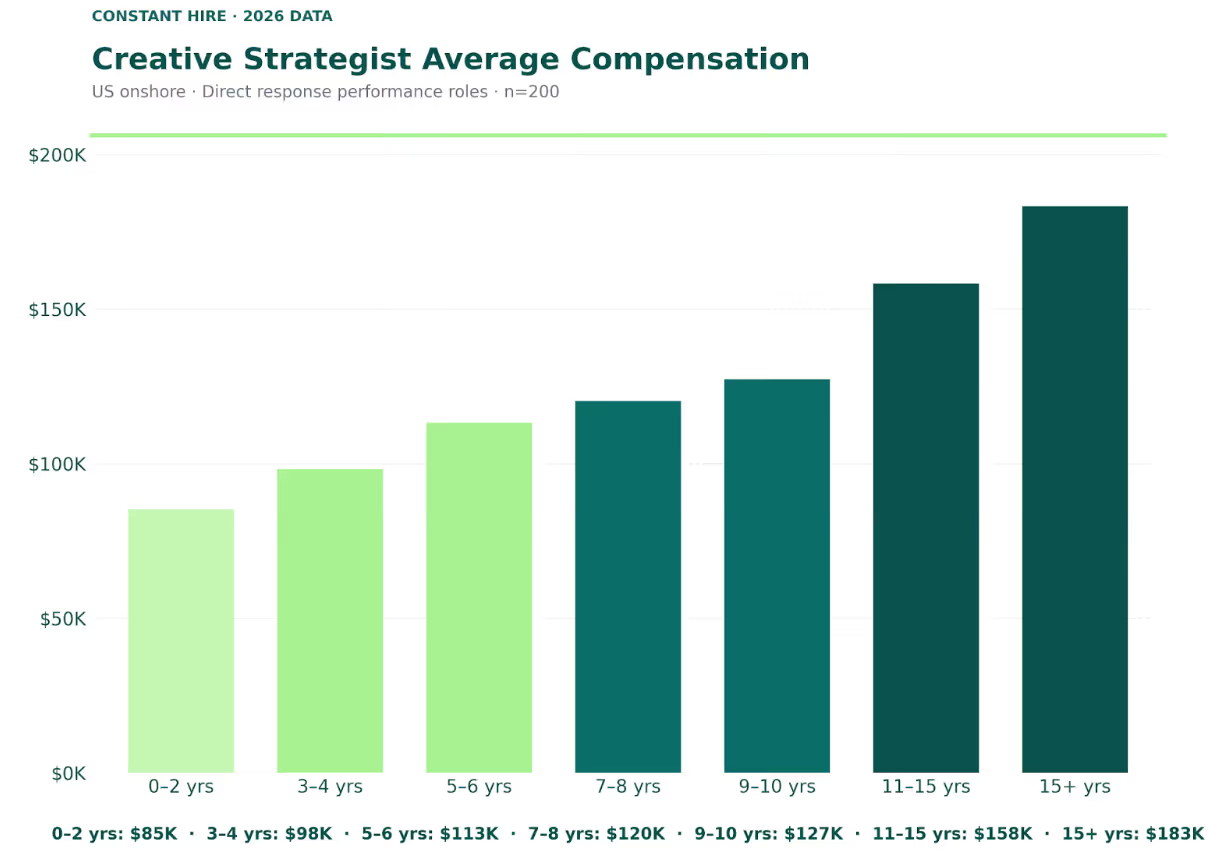
We’ve crunched the numbers from our 2025 interview cycles, covering over 200 direct response professionals, to provide a clear picture of creative strategist compensation. These proprietary insights reflect the actual salary expectations and current earnings of onshore talent in the US consumer brand space.
Based on 200 interviews we conducted throughout 2025, the average base salary for a U.S. creative strategist now sits at approximately $113,000, with senior-level roles reaching $183,000 and beyond. However, for brands looking to hire, the base pay is only part of the story; when you factor in benefits, payroll taxes, and specialized software, the 'fully loaded' cost of a high-performing strategist often exceeds $150,000 annually.
The cost differences between hiring freelancers and in-house strategists often narrow when ad spend exceeds $200K–$300K per month, because long-term learning begins to outweigh short-term flexibility.
When Hiring a Freelance Creative Strategist Makes Sense
Hiring a freelancer is often the right call when your business needs speed, flexibility, or short-term problem solving for your marketing efforts rather than long-term creative infrastructure.
You are an early-stage brand testing product-market fit
If you’re a startup or early-stage brand, you’re still validating messaging, offers, and target audiences. A freelance creative strategist can help generate and test concepts quickly without committing to a full-time salary before revenue is predictable.
The threshold where this shifts from freelance to permanent ownership usually aligns with the operational markers discussed in when to hire a creative strategist conversations around spend scale and internal testing complexity.
New platforms require different creative logic. A freelance strategist with specific channel experience has the know-how to accelerate learning and prevent expensive trial-and-error.
You have a temporary gap between hires
If a team member leaves or you’re restructuring, freelance support maintains creative output while you search for a permanent in-house hire.
Your ad spend fluctuates month to month
When budgets aren’t stable, locking into fixed salary costs can strain cash flow. Freelance allows you to scale creative strategy up or down with performance.
In these scenarios, speed and flexibility matter more to your marketing strategy than institutional learning.
When Hiring an In-House Creative Strategist Makes Sense
In-house creative strategists become the right move when your brand needs consistent ownership, structured testing, and long-term performance compounding rather than short-term execution boosts.
You are scaling paid spend consistently
Once ad spend increases month over month, creative output and testing discipline need to scale with it. An in-house creative strategist can build systems that support ongoing experimentation rather than reacting campaign by campaign. At higher spend levels, structured learning becomes more valuable than short bursts of output.
You manage multiple designers, editors, or creators
As creative teams grow, someone needs to unify direction and testing priorities. An in-house strategist ensures designers, illustrators, UGC creators, and copywriting editors are aligned around clear angles and performance goals instead of producing disconnected assets.
You run structured creative testing frameworks
If your brand already uses organized testing pipelines, such as weekly hook testing, structured angle iterations, or funnel-specific messaging, in-house ownership helps maintain consistency. Long-term documentation and insight tracking become a competitive advantage.
Long-term creative IP and messaging matter
Brands building defensible positioning over time benefit from internal ownership. An in-house creative strategist understands brand nuance, customer language evolution, and historical wins and losses. That depth compounds and strengthens creative performance year after year.
When growth depends on sustained creative velocity and long-term learning, in-house structure typically outperforms flexible freelance support.
If You’re Hiring In-House, Get It Right the First Time
Once creative becomes a structural growth lever, hiring the wrong strategist is expensive. Misalignment at this level slows testing velocity, weakens insight loops, and quietly erodes LTV:CAC.
If you’re building an in-house creative function, we help DTC and ecommerce brands hire strategy-led operators who understand performance, not just production.
Freelance vs. In-House vs. Agency: What’s the Difference?
While freelance and in-house are the most common options, agencies are often part of the conversation, so it’s important to understand how all three models differ in structure and control:
Freelance offers speed and flexibility.
In-house provides ownership and long-term compounding.
Agencies offer systems and scale but often with less direct control.
A creative strategist is not the same as a full agency retainer, which may include SEO, UX design, web design, and other services. Agencies manage execution at scale. Strategists define what should be tested and why.
Founders and business owners often confuse marketing agency retainers with creative strategy. However, they are different levers.
Risks to Watch Out For
Both freelance and in-house creative strategist models can fail; not because the role doesn’t work, but because expectations and structure aren’t clearly defined.
How do you protect yourself when hiring a freelancer?
Freelance creative strategist relationships tend to break down when scope and accountability are vague, so clarity upfront is critical. To protect yourself, take the following steps:
Define clear scope and deliverables.
Use trial projects before long-term retainers.
Ensure access to performance data.
Clarify intellectual property ownership.
Align on performance KPIs upfront.
Freelance creative strategist relationships fail most often due to unclear expectations.
Common in-house hiring mistakes
In-house hires typically struggle not because of skill gaps, but because the surrounding process is weak or undefined. Common mistakes with in-house hiring include:
Hiring too senior too early.
Not defining a creative process.
Letting the strategist work in isolation from media buyers.
Measuring vanity metrics instead of performance impact.
In-house failure usually stems from poor structure, not talent gaps.
Creative Strategist vs. Creative Director
Creative directors own vision, people management, and brand identity. Creative strategists own research, performance logic, and testing frameworks.
Clarifying this distinction prevents expensive mis-hires.
How to Vet a Creative Strategist (Freelance or In-House)
Regardless of the employment model, the evaluation criteria should stay consistent. The real question is whether they can think strategically, interpret performance data, and drive structured creative testing.
When evaluating freelance or in-house creative strategist candidates, ask:
Can they clearly explain why an ad worked?
Do they understand CTR, CVR, CPA, and MER?
Do they have a repeatable research methodology?
Can they collaborate cross-functionally?
Do they speak in hypotheses, not just aesthetics?
Strong creative strategists think in experiments and learning loops.
So… Freelance or In-House? A Simple Decision Framework
At this point, the decision should feel less emotional and more structural. Choosing between freelance and in-house is about aligning your hiring model with your current growth constraints, not personal preference.
Use the framework below to pressure-test your situation. Look at where your brand sits today across budget, speed, ad spend, team maturity, and long-term goals. The clearer your answers, the clearer the hiring path becomes.
Budget
Low and variable → Freelance
Stable and growing → In-house
Speed Needed
Immediate execution → Freelance
Long-term system building → In-house
Ad Spend Level
Under $150K/month → Often freelance
Over $250K/month → In-house typically compounds
Internal Team Maturity
Small team, no process → Freelance first
Structured team with media buyers → In-house
Growth Horizon
Short-term launch → Freelance
3–5 year scale vision → In-house
The best option is the one that supports creative velocity without sacrificing long-term learning.
Final Thoughts
There is no universal winner in the freelance vs. in-house creative strategist debate.
Freelance offers flexibility and speed. In-house offers compounding advantage and ownership.
The wrong hire hurts more than waiting. Creative strategy directly impacts paid performance, CAC efficiency, and long-term scalability.
For DTC and ecommerce brands scaling spend, clarity on this role is more important than the employment model itself. If you decide an in-house creative strategist is the right next step, Constant Hire specializes in helping ecommerce brands find operators who understand performance, not just aesthetics.
Choose the structure that matches your growth stage. Then execute with intention.
FAQs
What is the difference between a creative strategist and a media buyer?
A creative strategist owns messaging architecture, testing logic, and insight development that drives conversion performance. A media buyer manages platform execution, budget allocation, and pacing. In 2026, creative influences targeting more than audience settings, making the strategist responsible for performance logic while the buyer manages distribution mechanics.
At what revenue level should you hire an in-house creative strategist?
Most brands consider in-house once monthly ad spend exceeds $200K–$300K or revenue approaches $5M–$10M. At this level, creative learning compounds, and long-term LTV:CAC stability matters more than short-term flexibility. Below that threshold, freelance or fractional support often delivers better cost control.
Is a fractional or freelance creative strategist worth it?
Yes, when you need speed, outside perspective, or short-term testing velocity. Fractional strategists work well during product-market fit validation, channel launches, or hiring gaps. The trade-off is depth. Without daily immersion, long-term learning systems and cross-functional collaboration can be harder to build.
How does AI automation change creative hiring decisions?
AI automation increases production speed but reduces differentiation if strategy is weak. Platforms now automate targeting and bidding, making creative direction the primary performance lever. Hiring decisions should prioritize research depth, structured testing systems, and messaging clarity rather than basic content output or tool familiarity.
Connor Gross founded Constant Hire in 2024. An operator turned founder with deep experience building and scaling e-commerce brands. He previously sold an Amazon brand and generated over $30M in DTC revenue through private-label Shopify businesses. He now helps fast-growing DTC brands and agencies hire top talent across marketing, creative, ops, and sales. From E‑com Managers to TikTok Creators and Heads of Growth, he knows what great looks like, and how to recruit it.