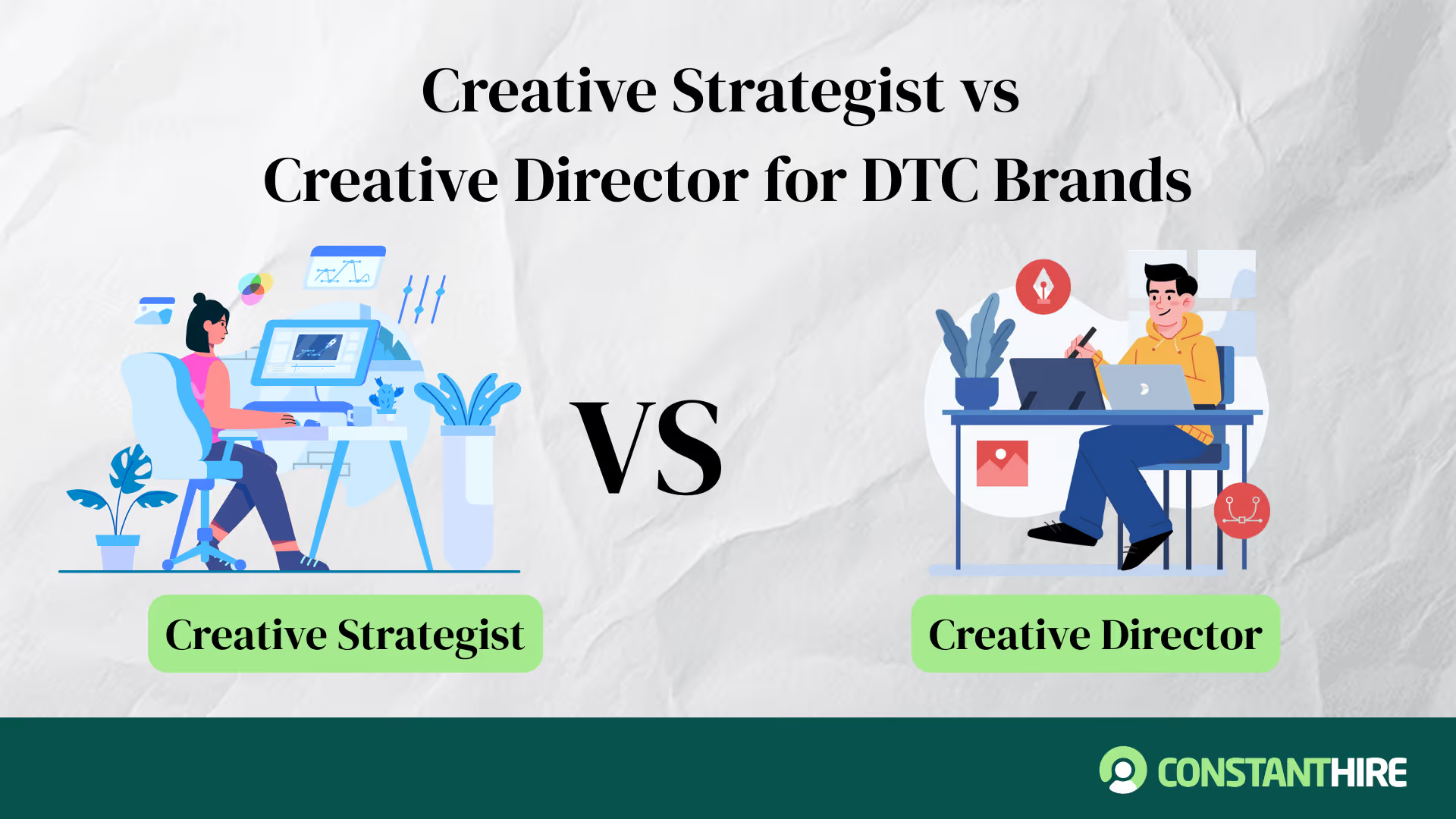
The core difference between a creative strategist and a creative director comes down to performance learning versus creative leadership. A creative strategist drives performance insight and testing velocity. A creative director drives creative vision, execution quality, and brand consistency.
Many DTC founders hire a creative director when what they actually need is a creative strategist. Others hire a strategist when the real issue is lack of creative leadership. The result is misaligned expectations and stalled growth. In practice, this often shows up during performance plateaus, when brands begin exploring specialized creative strategist recruitment agency partners without fully diagnosing whether the constraint is strategy or leadership..
This confusion has intensified in ecommerce. AI has automated large parts of media buying, which shifts performance leverage onto creative. At the same time, brand identity and paid acquisition are tightly intertwined.
Median DTC revenue growth slowed to roughly 3% while 87% of merchants reported raising prices due to margin pressure. When CAC rises and price sensitivity increases, creative quality and learning velocity directly impact profitability.
This guide breaks down both roles, compares responsibilities, and shows when each makes sense based on the growth stage.
Key Takeaways
- Creative Strategists drive performance learning; Creative Directors drive brand leadership.
- Most hiring mistakes come from misdiagnosing the bottleneck.
- In 2026, creative is the primary growth lever. As AI automates media buying, creative quality and iteration speed directly impact CM3, LTV, and acquisition efficiency.
- You rarely need both early, but you eventually need separation of insight and execution.
The Core Difference
In the creative strategist vs creative director debate, neither role is better. They solve different problems.
A creative strategist focuses on insight generation, testing frameworks, and performance learning. This shift toward structured experimentation is central to modern creative strategy for scaling DTC brands, where iteration velocity matters more than aesthetic polish. A creative director focuses on creative vision, brand standards, and execution quality across channels.
If performance is flat and you cannot identify why certain ads convert, you likely need strategy. If your creative team lacks direction or your brand expression is inconsistent, you likely need direction.
What Does a Creative Strategist Do in a DTC Brand?
A creative strategist in a DTC brand owns performance learning inside paid channels like Meta and TikTok.
A Creative Strategist is a performance-focused operator who turns customer insight into structured, testable creative hypotheses that improve acquisition efficiency.
They operate at the intersection of customer research, messaging, and metrics. As AI tools increasingly automate bid optimization, creativity becomes the primary targeting lever. The strategist role designs the testing loop that feeds those systems.
Core responsibilities include:
- Translating customer pain points and target audience insights into creative briefs
- Running A/B testing cycles across social media and paid acquisition
- Defining KPIs such as hook rate, CTR, and CAC ceilings
- Partnering with media buyers to optimize learning velocity
- Turning iteration cycles into repeatable frameworks
This is also where confusion tends to surface internally. In many DTC teams, performance ownership gets blurred between creative and media execution. The distinction becomes clearer when examining Creative Strategist vs Media Buyer and who actually drives insight versus who manages spend allocation.
They typically do not:
- Manage designers full-time
- Own final graphic design polish
- Set long-term brand strategy or brand guidelines
In high-growth brands spending over 50% of their acquisition budget on paid social, this role often becomes the performance bottleneck breaker.
What Does a Creative Director Do in a DTC Brand?
A creative director in ecommerce owns brand expression, visual elements, and creative execution across marketing channels.
A Creative Director is a senior creative leader who translates brand positioning into consistent, high-quality execution across teams and channels.
Unlike a brand strategist, who focuses on long-term brand positioning, the creative director ensures that everything shipped by the creative team stays on brand.
Key responsibilities include:
- Defining creative vision and brand identity standards
- Managing art directors, copywriters, designers, and producers
- Approving creative concepts and campaign directions
- Ensuring brand consistency across social media, email, PDPs, and marketplaces
- Balancing short-term marketing campaigns with long-term brand-building
In saturated categories and marketplaces, brand recall and consistency drive LTV. At the same time, apparel return rates can reach 40%, which directly erodes margins when creative misrepresents product fit or value.
The creative director influences these downstream metrics through quality control and alignment. In scaling environments, this responsibility often overlaps with CRO experts for ecommerce, particularly when creative messaging and landing page experience must stay tightly synchronized.
They direct the system. They do not spend their week analyzing CTR dashboards or architecting testing frameworks.
Creative Strategist vs Creative Director — Side-by-Side Comparison
At a high level: the strategist improves acquisition efficiency; the director improves brand durability.
| Dimension |
Creative Strategist |
Creative Director |
| Primary Focus |
Insights and performance learning |
Vision and execution quality |
| Owns Testing |
Yes |
No, informed by results |
| Owns Team |
No or limited pod |
Yes, leads creative team |
| Core Output |
Hypotheses, creative briefs, testing frameworks |
Creative direction, brand guidelines, final assets |
| Success Metrics |
Learning velocity, CAC efficiency, CM3 |
Brand consistency, LTV, creative quality |
| Best For |
Scaling paid growth |
Building and protecting brand |
With CAC inflation reaching as high as 40% in recent years, performance learning speed becomes a survival metric.
How Responsibilities Differ Day-to-Day
A Week in the Life of a Creative Strategist
A typical week centers on data and ideation.
Monday might start with reviewing performance metrics from paid campaigns across Meta and TikTok. They assess which hooks are fatigued and which creative concepts crossed target CAC thresholds.
Midweek often focuses on customer research. This includes analyzing reviews, social media comments, Reddit threads, and Amazon listings to refine target audience messaging.
They write multiple creative briefs, align with marketing teams on KPIs, and design new A/B testing plans. Their job is to increase iteration speed and learning velocity.
A Week in the Life of a Creative Director
A creative director’s week revolves around people and output quality.
They review creative work from designers and art directors, provide feedback during brainstorming sessions, and approve creative campaigns before launch.
They align with leadership on brand message, marketing strategy, and seasonal themes. They also handle project management, timelines, and hiring decisions for in-house creative roles.
If the strategist role optimizes experiments, the creative director protects the system that produces them.
When to Hire a Creative Strategist
Hire a creative strategist when performance learning is the bottleneck.
Signals include:
- Paid ads represent over 50% of acquisition
- Creative fatigue occurs in under 14 days
- You have assets but cannot explain why some convert
- Revenue is flat while spend increases
Patterns commonly seen when evaluating when to hire a creative strategist in growth-stage brands. If creative performance is the constraint, strategy comes first.
In most DTC brands between $2M and $10M ARR, scaling ad spend without structured testing frameworks leads to rising CAC and declining contribution margin. A strategist helps optimize learning before you scale headcount.
When to Hire a Creative Director
Hire a creative director when execution quality or leadership is the bottleneck.
Signals include:
- Multiple designers or copywriters working without cohesion
- Inconsistent brand identity across marketing channels
- Visual elements feel disconnected from brand positioning
- You are expanding into retail, marketplaces, or omnichannel
If you are scaling teams rather than scaling ads, you need leadership.
For brands moving into distributed commerce environments where checkout happens inside social platforms, consistent creative execution across platforms becomes critical.
Do You Ever Need Both?
Yes. Most brands do not need both at the same time early on.
- Early stage: strategist first.
- Scaling growth: strategist plus strong execution support.
- Mature brand with 5+ creatives: creative director plus strategist partnership.
The sequencing error is common. Brands often hire based on title prestige rather than constraint clarity, which mirrors broader ecommerce hiring mistakes seen during rapid growth phases.
This partnership separates insight from execution. One drives the “why” behind performance; the other protects the long-term brand narrative.
Avoid hiring both full-time too early. Org chart complexity can outpace revenue.
Creative Strategist vs Creative Director vs Brand Strategist (Quick Clarity)
Brand Strategist is a long-term brand positioning role that helps companies define identity, differentiation, and messaging pillars.
Creative Strategist focuses on performance messaging, testing frameworks, and acquisition learning.
Creative Director focuses on execution quality, creative leadership, and brand consistency across outputs.
Many founders conflate brand strategy with creative strategy. They are not interchangeable.
Salary Context (High-Level, Not Salesy)
As of February 2026:
The salary gap is real. The cost of hiring the wrong role is larger. A $150K hire solving the wrong bottleneck can slow growth in a year where median revenue expansion sits at 3%.
Common Hiring Mistakes Founders Make
- Hiring a creative director too early when paid performance is unstable.
- Expecting a creative strategist to manage a full creative team.
- Hiring based on portfolio aesthetics instead of target audience alignment.
- Confusing brand-building with performance marketing work.
Another mistake is recruiting via generic platforms without role-specific vetting. At Constant Hire, creative strategist and creative director candidates are evaluated on ecommerce-specific depth, not just surface-level creative work. That includes fluency in metrics, distributed commerce, and AI-assisted workflows.
A Simple Decision Framework for Founders
Use this four-question diagnostic:
- Is performance learning the problem?
- Is execution quality the problem?
- Do we lack insight or leadership?
- Are we scaling ads or scaling teams?
If you cannot explain why ads win or lose, hire a creative strategist.
If you cannot maintain brand consistency across outputs, hire a creative director.
Choose the role that solves the current bottleneck, not the org chart you hope to have in two years.
The mistake is rarely hiring “the wrong title.” It is hiring the right title for the wrong constraint. Performance problems are execution problems. Brand erosion is a leadership problem. Diagnosing which constraint exists determines which role compounds value.
Final Takeaway
The creative strategist vs creative director decision is not about seniority. It is about constraint.
Creative strategists scale learning. They turn customer insight into structured testing and measurable improvement in CAC and CM3.
Creative directors scale execution. They turn brand positioning into cohesive creative campaigns that protect LTV and long-term equity.
In a market where CAC has structurally inflated and revenue growth averages 3%, timing matters more than titles. Diagnose the bottleneck. Hire the role that fixes it.
If you need a second perspective on whether your growth ceiling is a strategy problem, a leadership problem, or both, we are always open to a conversation.