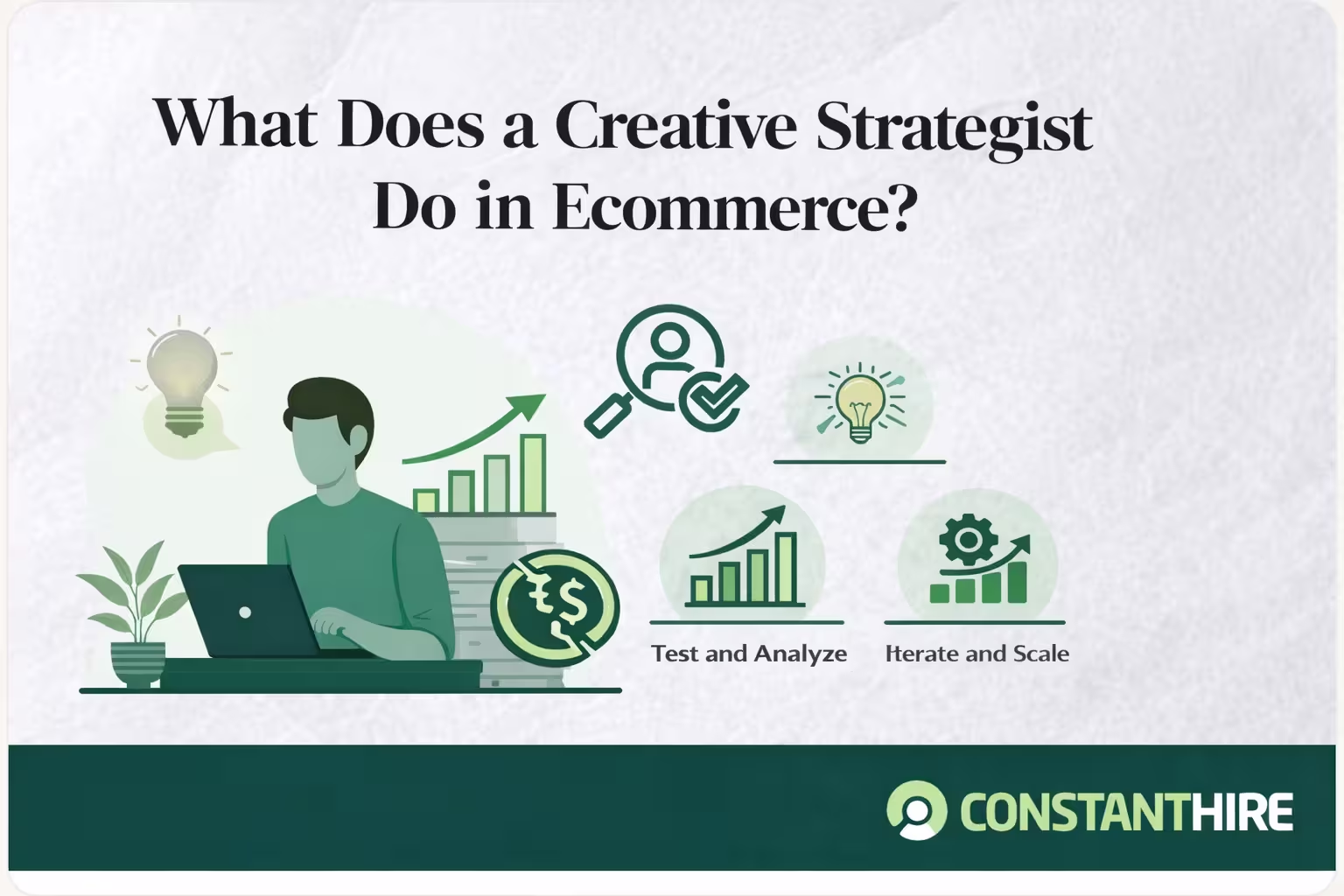
What does a creative strategist do in ecommerce? Learn the role’s responsibilities, skills, and when DTC brands should hire one to scale paid ads profitably.
A creative strategist in ecommerce turns customer insights, performance data, and structured testing frameworks into ads designed to scale profitably across paid channels.They sit at the intersection of research, creative direction, and performance, ensuring that what a brand produces actually converts.
Platforms have reduced manual targeting control, CPMs have structurally increased, and media buyers now depend on strong creative inputs to drive results. By 2026, more than 90% of digital display advertising is programmatic, with platforms automatically handling bidding, targeting, and optimization. Ecommerce brands need creative strategists because scaling isn’t about buying more traffic anymore, it’s about producing better ads, faster, with clear intent.
In this guide, you’ll learn what a creative strategist does in ecommerce, how the role operates in practice, what skills matter, expected compensation ranges, and how it differs from adjacent roles.
Key Takeaways
A creative strategist turns insights and data into performance-driven ad concepts.
The role bridges creative execution and paid media performance.
Ecommerce creative strategy is iterative, test-driven, and channel-specific.
Brands that scale profitably invest in creative strategy early.
What Is a Creative Strategist?
A creative strategist is a role focused on developing, testing, and scaling advertising concepts using customer insights and performance data to drive growth.
In practice, that means a creative strategist figures out what ads to make, why they should work, and how to improve them once they’re live.
In ecommerce, this role is deeply tied to:
Paid social media (Meta, TikTok, LinkedIn, YouTube)
Direct-response advertising
Rapid creative ideation and testing cycles
A creative strategist is not a designer, media buyer, art director, influencer manager, or copywriter, but collaborates closely with each of these roles.. Their job isn’t to produce assets themselves. It’s to ensure the assets being produced are the right ones.
For founders or teams hiring for this role, clarity in the job description directly affects performance outcomes. If you’re looking for help defining and recruiting for this position, a specialized creative strategist recruitment agency can help avoid common scope mistakes.
In early 2026, the ecommerce market has moved beyond incremental digital upgrades into a period of "Structural Reset". This reset is driven by three primary forces: the dominance of agentic AI in discovery, a fundamental shift in supply chain logistics due to tariff adjustments, and a crisis in consumer trust regarding data privacy.
The Creative Strategist sits at the intersection of these forces, tasked with translating complex consumer intent signals into assets that can survive the increasingly rigorous "High-Risk" suppression filters of major ad platforms.
What Does a Creative Strategist Do ?
Core Responsibilities
In ecommerce advertising, creative strategists typically own the following responsibilities:
Customer and market research: Pulling insights from reviews, Reddit threads, support tickets, surveys, focus groups, and comments to understand objections, desires, and the language customers actually use.
Ad concept and angle development: Translating insights into testable angles, hooks, and narratives for paid ads.
Creative briefs for execution: Writing clear briefs for designers, editors, and creators that explain the why behind each concept.
Collaboration with media buyers: Aligning on testing priorities, budgets, and performance feedback loops. This role works most effectively when paired with a strong media owner, whether in-house or hired through a paid media buyer recruitment agency.
Creative testing frameworks: Designing structured tests to isolate variables like hooks, formats, and messaging.
Performance analysis: Reviewing metrics such as thumb-stop rate, CTR, CVR, CPA, and MER to diagnose creative performance and learning velocity. With consent opt-out rates now increasing in many regions, traditional multi-touch attribution has become directionally unreliable, increasing the importance of creative-led testing frameworks.
Iteration and scaling: Refining winning concepts and expanding them across formats, creators, and platforms.
For example:
A skincare brand might test objection-handling ads based on negative reviews.
A subscription brand might develop onboarding-focused creatives to reduce churn.
A founder-led brand might scale storytelling ads once early performance signals confirm message-market fit.
What Are the Main Responsibilities of a Creative Strategist?
At a higher level, a creative strategist turns raw customer insight into repeatable creative performance.
They translate customer understanding into ad narratives, align creative output with brand voice and business goals, and maintain creative velocity to fight ad fatigue.
As over 85% of DTC brands now use AI-assisted or automated creative generation, differentiation increasingly comes from strategy, not asset volume.
Without this role, many brands end up with disconnected execution: designers producing assets, media buyers spending budgets, and no one owning the strategy tying it all together. This disconnect is often at the root of why ecommerce ads stop working as spend scales, even when traffic volume and budgets increase.
Creative strategists act as the bridge between creative teams and paid media, ensuring that learnings flow both ways.
What Skills Do You Need to Be a Creative Strategist?
A high-performing creative strategist isn’t defined by one skill set. The role requires a balance of strategic thinking, creative judgment, and ecommerce-specific execution, with each skill reinforcing the others in day-to-day decision-making.
Strategic and Analytical Skills
High-performing creative strategists are analytical thinkers first. They can synthesize research and market trends, form hypotheses, and read performance data without getting lost in vanity metrics. They understand why an ad worked, not just that it did.
Creative and Communication Skills
They also need creative thinking. This includes copy fundamentals, understanding hooks and framing, and the ability to give clear feedback. A strategist who cannot communicate clearly becomes a bottleneck for the entire creative process.
Ecommerce-Specific Knowledge
In ecommerce, context matters. Creative strategists need hands-on familiarity with:
Paid social mechanics (Meta, TikTok, YouTube)
Creative fatigue and iteration cycles
Funnel stages (TOF, MOF, BOF) and how messaging changes across them
This is why generalist brand strategists often struggle in performance-driven ecommerce environments.
In practice, creative fatigue in ecommerce ads shows up as stable impressions paired with declining CTR and rising CPA, even when targeting and budgets stay constant.
What Is the Job Title of Someone Who Strategizes Ads?
The most common title for someone who strategizes ads is creative strategist, but variations include:
Performance Creative Strategist
Growth Creative Strategist
Creative Strategy Lead
Titles vary because companies scope ownership and accountability differently. The function, not the label, is what matters for your marketing team. What you’re looking for is ownership over creative direction tied to performance outcomes.
Creative Strategist vs Creative Director vs Brand Strategist
While these titles sound similar, they solve different problems at different stages. Clarity here prevents role overlap, misaligned expectations, and stalled growth.
Creative Strategist vs Creative Director
A Creative Director typically owns the creative vision, team leadership, and brand consistency. A Creative Strategist owns research, testing logic, and performance learning. Directors think in long-term systems, while strategists think in experiments and iterations.
Creative Strategist vs Brand Strategist
Brand strategists focus on positioning and long-term perception. Creative strategists focus on short-cycle learning and paid performance. One is about who the brand is. The other is about what is going to make people convert this week.
Do I Need a Creative Director, Brand Strategist, or Advertiser?
The right role depends less on title and more on where your business is feeling friction today. Many brands discover this only after hiring too generally, which is why working with an ecommerce marketing recruitment agency focused on specialized roles can prevent costly sequencing mistakes. Different stages of growth create different creative bottlenecks, and hiring ahead of or behind that reality usually leads to wasted effort.
Small brands: A media buyer paired with a creative strategist is often enough. At this stage, the priority is learning what messages convert and building a repeatable testing rhythm, not managing large teams or brand systems.
Scaling brands: A creative strategist becomes essential. As spend increases, creative volume and learning speed matter more, and someone needs to own insight, testing frameworks, and iteration across channels.
Mature brands: Creative director and strategist roles separate cleanly. One role focuses on long-term brand vision and team leadership, while the other drives performance learnings and short-cycle optimization.
Ultimately, hiring should follow the bottleneck. If ads are live but underperforming, you need strategy. If direction is clear but execution is scattered, you need leadership. For many teams, the real challenge is recognizing when to hire a creative strategist versus continuing to rely on media buyers or generalist marketers to solve creative problems.
How Much Does a Creative Strategist Earn?
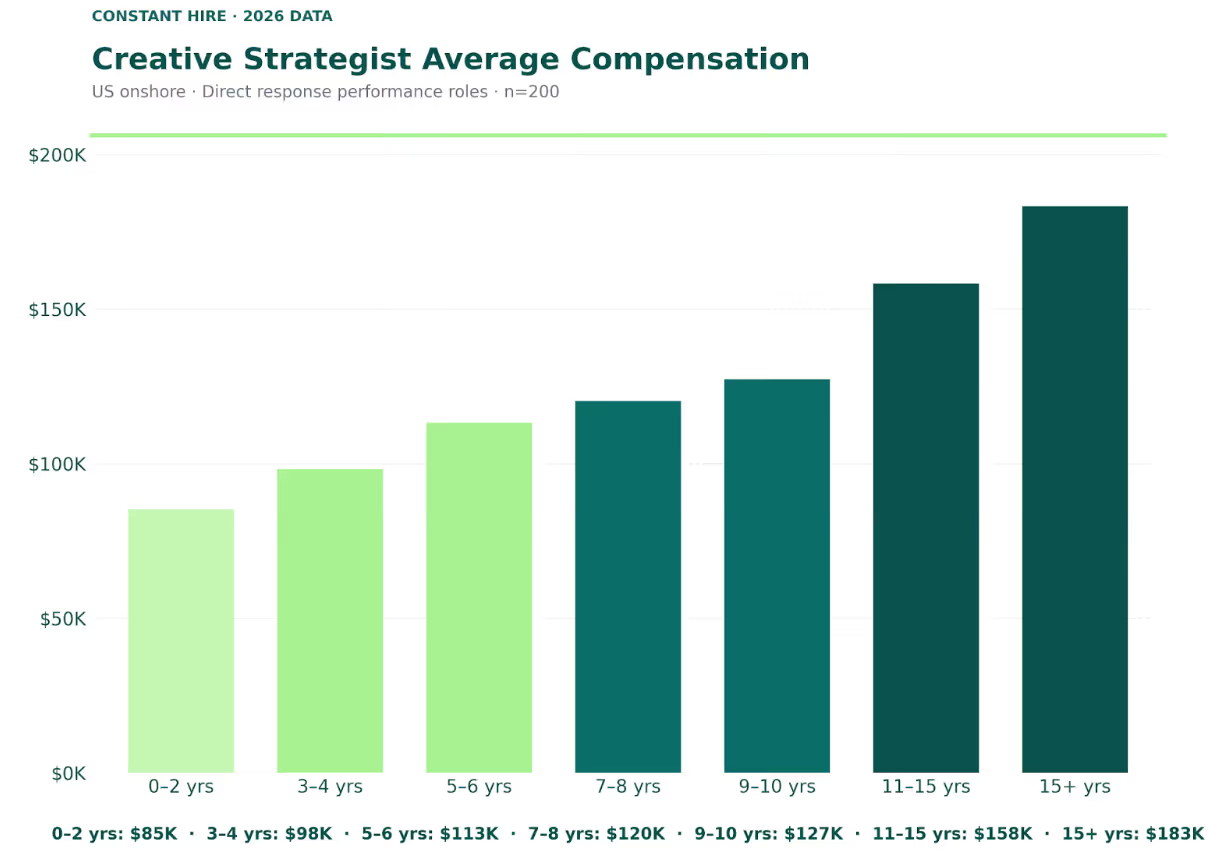
We’ve crunched the numbers from our 2025 interview cycles, covering over 200 direct response professionals, to provide a clear picture of creative strategist compensation. These proprietary insights reflect the actual salary expectations and current earnings of onshore talent in the US consumer brand space.
Based on 200 interviews we conducted throughout 2025, the average base salary for a U.S. creative strategist now sits at approximately $113,000, with senior-level roles reaching $183,000 and beyond. However, for brands looking to hire, the base pay is only part of the story; when you factor in benefits, payroll taxes, and specialized software, the 'fully loaded' cost of a high-performing strategist often exceeds $150,000 annually.
In ecommerce, typical US salary ranges look like:
Junior: $65,000–$85,000
Mid-level: $90,000–$120,000
Senior: $125,000–$160,000+
Pay varies based on channel experience, spend managed, and whether the role is in-house or agency-side. Freelance and fractional creative strategists may charge day rates or monthly retainers, especially for early-stage brands.
What Are the 7 Creative Strategies Used in Ecommerce Ads?
Most high-performing ecommerce ads fall into a small set of repeatable creative strategies:
Problem-solution framing: Clearly surfaces a customer pain point, then positions the product as the direct and credible solution.
Social proof and testimonials: Uses reviews, UGC, or third-party validation to reduce skepticism and build trust quickly.
UGC storytelling: Leverages creator or customer narratives to make the product feel authentic, relatable, and lived-in.
Founder narratives: Tells the origin story or mission behind the brand to build emotional connection and credibility.
Comparison ads: Shows how the product stacks up against alternatives to justify switching or paying a premium.
Objection handling: Directly addresses common hesitations like price, quality, or results to remove friction before purchase.
Iterative hook testing: Continuously tests different openings and angles to find what stops the scroll and drives engagement.
Each works when grounded in insight and tested systematically.
How Creative Strategists Work With Influencers
Creative strategists play a critical role in making influencer content perform in paid environments. They brief creators effectively by translating customer insights and ad angles into clear guidance, while still leaving room for creators to sound authentic. At the same time, they maintain brand consistency so messaging doesn’t drift as volume increases.
Just as importantly, creative strategists use creator feedback and performance data to inform paid ad strategy. When content underperforms, they diagnose whether the issue is messaging, framing, or target audience fit, and realign creators with the brand narrative rather than cycling through new talent blindly.
What Is Creative Project Management?
Creative project management is the process of organizing, prioritizing, and moving creative ideas from strategy to execution without slowing down performance. In ecommerce, creative strategists often own this function to ensure that testing stays consistent as volume and spend increase.
This typically includes running structured creative sprints to ship new concepts quickly, maintaining testing pipelines so ideas move smoothly from insight to execution to analysis, and establishing clear feedback loops between media buyers, designers, and creators.
Without this operational layer, creative velocity slows, learnings get lost, and performance stalls just as brands try to scale.
Is a Creative Strategist a Good Career Path?
Demand for creative strategists in ecommerce continues to rise. Common paths include designer-to-strategist and media buyer-to-strategist. Long-term success comes from balancing curiosity, discipline, and commercial awareness.
Final Thoughts
As paid channels become more competitive, creative strategy has moved from a supporting function to a core growth driver.
Creative strategy drives modern ecommerce performance.
The role blends insight, testing, and execution logic.
Brands that scale profitably invest here early.
Scaling ecommerce creative is rarely a tooling problem. It’s an execution and ownership problem. If you’re hiring for this role, clarity matters more than titles. Learning how to find and recruit better creative strategists can help founders avoid common mistakes without over-hiring too soon.
At Constant Hire, we work with DTC brands to define, scope, and hire specialized growth roles, including Creative Strategists who can turn insight into repeatable performance. We help founders avoid vague job descriptions, mis-scoped hires, and months of trial-and-error by placing operators who have already done the work at scale, including avoiding common ecommerce hiring mistakes that stall growth.
If you’re trying to understand whether a Creative Strategist is the right hire, or want help finding one with real ecommerce experience, get in touch with us.
FAQs
What does a creative strategist do day to day?
A creative strategist’s job day to day involves research, briefing, reviewing performance, and iterating on concepts.
Is a creative strategist more creative or analytical?
A creative strategist is both analytical and creative, but strong ones lean analytical.
How do creative strategists collaborate with media buyers?
Creative strategists collaborate with media buyers by aligning on tests, reviewing results, and refining inputs.
When should an ecommerce brand hire one?
An ecommerce brand should hire a creative strategist when paid spend increases but performance plateaus.
Connor Gross founded Constant Hire in 2024. An operator turned founder with deep experience building and scaling e-commerce brands. He previously sold an Amazon brand and generated over $30M+ in DTC revenue through private-label Shopify businesses. He now helps fast-growing DTC brands and agencies hire top talent across marketing, creative, ops, and sales. From E‑com Managers to TikTok Creators and Heads of Growth, he knows what great looks like, and how to recruit it.