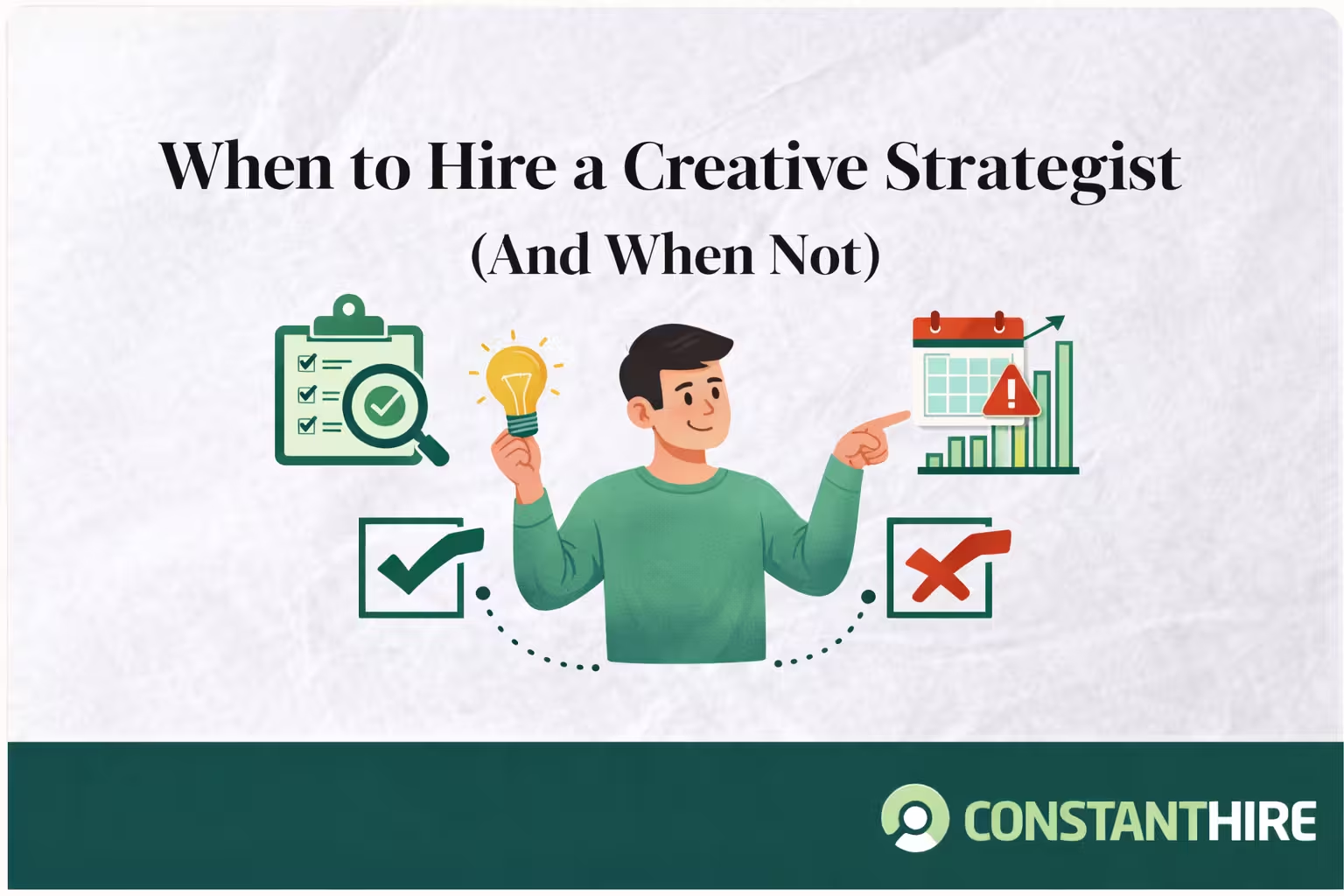
The right time to hire a creative strategist is when creative insight on your Meta Ads, not traffic volume or targeting mechanics, becomes the limiting factor on growth. The wrong time is when you lack enough performance data or execution capacity to learn from creative tests.
From our experience, many founders hire this role either too early, expecting strategy to replace signal, or too late, after ad performance has already stalled. The confusion comes from misunderstanding what the creative strategist role actually owns and what it does not.
This article explains when hiring a creative strategist makes sense, when it does not, and which role you may need instead depending on stage, spend, and team structure. The goal is not faster hiring. It is correct hiring.
Key Takeaways
- Hire a creative strategist when creative insight becomes the constraint, not traffic or spend. If ad performance plateaus despite stable budgets and consistent traffic quality, the problem is usually creative learning, not media buying or targeting.
- Creative volume without learning is a warning sign. Shipping more ads does not equal progress unless someone owns hypotheses, performance metrics, and iteration logic. The creative strategist role exists to turn output into insight.
- Timing matters more than role prestige. Hiring too early leads to strategy without signal; hiring too late leads to burned budgets, creative debt, and panic hiring. The role compounds results only when data and execution capacity already exist.
- The creative strategist is a systems role, not a production role. Their value comes from aligning media buyers, creative teams, and performance data into a repeatable workflow that supports scalable growth and smarter hiring decisions.
What Does a Creative Strategist Do?
A creative strategist sits between performance data and creative execution. Their job is to turn customer insights and performance metrics into repeatable creative ideas that improve ad performance over time.
A Creative Strategist converts performance data and customer insight into testable creative hypotheses that improve acquisition efficiency over time.
In practice, this includes researching customer pain points, defining creative hypotheses, writing performance-anchored briefs, and designing a testing workflow that links creative decisions to measurable outcomes. They partner closely with media buyers, copywriters, designers, and content creators to ensure creative output aligns with what the data supports.
What they do not do matters just as much. A creative strategist is not a designer, not a media buyer, and not a brand-only thinker. They do not spend all day in Figma or Ads Manager. They own the logic behind why certain creative ideas are tested and how results are interpreted.
As paid media platforms shift toward creative-led optimization, this role has become central to performance marketing execution rather than a nice-to-have support function, which mirrors why creative strategy has become the biggest lever for scaling DTC brands.
| Role Feature |
Content Creator |
Creative Strategist |
| Primary Objective |
Production of high-quality assets (video, photo). |
Engineering winning creative hypotheses. |
| Key Metric |
Aesthetic quality, brand alignment, views. |
CTR, CVR, Hook-Hold Rate, CM3. |
| Core Skill |
Adobe Suite, filming, editing, storytelling. |
Data analysis, buyer psychology, briefing. |
| Workflow |
Executes based on a provided brief. |
Generates the brief based on market research. |
The creative strategist role is responsible for learning velocity and performance insight, while content creators focus on execution quality.
The 3 Clear Signs It’s Time to Hire a Creative Strategist
Sign #1: Your Ads Plateau Despite Stable Spend
One of the clearest signals is when ad performance stalls even though traffic quality and ad spend remain stable. CPAs rise, return on ad spend flattens, and new formats fail to move performance.
At this stage, targeting and media buying changes no longer solve the problem. Platforms like Meta and TikTok now rely primarily on creative signals to drive delivery, making creative fatigue the bottleneck rather than audience selection .
If refreshing visuals or swapping headlines does not improve ad performance, the issue is usually a lack of structured creative strategy rather than execution speed.
Sign #2: You’re Shipping Ads, But Not Learning
Many marketing teams produce a high volume of ads without generating insight. Creative ships weekly, but no one can explain which variables drove performance or why results changed.
There are no documented hypotheses, no creative concepts tied to specific pain points, and no performance metrics mapped back to creative decisions. Without this learning loop, teams repeat the same ideas with minor variations and stall progress.
Research shows that over 85% of DTC advertisers now use AI-assisted creative production tools, which increases volume but does not replace strategic interpretation of results. A creative strategist is the role that turns output into learning.
Sign #3: Creative Is Blocking Scale
When media buyers are waiting on validated ideas, designers are executing without clear hypotheses, and no one owns the “why” behind creative decisions, scale slows, even if you already have strong paid media buyers in place.
In these cases, the bottleneck is not talent but alignment. A creative strategist removes friction by setting creative direction, defining testing priorities, and keeping the workflow moving across creative teams.
As ad platforms demand more creative variation to maintain delivery, teams without a strategist struggle to maintain velocity without sacrificing performance .
When You Should NOT Hire a Creative Strategist
Hiring this role too early creates strategy without signal. Pre-PMF brands or teams running very low ad spend often lack enough performance data to support meaningful creative insights.
If your ad account generates fewer than roughly 50 conversions per week, algorithms struggle to learn reliably, and neither can a strategist. In these situations, a founder-led approach, media buyer support, or freelancers focused on execution is usually more effective, especially when weighing freelance vs full-time ecommerce teams.
Another common mistake is expecting one hire to cover strategy, design, media buying, and brand building. That violates the 70% rule of hiring, which states roles should be hired for core strengths rather than imagined coverage. Without internal execution capacity, even the best strategist will stall, which is why team foundations matter before strategic hires when building an ecommerce team.
What Happens When You Hire Too Early (Or Too Late)
Hiring too early leads to frustration on both sides. The strategist lacks signal, the founder expects answers, and creative ideas feel theoretical. Strategy without data quickly becomes opinion.
Hiring too late creates a different problem. Budgets burn inefficiently, creative debt accumulates, and teams panic-hire under pressure. By the time a strategist arrives, ad performance has already declined, and rebuilding learning systems takes longer.
Mid-market brands facing margin compression between $10M and $50M in revenue often experience this delay. EBITDA margins in this range have compressed to roughly 7–8%, driven in part by structural CAC increases of 25-40% year over year, making late corrective hires costly.
Creative Strategist vs Creative Director vs Brand Strategist
| Role |
Primary Responsibility |
Core Output |
Key Metric |
Common Misuse |
| Content Creator |
Asset production |
Videos, images, copy |
Views, engagement, brand fit |
Expected to “think strategy” |
| Creative Strategist |
Insight → hypothesis → testing |
Creative briefs, test plans, learnings |
CTR, CVR, Hook-Hold Rate, CM3 |
Treated as a producer |
| Creative Director |
People + execution quality |
Visual standards, team output |
Consistency, craft quality |
Asked to own performance data |
These roles solve different problems. Misalignment occurs when performance ownership, execution, and insight generation are blurred.
Creative Strategist vs Creative Director
The creative strategist vs creative director distinction matters here: a creative director owns people management, visual standards, and execution quality. They manage designers, set visual standards, and guide brand expression.
A creative strategist owns insights, testing logic, and performance learning. They decide what to test, why it matters, and how results inform the next iteration. In performance marketing teams, the strategist feeds direction into the director rather than replacing them.
Creative Strategist vs Brand Strategist
Brand strategy focuses on long-term identity, positioning, and brand building. Creative strategy focuses on short-cycle learning loops that improve paid media and content performance.
Both roles matter, but they solve different problems. Confusing them often leads to slow execution or misaligned expectations.
So… Which One Do You Need Right Now?
Early brands often need execution capacity and media buying support before strategy compounds. Scaling brands benefit most from a creative strategist. Mature brands typically need both creative direction and brand leadership layered together.
How Much Does a Creative Strategist Get Paid?
In the United States, the average annual salary for a creative strategist is approximately $92,879, with a median range between $80,000 and $88,700 depending on experience and scope .
| Percentile |
Annual Salary |
| 25th |
$71,454 |
| 50th |
$80,314 – $88,700 |
| 75th |
$88,245 – $103,000 |
| 90th |
$95,466 – $135,500 |
Costs vary based on ad spend managed, channels owned, years of experience, and whether the role is in-house, freelance, or fractional. Remote roles still show geographic variance, with California paying 22–24% above national averages .
Defining the Right Goals Before You Hire
Before starting the hiring process, founders must define the problem clearly. Are you solving creative fatigue, lack of learning, or workflow breakdowns?
Success should be defined in 90-day terms. Examples include doubling creative volume, improving CTR by 20% over baseline, or reducing time from creative brief to launch under 10 days .
Clarifying inputs also matters. Will the strategist own ideation, data analysis, creative briefs, or project management? Clear scope prevents mis-hires and accelerates impact.
How Creative Strategy Connects to Social Channels and Team Roles
As creative strategy becomes more performance-driven, its connection to social media execution matters more than ever. Platforms like TikTok, Meta, and LinkedIn now reward clarity of message and consistency of creative direction over one-off creative ideas. A creative strategist ensures that every asset aligns with a defined target audience and supports the broader marketing strategy, rather than reacting to trends in isolation.
In well-structured creative teams, the strategist works closely with an art director to translate insights into visual systems that can scale across channels. The strategist defines the creative concept and learning goal, while the art director ensures visual cohesion across paid media and organic social media outputs. This separation prevents design teams from guessing and keeps execution focused.
This role also influences how brands show up professionally on platforms like LinkedIn, where founder-led content, hiring signals, and brand credibility increasingly affect performance marketing outcomes upstream.
When hiring, founders should avoid vague expectations. A clear job description matters. We recommend using a structured creative strategist job description that outlines ownership over creative briefs, ideation, data analysis, and workflow management.
How Creative Teams Must Adapt as Platforms and AI Evolve
Velocity now matters more than perfection. Algorithms reward consistent iteration over polished one-offs.
AI accelerates ideation and content creation, but it does not replace strategic judgment. DTC advertisers already use AI for creative production, increasing the need for humans who can interpret performance data and guide direction.
As platforms shift fully toward creative-first delivery, the creative strategist role becomes more critical, not less.
Who Should Help You If You’re Not Ready Yet?
If you are not ready to hire full-time, alternatives exist. Media buyers can guide creative testing at smaller scales. Brand strategists can clarify positioning. Freelancers or fractional support can help build early workflows without long-term overhead.
These options are stage-appropriate, not inferior. The goal is matching capability to signal.
Final Thoughts
Hiring a creative strategist is a timing decision, not a trend decision. When hired at the right moment, the role compounds learning, improves ad performance, and creates leverage across marketing teams.
When hired too early or too late, it creates friction and wasted spend. Clarity beats speed.
For founders navigating modern performance marketing, understanding when to hire a creative strategist often matters more than how fast you fill the role.
This is where teams like us at Constant Hire come in, helping brands align hiring decisions with actual growth constraints rather than assumptions.