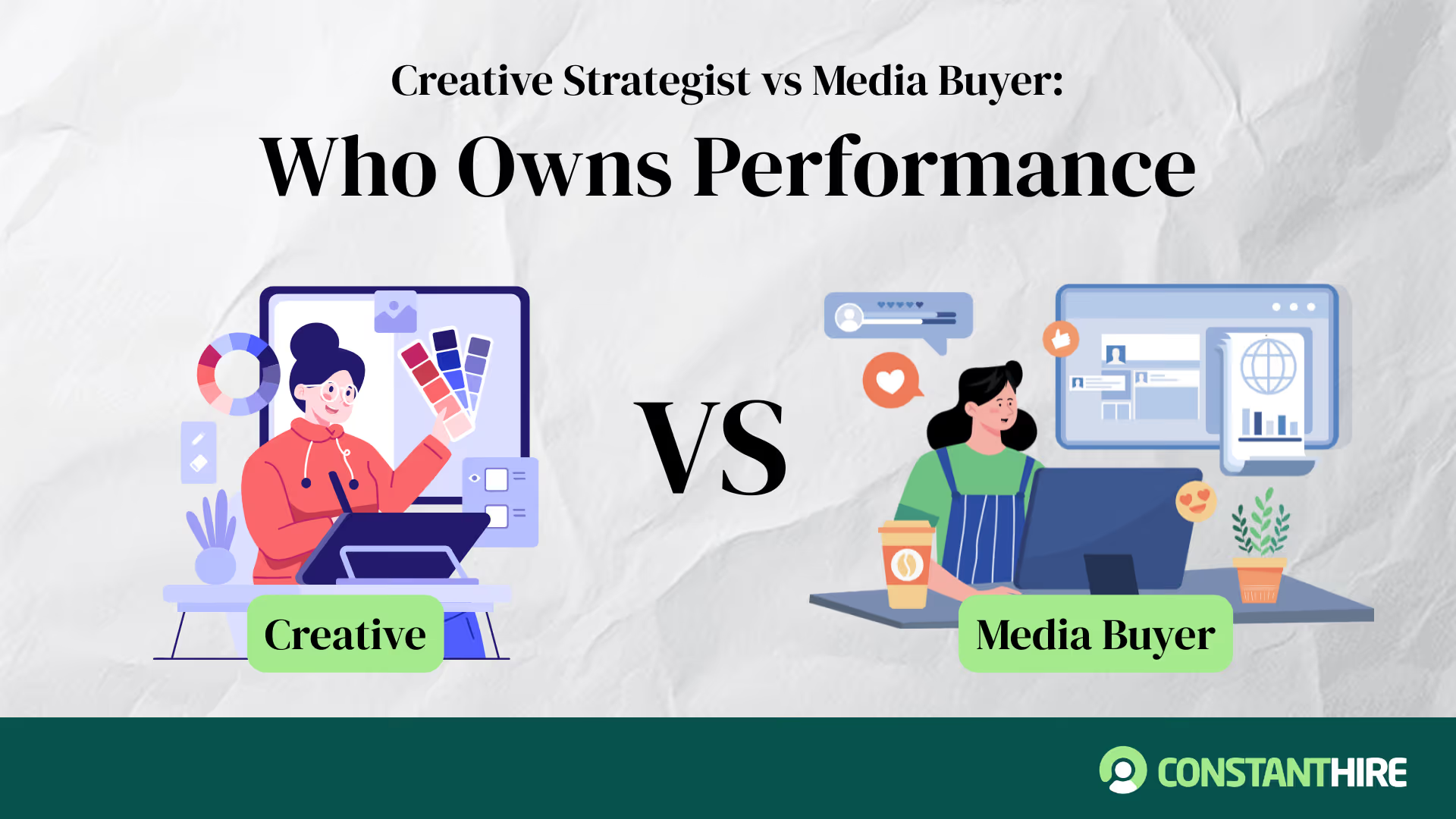
Performance is not owned by one role. In modern DTC and e-commerce teams, performance emerges from how creative strategy and media buying are defined, staffed, and operationally aligned. The creative strategist vs media buyer debate exists because most teams still hire for output instead of ownership.
The short answer is this: the creative strategist owns the performance signal, while the media buyer owns the performance system that allows that signal to scale. When companies blur those responsibilities, they create slow iteration cycles, misaligned KPIs, and expensive mis-hires. That is a different fault line than the creative strategist vs creative director distinction, which separates strategic ownership from creative production management.
This distinction is operationally decisive in 2026. U.S. e-commerce sales passed $310.3 billion in Q3 2025, signaling a shift toward mature operators with tighter margin discipline. At the same time, Meta’s Andromeda update increased model capacity by 10,000x shifting ad delivery from manual audience construction toward real-time interpretation of creative visuals and behavioral signals.
If you are hiring for paid media, growth, or creative leadership, understanding where strategy ends and execution begins is the difference between scaling ad performance and burning ad spend.
Key Takeaways
- Performance is not a role. It is an outcome of ownership. When creative signal and media systems lack clear owners, teams default to surface-level optimizations that do not compound.
- Creative defines what the algorithm learns. Media determines how efficiently it learns. Confusing these responsibilities leads to slow iteration, misaligned KPIs, and fragile performance.
- Modern platforms reward signal quality over tactical cleverness. In 2026, audience hacks and bid tweaks matter far less than message clarity, concept diversity, and system simplicity.
- The fastest-growing brands hire for specialization, not versatility. Teams that avoid the generalist trap outperform by separating insight generation from delivery architecture.
Decoding the Ad World: Creative Strategist vs. Media Buyer
The creative strategist vs media buyer question exists because both roles touch paid media, but they solve different problems. One defines what the algorithm learns. The other ensures the algorithm can learn efficiently.
In performance marketing, creative defines the targeting input, which is why creative strategy often becomes the biggest lever once media tactics stop producing gains. Media buying defines the delivery environment. Treating these as interchangeable roles leads to guesswork, duplicated effort, and fragile ROAS.
This distinction is especially relevant in DTC and e-commerce, where paid media, creative testing, and rapid iterations determine whether a brand compounds or stalls.
| Area |
Creative Strategist (Signal) |
Media Buyer (System) |
| Primary Ownership |
What the algorithm learns |
How the algorithm learns |
| Core Focus |
Messaging, concepts, narrative clarity |
Account structure, budgets, data flow |
| Key Decisions |
Hooks, framing, proof, formats |
Spend allocation, campaign design |
| Success Metrics |
Hook rate, retention, fatigue signals |
MER, CM3, blended efficiency |
| Failure Mode |
Generic or stale messaging |
Over-segmentation, noisy data |
| Time Horizon |
Weeks of iteration |
Daily to weekly optimization |
The Visionary: What Exactly Does a Creative Strategist Do?
A creative strategist is the role responsible for defining what messages, formats, and narratives enter the ad account, which is why many brands reach an inflection point where they need to hire a creative strategist rather than treating creative as a downstream execution task.
Creative strategist roles focus on translating customer insight into repeatable creative systems that drive ad performance across social media platforms like TikTok and Meta.
A creative strategist is a performance ownership role, not a production or design role.
Crafting the Narrative: From Concept to Campaign
Creative strategy starts with the target audience. The strategist defines the problem framing, messaging hierarchy, and emotional angle that guide copywriting, UGC direction, and ad creative development.
In practice, this means creating creative briefs that specify hooks, objections, proof points, and ad formats before production starts. This removes guesswork from the creative team and ensures new creative is intentional rather than reactive.
Managing the Distribution Ecosystem
Although creative strategists do not manage bids or placements, they design creative with placements in mind. A TikTok-first UGC concept differs from a Meta feed video in pacing, framing, and CTA structure.
As ad platforms increasingly rely on creative to infer intent, creative strategy has become a primary performance lever rather than a brand-only function.
Technical Responsibilities: Tracking, Budgets, and Scaling
Creative strategists own the creative testing framework, including concept velocity, variable isolation, and learning documentation. They decide what variables change between iterations, how many concepts enter testing, and when to kill or scale a direction.
Metrics such as click-through rate, hook retention, and creative fatigue signals guide decisions. These metrics explain why ads win or lose, not just whether they did.
The “Why” Behind the “What”: Understanding the User Journey
Creative strategy connects ad creative to landing page expectations, influencer content, and broader marketing campaigns. This alignment reduces drop-off and improves downstream ad performance.
When this role is missing, teams often over-index on media buying to fix creative problems.
The Architect: What Exactly Does a Media Buyer Do?
A media buyer is responsible for the system that delivers creative to the market, a responsibility that is frequently misunderstood in modern ecommerce teams.
The media buyer role focuses on account structure, ad spend allocation, and performance optimization across paid media channels.
A media buyer is an execution and financial control role, which is why scaling teams eventually need to hire a media buyer who owns budget allocation, account structure, and signal efficiency at the system level.
Navigating the Landscape: Optimizing Placements and Budgets
Media buyers manage the ad account. They set up campaigns, manage placements, control ad spend, and ensure clean data flow to the algorithm.
In 2026, this means simplifying structures to preserve learning signals. Over-segmentation slows optimization and damages ad performance under modern algorithms.
The “Where” and “How Much”: Maximizing Reach and Efficiency
Media buyers are accountable for ROAS, MER, and blended performance metrics. They decide how budgets move between campaigns, platforms, and objectives.
As attribution weakens, high-performing teams increasingly manage to Contribution Margin 3 (CM3), with healthy DTC benchmarks ranging from 25–35%, especially as more brands experience performance decay that cannot be fixed inside the ad account.
The Iteration Engine: Briefing, Testing, and Hook Analysis
Media buyers provide performance feedback to creative strategists. This includes which ad formats scale, which hooks stall, and where CTR or CPA breaks down.
This feedback loop enables creative testing to remain data-driven rather than opinion-based.
The Great Divide: Where the Roles Diverge
The creative strategist vs media buyer distinction becomes clearest when performance dips.
Creative strategists diagnose why messaging fails. Media buyers diagnose where delivery breaks.
Quantitative vs. Qualitative Success Metrics
Creative strategists analyze engagement quality, messaging clarity, and creative fatigue. Media buyers analyze efficiency metrics such as ROAS, CTR, and cost per acquisition.
Both matter. Confusing them leads to teams optimizing the wrong levers.
Toolstacks and Time Horizons
Media buyers live inside ad managers and reporting dashboards. Creative strategists operate across creative testing libraries, UGC pipelines, and project management systems.
Media buying optimizes daily. Creative strategy compounds over weeks of iterations.
Where Their Worlds Intersect: A Symbiotic Relationship
Performance marketing works when strategy and execution stay separate but synchronized.
The Performance Creative Workflow
High-performing teams treat creative as targeting and media buying as distribution. Media buyers surface performance signals. Creative strategists turn those signals into new concepts, not minor tweaks.
This loop accelerates iterations and reduces wasted ad spend.
Establishing a Shared Language for Growth
Both roles must align on KPIs, timelines, and ownership. When neither owns the outcome end to end, performance becomes fragile.
Hiring for Performance: Avoiding the Generalist Trap
A Generalist Blindspot occurs when a company assumes one hire can fully own both creative signal generation and media system architecture, a pattern that shows up repeatedly in failed ecommerce hires. This is common in fast-growing DTC teams where speed and efficiency are prioritized over role clarity. On paper, a single “growth” or “performance” hire looks economical. In reality, it introduces execution friction.
Creative strategy and media buying operate on different skill sets and time horizons. Creative work requires customer insight, narrative judgment, and disciplined testing of meaning. Media buying requires financial control, system design, and daily optimization. When one person owns both, one side inevitably suffers. Most often, creative quality erodes while media activity increases to compensate.
This failure becomes expensive when it shows up at the hiring level.
For example, a mid-eight-figure DTC brand hired a full-stack growth marketer to own both creative and media. Creative decisions gravitated toward what was easiest to launch in the ad account rather than what customers actually responded to. Testing narrowed to minor hook variations while account structure grew more complex to offset weak signals. CAC rose 42% over six months. After separating the role into a dedicated Creative Strategist and a senior Media Buyer, iteration speed doubled and Contribution Margin 3 recovered within one quarter. The issue was not talent. It was role design.
High-performing teams avoid this trap by hiring for ownership, not versatility. They define who owns the performance signal and who owns the performance system, then align metrics and incentives accordingly. This separation does not slow teams down. It removes guesswork and creates performance that compounds instead of decays.
At Constant Hire, we’ve noted that most mis-hires occur when companies hire for execution while expecting strategic ownership. Clarifying role boundaries prevents this failure mode and accelerates ad performance.
Final Take: Who Owns Performance?
Performance is not owned by a single role. It is produced by a system.
Creative strategy owns the signal quality. Media buying owns the system efficiency. Operations and CX influence conversion reliability.
When teams align these roles intentionally, performance marketing becomes repeatable rather than fragile. When they do not, no amount of optimization can fix structural confusion.
Hiring decisions should reflect this reality. Clear ownership beats heroic multitasking every time. If you are unsure whether your performance issues stem from creative signal, media systems, or role design, our media buyer recruitment team can help you pressure-test your current structure before the next hire.