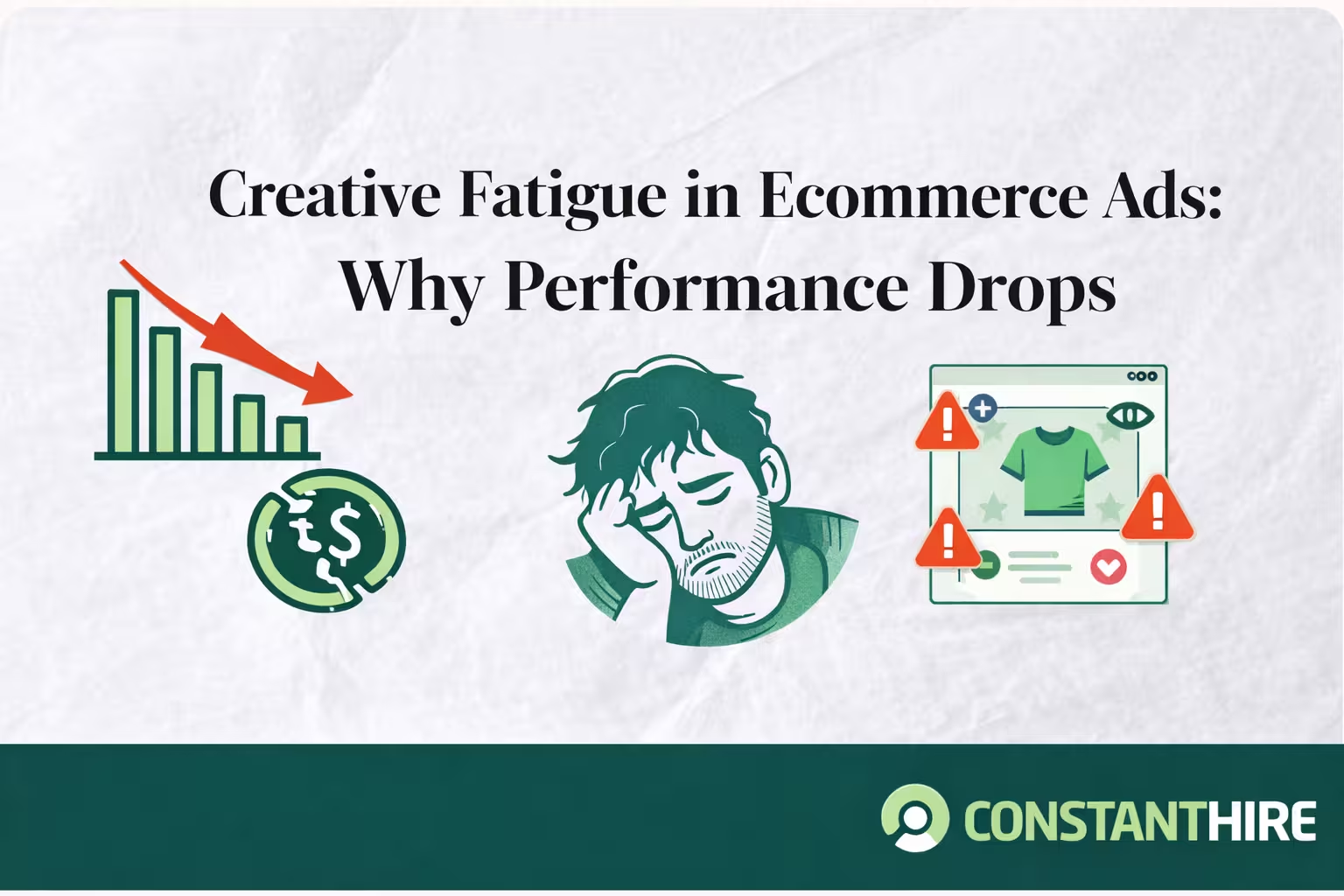
Creative fatigue in e-commerce isn't just a drop in clicks; it’s a technical “punishment phase” where algorithms hike your CPMs the moment your message stops earning its keep. As platforms rely more heavily on creative elements than audience targeting, performance drops often trace back to message repetition rather than media buying errors.
CAC for ecommerce brands has increased 40% in recent years due to saturation and signal loss.This issue is central to digital marketing for e-commerce brands in 2026.
When teams focus on surface-level changes without a defined creative strategy, they cycle the same ideas faster rather than introducing new learning. This leads to predictable engagement drops, even though the ads technically look “new”. Strong creative strategy aligns messaging to specific objections and stages of awareness; without it, brands rely on recycled templates that accelerate fatigue.
The 2026 landscape is defined by compressed decay curves and a rising tide of "AI slop", identical UGC and templated demos that consumers treat as "wallpaper". This is a total algorithmic deprioritization where platforms raise your CPM as a "novelty score" penalty.
To scale, brands must shift from chasing ROAS to mastering Contribution Margin (CM3) and feeding AI-driven retrieval models like Meta’s Andromeda the machine-readable signals they require.
Key Takeaways
- Algorithmic Punishment: Creative fatigue triggers a "novelty score" penalty, causing platforms to increase CPMs and shift delivery to lower-quality impressions.
- The Three-Second Mandate: In 2026, success is decided in the first 1,000ms; a thumb-stop rate below 30% indicates a failure to interrupt the scroll.
- Infrastructure Shift: Meta’s Andromeda and GEM systems use "Semantic Embedding" to match ads with intent groups, making creative the primary targeting lever.
- Financial Resilience: Scaling brands have moved from ROAS to Contribution Margin (CM3) to find hidden leaks like returns and shipping costs.
What Is Creative Fatigue in Ads?
Creative fatigue is the point at which an ad’s message no longer produces incremental engagement or conversion signals because the audience has already internalized it.
Creative fatigue is not the same as ad fatigue. Ad fatigue occurs when delivery slows due to frequency caps, limited audience size, or overexposure within an ad set, signals often first spotted by experienced ecommerce paid media buyers. Creative fatigue occurs when the message itself has lost impact, even if reach is still available.
Ecommerce brands are more exposed because campaigns rely on short buying cycles, aggressive retargeting, and repeated offers. Understanding these performance dynamics is increasingly part of modern ecommerce marketing manager responsibilities. When the same ad runs across prospecting and retargeting, campaign performance deteriorates quickly even with healthy audience size.
Why Creative Fatigue Hits Ecommerce Ads So Fast
Consumers scroll past thousands of ads each day across social media platforms. Pattern recognition beats novelty. Once an ad feels familiar, attention collapses.
Platform algorithms reinforce this behavior. Meta and TikTok prioritize ads that generate fresh engagement signals. When creative elements stop driving meaningful interactions, delivery shifts toward lower-quality impressions, pushing CPC and CPA higher.
The democratization of content has created a rising tide of "AI slop", identical UGC testimonials and templated demos that consumers now treat as "wallpaper". This reinforces why creative strategy for scaling DTC brands has become the primary performance lever.
On high-velocity platforms like TikTok, creative burnout typically occurs within 3–5 days for high-spend accounts, while Meta assets decay within 7–14 days. This is not just a drop in interest; it is a total algorithmic deprioritization where platforms raise your CPM as a "novelty score" penalty. This mechanic explains why ecommerce ads stop working even when media buying, budgets, and audiences remain unchanged.
The Warning Signs of Creative Fatigue
Performance Signals
Creative fatigue appears first in creative-level metrics, not account-level dashboards. Median ecommerce conversion rates in 2026 sit roughly between 1.9% and 2.5%, while high-performing brands consistently exceed 3%. Early warning signs include declining click-through rate, rising CPC, and increasing CPA despite stable ad spend.
Meta Ads benchmarks show average ecommerce CTR between 2.0% and 5.0%, while high-performing ads exceed 6.0%. When a previously top-performing ad drifts toward baseline, fatigue is usually the driver. Campaign performance may also show steady spend with shrinking conversion volume.
Conversion rates often tell the second half of the story. When creative fatigue sets in, click-through rate usually declines first, but conversion rates tend to follow once lower-intent users begin seeing the ads. Algorithms expand delivery to maintain spend, but traffic quality worsens, quietly eroding efficiency.
This is why watching only top-line ROAS hides the problem. Fatigued creative often shows stable spend, slightly worse CPC, and then a delayed drop in conversion rates. By the time revenue impact is obvious, the campaign has already been training the algorithm on weaker signals. Tracking performance metrics at the creative level, not just the campaign level, is the only way to catch this early.
Behavioral Signals
Behavioral signals often appear before revenue impact. Comments repeat the same objections, influencer-style testimonials stop attracting saves, and engagement quality drops.
Video ads show steeper falloff in the first three seconds, signaling that the hook no longer interrupts scrolling behavior. Algorithms interpret these engagement drops as declining relevance.
The Three-Second Mandate
In 2026, the success of an ad is decided in the first 1,000 milliseconds. Early warning signs of fatigue are now measured by:
- Thumb-stop Rate: The percentage of users watching at least 3 seconds. If this is below 30%, your creative is failing to interrupt the scroll. High performers hit 40%+.
- CPM Creep: As the algorithm detects lower engagement, it enters a "punishment phase," raising costs to maintain platform quality.
- Completion Rate: A rate below 40% suggests the "bridge" between your hook and body content is no longer providing value.
How to Measure Creative Fatigue (Without Guessing)
Creative fatigue must be measured at the creative level, not by frequency alone. That measurement only happens inside a disciplined creative testing framework, not by watching frequency caps alone. Frequency caps can stay low while fatigue still occurs if the message repeats across formats.
Key metrics include thumb-stop rate, creative-level CTR decay, and CPA trends over time. On TikTok, thumb-stop rates below 30% indicate weak interruption, while high-performing ads exceed 40%.
Standard TikTok ad campaigns typically convert between 0.46% and 2.4%, while TikTok Shop campaigns frequently exceed 10% conversion due to in-app checkout removing friction. These benchmarks highlight the growing importance of the TikTok Shop manager role.
Tracking performance against launch baselines helps isolate message decay from audience saturation. When optimization no longer improves results, the creative lifespan has ended, a moment when many brands decide to hire a creative strategist.
| Metric |
2026 Benchmark (Healthy) |
Fatigue Warning Signal |
| Thumb-stop Rate |
40% – 55% |
< 30% |
| Average Order Value (AOV) |
$88.31 (Median) |
Significant drop in basket size |
| CAC Payback Period |
< 6 months |
> 12 months |
| Meta CTR (E-com) |
2.5% – 5.0% |
< 1.8% |
| TikTok Shop CVR |
10% – 12% |
< 6% |
| Standard Web CVR |
2.5% – 3.2% |
< 1.5% |
2026 performance benchmarks commonly observed across scaled ecommerce accounts. Warning signals indicate early-stage creative fatigue.
Creative as the Primary Targeting Lever: Andromeda & GEM
Modern platforms have moved away from manual interest targeting toward AI-driven retrieval models.
Meta’s Andromeda: This system uses "Semantic Embedding" to analyze every pixel and word of a voiceover to match ads with user intent. If an ad lacks clear machine-readable signals, it is retrieved by low-quality audiences, leading to poor ROAS.
Meta’s GEM: This "Generative Brain" is 4x more efficient than 2024 models at predicting which creative will resonate at specific journey stages.
By late 2026, Meta is moving toward "Goal-Only" interfaces where advertisers simply provide a URL and a budget, leaving the AI to generate the variations.
Creative Fatigue vs Ad Fatigue: What’s the Difference?
Ad fatigue is a delivery constraint. Creative fatigue is a messaging constraint.
Ad fatigue occurs when frequency caps limit reach or audience size restricts scale. Creative fatigue occurs when users understand the message and stop responding.
Swapping audiences rarely fixes creative fatigue because the same message follows the user. This is why fatigue often masquerades as targeting failure inside ads manager dashboards.
How Many Ad Creatives Should Ecommerce Brands Test?
Most ecommerce brands test too few ideas and too many small tweaks. Early-stage brands benefit from fewer concepts with deeper insight extraction. Scaling brands require volume. Many achieve this through fractional ecommerce hiring rather than full in-house expansion.
At Constant Hire, we’ve seen that high-spend advertisers spending over $3.5M per quarter launch 5-10 new ads per week, totaling more than 2,400 creative variations per quarter.
Brands that produce more creative variations avoid fatigue longer. One high-performing ad cannot sustain long-term ad performance.
How Often Should You Update Ad Creative?
Waiting for performance to drop before launching new creative guarantees higher costs. By the time metrics decline, algorithms have already deprioritized delivery.
Healthy teams separate creative refreshes into two tracks: iterations and new creative. Iterations adjust hooks, CTAs, or formats. New creative introduces new beliefs, objections, or narratives.
On Meta, refresh cycles of 7-10 days align with observed creative lifespan benchmarks.
Why Optimization Can’t Fix Creative Fatigue
Daily optimization is often mistaken for a solution. In reality, optimization reallocates spend across existing inputs.
Bid changes, budget tweaks, and targeting adjustments cannot restore engagement once the message is exhausted. Creative is the input to algorithms. You cannot out-optimize a creative production problem. That reality is why brands often turn to performance marketing recruiters instead of further optimization.
This is where a/b testing is often misapplied. Teams run constant a/b testing on bids, audiences, or minor copy changes, expecting performance to recover. But when the underlying message is fatigued, these tests simply reshuffle underperforming creative rather than generate new learning. The test technically runs, but it produces no meaningful signal.
How to Handle Creative Fatigue When Audiences Burn Out Fast
Increase Message Diversity
Message diversity means testing multiple beliefs, objections, and narratives, not just different formats like carousel or video ads.
High-performing ads vary proof, framing, and call-to-action while keeping the offer consistent.
Build a Creative Supply System
Creative should be treated like inventory. The system flows from research to ideation, creative testing, and documented learning.
Brands without a system rely on sporadic new creative and experience internal burn out alongside rising acquisition costs.
Separate Testing From Scaling
Testing should occur in controlled environments that protect winners. Mixing experiments into scaling campaigns accelerates fatigue inside the ad account.
The 3-2-2 Method (And Why It Helps, but Isn’t Enough)
The 3-2-2 method structures testing by launching three creatives, two audiences, and two angles inside dynamic creative setups.
Frameworks help organize testing and support algorithmic learning. However, frameworks alone do not sustain results. Insights, not formulas, prevent fatigue.
The Long-Term Fix: Systems That Beat Creative Fatigue
Sustainable systems rely on repeatable structure, not constant reinvention. High-performing teams do not start from scratch every week. They use documented templates that encode what has already been learned. These templates are not static designs. They are strategic frameworks that define hooks, proof types, CTAs, and pacing based on prior performance.
Templates reduce production friction while increasing consistency in testing. They allow teams to compare performance metrics cleanly because the underlying structure stays constant while the message changes. This is how brands maintain creative velocity without sacrificing insight quality.
Over time, these systems compound. Each test feeds the next iteration, creative strategy becomes clearer, and conversion rates stabilize even as spend increases. Brands without this structure rely on hero ads and reactive refreshes. Brands with it treat creative as infrastructure that supports scale.
Long-term performance improves when a clear owner manages creative strategy and testing, a responsibility that typically sits with a creative strategist in ecommerce.
Creative Strategist is a role that helps ecommerce brands maintain consistent ad performance by turning data-driven learnings into repeatable systems.
High-performing teams document learnings, track creative velocity, and connect feedback loops across growth, creative, and landing page performance. This makes recruiting creative strategists a direct lever for performance improvement.
At Constant Hire, we see the largest performance gains when brands move from reactive production to structured ownership.
Beyond ROAS: The Shift to CM3
Relying on front-end ROAS is now considered a strategic liability because it masks unprofitable growth and high return rates. Mature 2026 operators manage by Contribution Margin (CM3):
$$CM3 = (Net Sales - Discounts - Returns) - (COGS + Shipping + Payment Fees + Ad Spend)$$
Loyal customers often convert at rates between 60% and 70%, while new prospects typically convert between 5% and 20%, making retention a primary profitability lever in 2026. This is why scaling brands increasingly hire retention marketer specialists.
With higher acquisition costs, tracking the CAC Payback Period is essential. For B2C E-commerce, the median payback is 4.2-6.8 months, with a healthy benchmark being under 12 months. We’ve seen with our clients that a strong email marketing program for ecommerce is a primary driver of faster payback.
Because privacy restrictions have reduced user-level tracking, leading ecommerce teams now combine Marketing Mix Modeling (MMM) for strategic budget allocation with Multi-Touch Attribution (MTA) for daily creative and channel optimization.
Technical Hygiene & Account Suppression
In 2026, Meta uses an automated "High-Risk" suppression system that deletes accounts without human appeal based on "Trust Scores". Risks include connection to disabled accounts, frequent VPN use, or technical hygiene issues like multiple rejected ads.
Furthermore, on TikTok, all promotional content must use the "Branded Content" toggle and visible AI labels or face an algorithmic penalty.
Final Takeaway
Creative fatigue in ecommerce ads is predictable, measurable, and preventable. Performance drops when learning stops and messages repeat faster than attention resets.
Brands that treat creative as a one-off asset experience engagement drops, higher CPC, and declining ROAS. Brands that build creative systems scale longer and more efficiently.
The successful 2026 playbook requires Creative Velocity to avoid Andromeda's punishment triggers, Financial Rigor via CM3 analysis, and strict Technical Compliance to protect your account infrastructure.
Fixing creative fatigue requires ownership, not more optimization. For scaling ecommerce brands, that ownership often comes from hiring a dedicated creative strategist who treats creative as infrastructure, not decoration.
Speak with our team to hire a creative strategist who can turn creative from a cost center into scalable infrastructure.