Starting an ecommerce business is the process of validating a product, registering the business, building a storefront, and acquiring the first customers, which helps a founder reach paying demand without the fixed cost of retail. The mechanical part takes weeks. What determines whether the business survives is what the founder does between the first sale and the first hire.
The part that decides the outcome is cash, not revenue. A physical-product brand pays for inventory months before it collects the money from selling that inventory, and every hiring decision competes with the next purchase order for the same dollars. This guide covers what it costs, what margins are realistic, the seven steps to launch, and the operating model that carries a bootstrapped brand from the first sale to the first hire.
Key takeaways
Validate the product idea against a real target market before you spend anything. Order samples at $30 to $100, sell to 20 people you are not related to, and disqualify any product that cannot carry 60% gross margin at your realistic landed cost. A first private-label run costs $3,000 to $10,000-plus, committed before the first dollar of revenue.
Starting an online business costs $0 to $50,000-plus, and inventory decides where you land. A marketplace listing runs $0 to $500, a branded store with stock $3,000 to $8,000, and a full brand-led launch $10,000 to $50,000-plus. Register your business as a sole proprietorship if you are testing, which costs $130 to $1,000 by state, and lock the business name and domain at the same time. Apps and subscriptions are the smallest part of your operating costs.
The founder runs acquisition and customer experience personally through the first hundred orders. Buy a theme rather than building one, remove friction from the checkout process, and write the product copy and first email flows yourself. Founder-led support and marketing strategies are how you learn which objections recur, and that is research no hire reproduces.
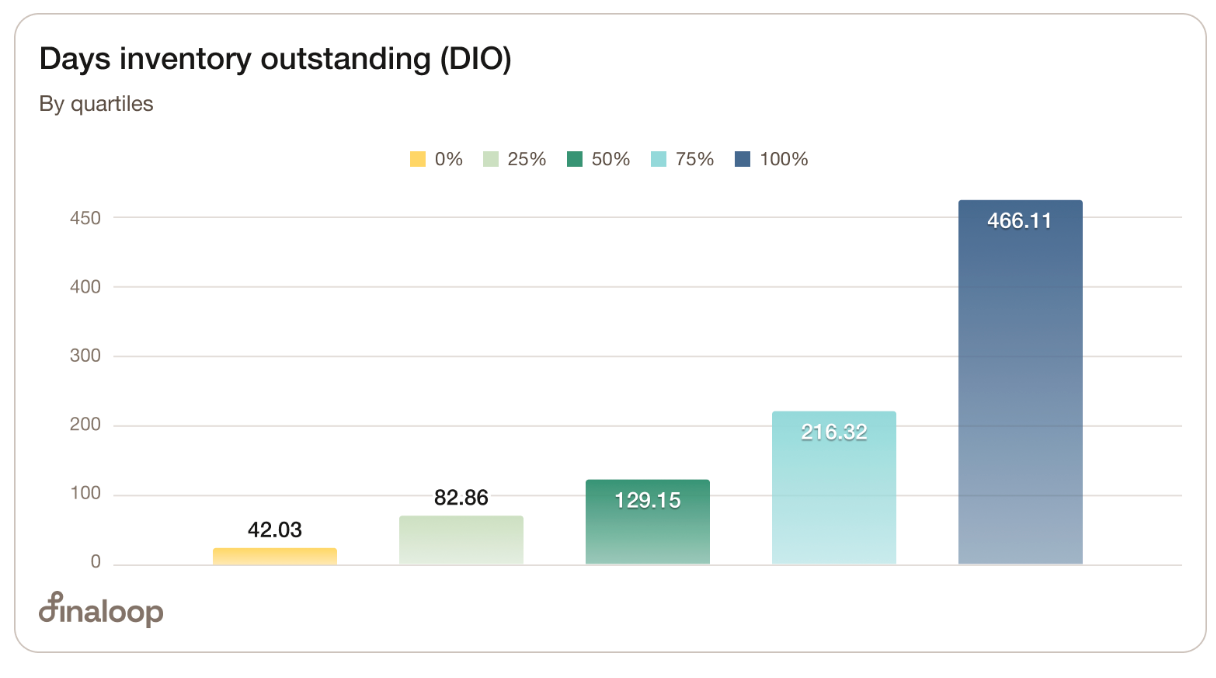
Hiring is a cash decision before it is an org-design decision. A physical-product brand pays for inventory 60 to 120-plus days before collecting the cash, with median days inventory outstanding near 129. Reach for the cheapest model that clears the bottleneck: software, then a freelancer, then an agency or fractional, then full-time. The first full-time hire is a generalist ecommerce or operations manager, not a "head of."
What is an ecommerce business?
An ecommerce business is a company that sells products or services through an online store, which helps founders reach paying customers without a retail lease.
Two models matter for a bootstrapped physical-product brand. Business-to-consumer (B2C) is selling direct to the buyer, the core DTC model, with higher margins and a shorter cash cycle. Business-to-business (B2B) is wholesale and distribution: lower margins, larger orders, longer payment terms, and net-30 or net-60 waits on money you have already spent on inventory.
Which one you pick sets your gross margin and your cash cycle before you make a single marketing decision. A DTC skincare brand running 60% to 80% gross margin and a food and beverage brand running 35% or lower are not the same business, and they cannot carry the same team at the same revenue.
Is ecommerce actually profitable?
Yes, but the number every guide quotes is gross margin, and gross margin does not pay anybody. Net margin does. The gap between the two is where most of the real answer lives.
A sustainable gross margin for ecommerce runs 60% to 70%, with the most profitable stores around 60% to 65% (TrueProfit, 5,000-plus active Shopify stores, January 2025 to February 2026).
Source: TrueProfit
Median DTC net margin in 2026 is 3% to 10%, while ad spend alone consumes 20% to 35% of revenue.
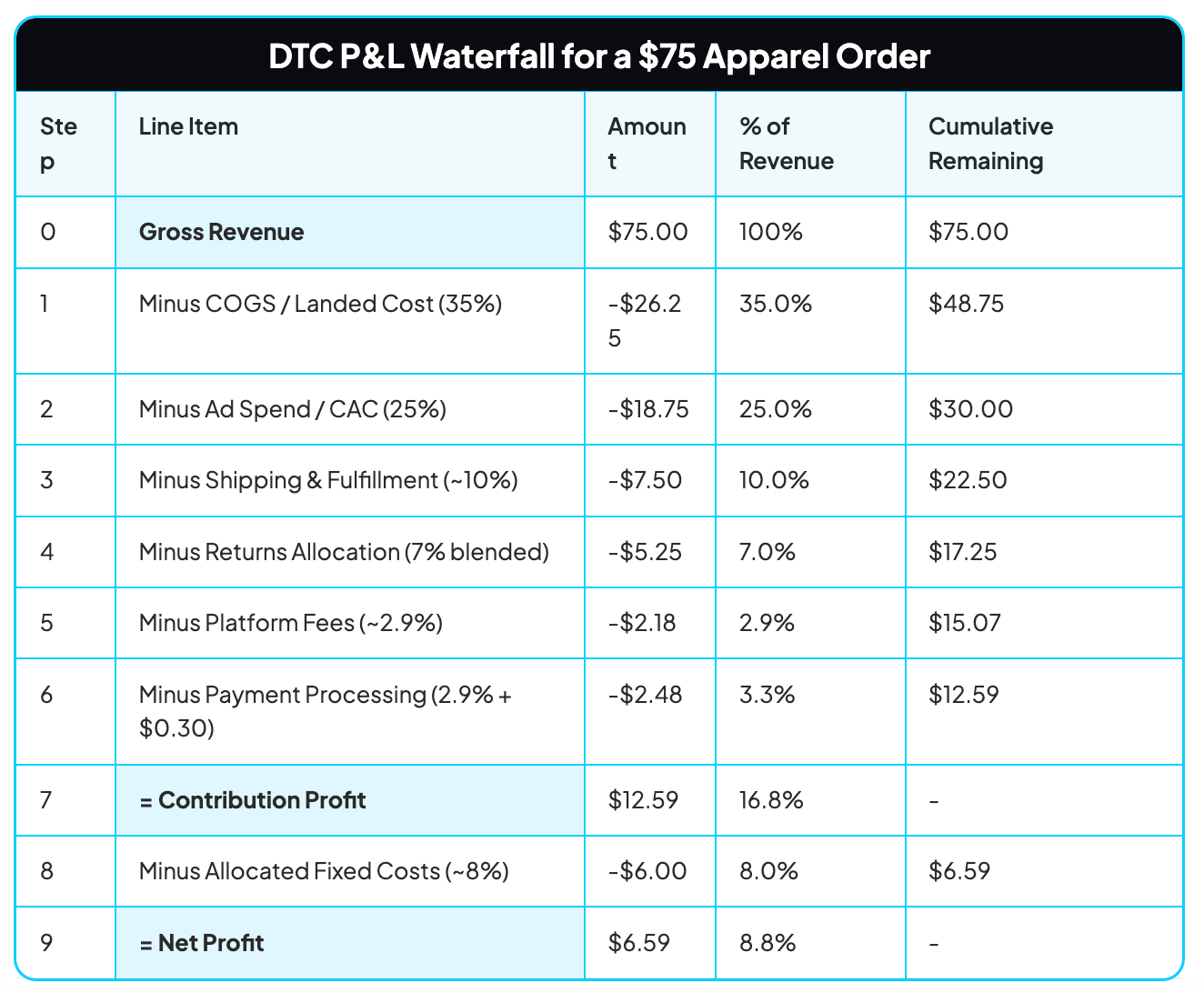
Luca's worked example: a $75 apparel order nets $6.59, or 8.8% after subtracting cost of goods at 35%, ad spend at 25%, shipping and returns at 17%, platform fees at 2.9%, and payment processing at 3.3%.
Source: Ask Luca
Business model
Typical gross margin
Typical net margin
What drives the gap
Dropshipping
65% to 70%
Around 17%
Mostly paid-traffic dependent. Little owned demand.
Print on demand
Around 61%
Around 16%
Low inventory risk, thinner unit economics
Private label / DTC
60% to 65%
3% to 10% median
Inventory cash plus ad spend at 20% to 35% of revenue
Amazon FBA private label
Varies by category
Roughly 15% to 30%
Referral and fulfillment fees take 25% to 40% before ad spend; 40% to 55% once ads and returns are counted
Benchmark to aim for
60% to 70%
10%-plus is strong
Below 60% gross, scaling gets tight
Sourced from TrueProfit, aggregated from 5,000-plus active Shopify stores, January 2025 to February 2026, with business-model rows from its August 30 to September 5, 2026 weekly refresh, and Luca, 2026.
Dropshipping shows the highest gross margin and one of the lowest net margins in the table, because most stores running it pay for nearly every visit. Shopify's own guide to organic dropshipping shows the model can run on SEO, organic social, and email instead. That takes sustained content and list-building work. High gross margin without owned demand is an ad account with a storefront attached.
How to start an ecommerce business in seven steps
Step 1. Validate the product before you build anything
Source products and order samples before you commit to a full run. Sample orders run $30 to $100, and a first meaningful private-label order runs $3k to $10k-plus before packaging, shipping, and duties.
Check three things before you commit: a demand signal (existing search volume, an active community, rising category penetration), the unit-level margin math before ad spend, and the disqualifier test. Any product that cannot carry at least 60% gross margin at your realistic landed cost fails it, however much you like it. Then sell to 20 people in your target audience who you are not related to, before you design packaging. Samples first, a real audience second, packaging last.
Step 2. Choose the business model
Cash and margin decide the model, not preference. The four ecommerce business models below differ mostly in how much cash they demand up front, which is the first thing an ecommerce business plan has to settle.
Dropshipping needs no inventory. A supplier ships directly to the customer, and gross margin runs 65% to 70% but compresses to around 17% net because most dropshippers buy nearly all of their traffic. Print on demand needs zero upfront capital, with the same thinner unit economics shown there.
Private label carries the highest ceiling but needs $3k to $10k-plus of inventory cash committed before the first dollar of revenue. Wholesale and B2B run lower margins on larger orders with longer payment terms.
Pick the model whose cash requirement matches what you have. That requirement sets your working capital cycle for the life of the business.
Step 3. Register the business and handle taxes
Per the SBA, a sole proprietorship is a reasonable choice for a low-risk business and for an owner testing an idea, and the choice is not permanent. You can convert to an LLC as revenue and personal liability grow, though that conversion can carry state restrictions and tax consequences.
An LLC separates business and personal liability, protecting personal assets in most instances, and is the common structure once there is real inventory and real revenue at stake.
Registration runs roughly $130 to $1,000 depending on the state, so confirm the exact fee with your state's filing office before you file.
Three more things apply here: an EIN, which the IRS requires once you hire employees, form a partnership or corporation, or pay sales and excise taxes; a general business license, required in most US cities and counties even for a home-based operation; and sales tax nexus, triggered by physical presence or by crossing a state economic threshold. This is not legal or tax advice.
Step 4. Pick the channel before the platform
Most advice on how to sell online starts with the platform. Reverse that order. The channel decision comes first because it sets your fee structure. The channel decision comes first because it sets your fee structure. The full Amazon FBA fee stack runs 40% to 55% of the sale price once fulfillment, storage, inbound placement, advertising, and returns are counted, against the 15% referral fee most sellers budget for. That is defensible for a product with existing Amazon search demand and punishing for a brand trying to build owned demand.
Hosted e-commerce platforms start around $29 to $39 a month on Shopify, depending on the billing cycle.
A marketplace listing costs almost nothing upfront. A custom ecommerce website with real functionality runs $5k to $20k, money a pre-revenue brand should not spend.
Step 5. Build the storefront
Buy a theme instead of building one. Four things affect conversion at launch. Product photography: a phone and daylight beat nothing, and a professional shoot runs $20 to $75 per finished packshot and $100 to $500 or more per on-model image. Product copy that answers the objection instead of describing the item. A checkout with no added friction. Mobile, because that is where the traffic is.
Founders spend weeks on the homepage, but almost no paying customer sees it before the product pages.
Step 6. Set up fulfillment
Self-fulfill your first hundred orders. That is how you learn where the cost and the complaints come from, before you hand the job to someone else. Then move to a 3PL, the first outsourcing decision the brand makes and the template for every one after; pay for a function before you can justify a headcount for it.
Cover shipping supplies, and set a returns policy before the first return arrives. In Luca's worked example, shipping and returns absorb 17% of a $75 apparel order.
Step 7. Get the first hundred customers
The founder does acquisition personally at this stage, and that is not a stopgap. Founder-led acquisition and support are how you learn what the customer values, which objections keep recurring, and where the messaging lands. That is market research no hire can reproduce.
Answer every support ticket yourself, write the first email marketing flows yourself, and read every review. New sellers commonly budget $300 to $1,500 a month on paid across Google Ads, Meta and TikTok. Some start at zero, building organic traffic through search engine optimization and social media marketing instead, but paid usually shortens time to first sale.
How much money do you need to start an ecommerce business?
Ecommerce startup costs break into three honest bands, and the table below splits the leanest one further. A bare marketplace listing or print-on-demand launch with no inventory at all can start as low as $0 to $500, while a lean dropshipping store with its own platform and domain name runs $500 to $2,000.
Add real inventory to a branded store, and the range moves to $3k to $8k. A full brand-led launch, with a meaningful inventory buy, design, and paid media, runs $10k to $50k-plus.
Software is usually under 15% of true first-year spend, against the inventory, design, and paid-media costs below.
Inventory and acquisition absorb almost all of a founder's real first-year spend, so optimizing app subscriptions is optimizing the wrong number.
The cash conversion cycle binds harder than the launch budget. A physical-product brand pays for inventory 60 to 120-plus days before it collects the cash from selling that inventory, and median days inventory outstanding is about 129 days, roughly 2.8 inventory turns a year.
Source: Finaloop
For example, a brand carrying $500k of inventory on a 90-day cycle has half a million dollars unavailable for three months.
Stage
Day range
Cash position
Purchase order placed, deposit paid
Day 0
Cash out, 30% of PO
Balance paid, goods ship
Day 30 to 45
Cash out, 70% of PO
Goods arrive at 3PL
Day 50 to 70
Cash fully committed
Median sell-through complete
Day 129
Cash returns
Payment processor settlement
Day 131 to 133
Cash available
Every hiring decision in the second half of this article is a cash decision before it is an org-design decision.
Launch type
Upfront
Monthly
Where the money goes
Marketplace/print on demand
$0 to $500
$0 to $100
Listing fees, samples. No inventory.
Lean dropshipping store
$500 to $2,000
$100 to $500
Platform, domain, a small test ad budget
Branded store with inventory
$3,000 to $8,000
$500 to $1,500
First inventory run, theme, photography, ads
Brand-led launch
$10,000 to $50,000-plus
$1,500 to $5,000-plus
Meaningful inventory buy, design, sustained paid media
Sourced from 2026 industry cost breakdowns, presented as ranges rather than a single average given inconsistent secondary aggregators.
Four costs land outside every budget band above, and they land early. Sample orders run $30 to $100 before you commit to a production run. State registration runs $130 to $1,000. Product photography runs up to about $300 per product if you hire out. Business insurance and accounting software are small monthly lines that nobody forecasts and everybody pays.
Who does the work before you hire anyone
A set of functions has to exist in some form for the business to operate at all; the list covers product sourcing and supplier management, brand and packaging, storefront, creative, paid acquisition, organic and SEO, email and SMS, support, fulfillment, inventory management and cash forecasting, bookkeeping, and compliance where the category demands it.
Who performs those functions, and through what engagement model, is the entire game. At launch, the honest answer for most is software or a freelancer, not a hire.
Function
Pre-launch
$0 to $250,000
$250,000 to $1M
Product and sourcing
Founder
Founder
Founder
Brand identity and packaging
Freelancer (project)
Freelancer
Freelancer or studio
Storefront build
Theme plus freelancer
Founder maintains
Freelance developer (project)
Photography and creative
Freelancer (project)
Freelancer plus UGC
Freelancer plus UGC creators
Paid acquisition
Founder
Founder or freelancer
Freelancer or boutique agency
Organic and SEO
Founder
Founder
Founder or freelancer
Email and SMS
App automation
App plus founder
Klaviyo freelancer or agency
Customer support
Founder
Founder plus helpdesk app
Offshore VA plus helpdesk
Fulfillment
Self-fulfill or 3PL
3PL
3PL
Inventory and cash forecast
Founder (spreadsheet)
Founder
Founder plus bookkeeper
Bookkeeping
Founder or freelancer
Freelance bookkeeper
Freelance bookkeeper
Compliance (regulated only)
Counsel (project)
Counsel as needed
Counsel plus testing labs
First full-time hire
None
None
Ecommerce or ops generalist
Sourced from Constant Hire, based on placement and search work.
Before the $250k threshold in the table above, only three things are worth real money: a freelance bookkeeper, a freelance designer or photographer who covers brand, packaging, and product images, and a 3PL. Everything else the founder does, or software does.
Regulated categories are the exception. Supplements, food and beverage, and cosmetics need episodic regulatory counsel and a contract manufacturer or testing lab from launch, since the FDA covers labeling claims and the FTC covers advertising claims, and both require prior substantiation.
A dedicated quality or regulatory hire can wait. Outside counsel handling label and claim review for a small product line runs $2k to $12k a year, and a substantiation file for a single claim runs $1.5k to $7.5k, cheap enough to outsource well past the first full-time generalist hire.
Which roles to fill first and which to defer
A role should open when a measurable bottleneck appears. Calendar timing and a competitor's org chart are poor substitutes for that signal. The diagnostic triggers are concrete key performance indicators (KPIs), support tickets per week, ad spend per month, orders per day, SKU count, channel count.
Ecommerce stores receive roughly 20 to 50 support tickets per 100 orders. Gorgias Ecom Lab data, measured at the $10M GMV band in March 2026, puts an electronics brand at about 46 per 100 orders against food and beverage at about 20. Gorgias notes nobody publishes a clean per-vertical table, so treat these as planning ratios rather than survey results.
Messy books distort margin and inventory decisions
Freelance designer/photographer
Pre-launch
Packaging, PDP images, ad creative needed
Spend before product-market fit
Amateur creative suppresses conversion
Paid media freelancer or agency
$0 to $500,000
Ad spend past $10,000 to $20,000 a month
Retainer eats budget before the offer is proven
ROAS decays unwatched, CAC climbs
Ecommerce or ops generalist (first FT hire)
$250,000 to $1M
Founder cannot run the site plus everything else
Salary before the P&L can carry it
Site operations and merchandising decay
First CX hire (specialist, not a "head of")
$2M to $5M
More than 200 to 400 tickets a week
A Head of CX answering tickets at $1M
CSAT and repeat rate fall, refunds rise
Dedicated retention owner (freelance, fractional, or agency)
$1M to $3M
Email and SMS stuck at 10% to 15% of revenue
Underused before there is traffic
20 to 30 points of revenue share unclaimed
Performance marketer (in-house)
$3M to $5M
Ad spend past $100,000 a month across multiple channels
Fixed cost before spend justifies it
Agency margin caps scaling, slow iteration
Ops/supply chain planner
$2M to $5M
Stockouts, overstock, cash trapped in inventory
Overhead before SKU complexity
Cash crises, missed sell-through
Fractional CFO
$5M to $25M
Cannot state your CAC ceiling or 13-week cash position
Advice before the books are clean
Cash surprises, bad inventory bets
Fractional COO
$3M to $5M-plus
Founder is the bottleneck across operations
Structure before there is anything to run
Execution stalls, founder burnout
Sourced from Constant Hire placement experience
The first ecommerce hire is a generalist ecommerce or operations manager, not a specialist and not a "head of." That hire becomes necessary when the founder can no longer run the site and daily operations alongside acquisition and product, usually between $250k and $1M in revenue, the band shown in the table above.
The roles brands defer too long, and the ones they hire too senior
Brands defer retention too long.
Omnisend, which sells the software that runs these flows, found in its 2026 ecommerce report that automated flows produce 30% of email revenue from 2% of sends, earning 16 times more per send than scheduled campaigns.
Someone has to build those flows. In Constant Hire's placement work, brands with no dedicated owner sit at 10% to 15% of revenue from email and SMS, against 30% to 45% for brands with one. Vendor benchmarks land in the same range: Klaviyo puts top performers at 30% to 40%, and Darkroom's P90 set at 38% to 45%. That leaves 20 to 30 points of revenue share unclaimed every quarter.
A dedicated owner is not the same thing as a full-time hire. Constant Hire's position is that a full-time retention marketer makes sense past $20M in annual revenue, or past $10M with a subscription component. Below that, a freelancer, a Klaviyo specialist, or a fractional retention lead covers the function at a fraction of the loaded cost. The mistake is not hiring too late. It is leaving the channel unowned by anyone.
Brands put off hiring a bookkeeper just as often. Founders run on a shoebox of receipts long after clean books would help.
Three hires regularly land too senior, too early, per Constant Hire's own placement work. They are a "head of" title before there is a team to head, a senior brand or creative director hired at $2M when a performance executor was needed, and a full-time CFO before there are clean books to use.
The title-to-scope mismatch costs more than the salary does. A senior operator hired to build a function ends up executing it alone, leaves, and Constant Hire has seen the resulting rebuild cost the brand 6 to 12 months.
Colin Hale, Recruiting & Client Services Manager at Constant Hire, describes this from direct experience. "In our own search work, the roles that stall most often are growth-leadership searches at brands between $5M and $20M where the brief blends acquisition, retention, conversion, and merchandising into a single title. The search is hard because the role is three jobs.”
Freelance, fractional, agency, or full-time?
The nature of the work determines the engagement model. Episodic, low-context work (a theme build, a photoshoot, a logo) belongs with a freelancer or an agency, while continuous, high-context, cross-functional, customer-facing work belongs in-house, spanning P&L, support, and inventory.
A fractional engagement costs a monthly retainer and nothing else. A full-time employee costs considerably more than base salary.
A full-time US employee costs roughly 25% to 35% over base salary once payroll taxes, benefits, and software are counted, based on Constant Hire placement data. The long-standing MIT benchmark from senior lecturer Joseph G. Hadzima Jr. puts the same figure at 1.25 to 1.4 times base salary.
Recruiting cost is the part founders leave out entirely. Filling a specialist ecommerce role carries internal time, vacancy loss, and mis-hire risk well beyond the job-board invoice, and an open seat runs roughly $500 a day. That multiplier does not apply to contractors, who cost their invoiced rate, which is why early-stage brands lean on them and why the table below does the math this way.
Function
Cheaper model below the threshold
The threshold that flips it
Cheaper model above
Paid media
Agency or freelancer (under $25,000 a month)
$25,000 a month brings creative in-house; $100,000 a month brings media in-house
Core hybrid, then in-house performance hire with agency on niche channels
Creative production
Freelancers plus UGC
Consistently needing 25 to 35 assets a month
In-house content lead
Customer support
Offshore VA plus helpdesk automation
1,500 to 2,500 tickets a month
In-house CX manager plus team
Site and store operations
Founder plus a Shopify freelancer
Founder can no longer run the site daily, roughly $250,000 to $1M
Full-time ecommerce manager
Finance
Bookkeeper plus spreadsheet
Clean books but no CAC ceiling or cash forecast, roughly $2M to $5M
Fractional CFO
Finance (full-time)
Fractional CFO
Roughly $20M to $30M in revenue
Full-time controller or CFO
Sourced from Constant Hire, using Hadzima's loaded-cost math.
A boutique agency at $8k a month costs $96k a year. A full-time performance marketer on a $110k base costs roughly $143k loaded.
The switch happens in two steps, not one. Under $25,000 a month in spend, outsource the whole function and keep the cash in inventory. Between $25,000 and $100,000, run a hybrid: bring creative in-house, because creative fatigue is the bottleneck at that volume, and keep the agency on media buying and tracking. Past $100,000 a month, percentage-of-spend fees at 10% to 20% start exceeding the loaded salary and bringing media in-house pays.
One warning on contractors
A founder who keeps a "freelancer" on continuous, directed, full-time work on core brand activity is creating a misclassification liability, and the contract label does not protect them.
Three tests can apply. They are the IRS common-law test, the Department of Labor's economic-reality test, which a February 2026 proposed rule would rebuild around control and opportunity for profit or loss, and a state ABC test, strictest in California. The Department no longer applies the 2024 rule in its own investigations, but the 2024 rule still governs private litigation, so the underlying exposure has not gone away.
Move a contractor to W-2 once the facts of the relationship point that way, and treat continuous full-time work on core activity as one of those facts. This is not legal advice, and the federal posture has been shifting.
What changes when you cross $1M
Below $1M, the team is the founder plus one or two contractors. Crossing $1M moves a brand to three to five full-time people plus one or two contractors, covering conversion, acquisition, and operations. At $5M to $15M it is 8 to 15 with channel-specific leads, and past $15M it is 15 to 30-plus across departments (Constant Hire, 2026).
The lag signal at $1M to $5M is not headcount. It is contribution margin compressing while revenue grows, which means nobody owns on-site conversion or operational cost control. Freeze hiring and audit for work a contractor or automation could absorb before adding a salary against it. Org shape, reporting lines, and function mapping past $3M live in ecommerce team structure.
The hiring question underneath every threshold in this article is the same one: can contribution margin after ad spend and fulfillment carry a fixed salary without starving the next inventory buy? If the answer is no, the next move is a contractor or a fractional engagement, not a hire. A software company that adds a salary spends that salary. A physical-product company spends it on top of the cash already locked inside inventory.
Constant Hire places pre-vetted ecommerce and DTC operators, including paid media leads, lifecycle marketers, and ecommerce managers, with first interviews inside five business days. When the trigger for your first real hire fires, that is the search we run.
FAQs
How much money do I need to start an ecommerce business?
A bare marketplace listing or print-on-demand launch runs $0 to $500. A lean dropshipping store runs $500 to $2,000. Stocking a branded store puts you at $3k to $8k, while a full brand-led launch with paid media reaches $10k to $50k-plus. Inventory and acquisition absorb most of a founder's real first-year spend.
Do I need an LLC for an ecommerce business?
Not to start. Per the SBA, a sole proprietorship suits a low-risk business and an owner testing an idea, and the choice is not permanent. An LLC separates personal and business liability and is worth forming once you hold real inventory or real revenue. Registration runs roughly $130 to $1,000 by state. This is not legal advice.
Who should be the first hire at an ecommerce business?
A generalist ecommerce or operations manager fills that role, not a specialist or a "head of" title. The trigger is the founder no longer being able to run the site and daily operations alongside acquisition and product, usually between $250k and $1M in revenue. Before that, a 3PL, a freelance bookkeeper, and a freelance designer cover more ground per dollar.
How long does it take to make money with an ecommerce business?
Longer than the revenue suggests. A physical-product brand pays for inventory 60 to 120-plus days before it collects the cash from selling it, and median days inventory outstanding sits near 129 days. That means the cash from your first inventory buy typically returns in month four or five, not month one. Roughly 60% of Shopify stores earn under $1,000 a month, so a founder should plan to fund the first two inventory cycles without taking a wage.
Should I hire a freelancer or an agency for my first ecommerce marketing help?
Run the break-even before you choose. Under roughly $75,000 a month in ad spend, an agency or freelancer wins on cash and carries no ramp or severance risk. Above $75,000 to $100,000 across multiple channels, a percentage-of-spend arrangement starts exceeding a loaded in-house salary and bringing media in-house begins to pay. For creative, the flip sits near 25 to 35 assets a month. Below those thresholds, the freelancer is not a compromise. It is the correct answer.
Can I start an ecommerce business while working full time?
Yes, with one constraint that decides whether it works. Fulfillment goes to a 3PL, support runs on a helpdesk with good macros, and email runs on app automation. What cannot be delegated cheaply is founder-led acquisition and customer contact, because that is how you learn which objections recur and where the messaging lands. If you cannot personally answer support tickets and read every review in the first hundred orders, the validation loop does not close and no amount of software substitutes for it.
Connor Gross founded Constant Hire in 2024. An operator turned founder with deep experience building and scaling e-commerce brands. He previously sold an Amazon brand and generated over $30M in DTC revenue through private-label Shopify businesses. He now helps fast-growing DTC brands and agencies hire top talent across marketing, creative, ops, and sales. From E‑com Managers to TikTok Creators and Heads of Growth, he knows what great looks like, and how to recruit it.