Ecommerce product photography is the production of standardized, marketplace-compliant product images that helps online brands convert traffic and reduce returns caused by inaccurate visual representation.
In Baymard Institute's product page usability testing, exploring the product images was the first action for 56% of test subjects, ahead of the title or the description. An inaccurate image can still win the sale. The margin goes back out the door when the product does.Salsify's 2025 consumer research puts it at 71% of shoppers who have returned an item because it did not match the online listing. The National Retail Federation estimates the 2025 US ecommerce return rate at 19.3%, against $849.9 billion in total returned merchandise.
Photography moves your margin, for better or worse. It drives conversion rates, then decides, through return rates, whether the sale holds.
This piece is written for the person approving the budget and making the hire, not the person holding the camera. It covers the assets a DTC catalog needs, what they cost, what a real production workflow looks like, who runs the work, which delivery model fits your SKU volume, and how to screen a photographer before you pay one.
Key Takeaways
Price the asset set, not the photoshoot. A single SKU needs four to six finished images before variants: a marketplace packshot, detail shots, packaging shots, and usually a lifestyle frame. Quoting per product photo understates the real bill by four to six times, so a 100-SKU launch at $50 a shot costs $20,000 to $30,000 rather than $5,000.
The delivery model sets the cost, not the vendor. Product photography for ecommerce runs $20 to $75 per finished packshot and $100 to $500 or more per on-model image. Under 50 SKUs a year, an online store should stay freelance or DIY. Most ecommerce brands between 200 and 1,500 SKUs run hybrid, capturing in-house and outsourcing retouching at $0.70 to $3.00 per image.
Ecommerce photography is five jobs, not one hire. Producer, lead photographer, digital technician, retoucher, and stylist. Brands almost always ask for one generalist photographer who also covers design, then an ecommerce store's catalog drifts out of the brand's aesthetic because nobody owned color accuracy on set in real time.
AI does not replace the main listing product photo. It generates secondary and social media variants from a real studio packshot, so the capture still has to happen. Article 50 of the EU AI Act requires machine-readable markers on generated images from August 2, 2026, which moves the hire toward accurate source capture and metadata discipline.
What is ecommerce product photography?
General product photography optimizes one image for impact. Ecommerce product photography optimizes a repeatable system. Every image has to match every other image in the catalog, match the physical product, and satisfy the platform hosting it.
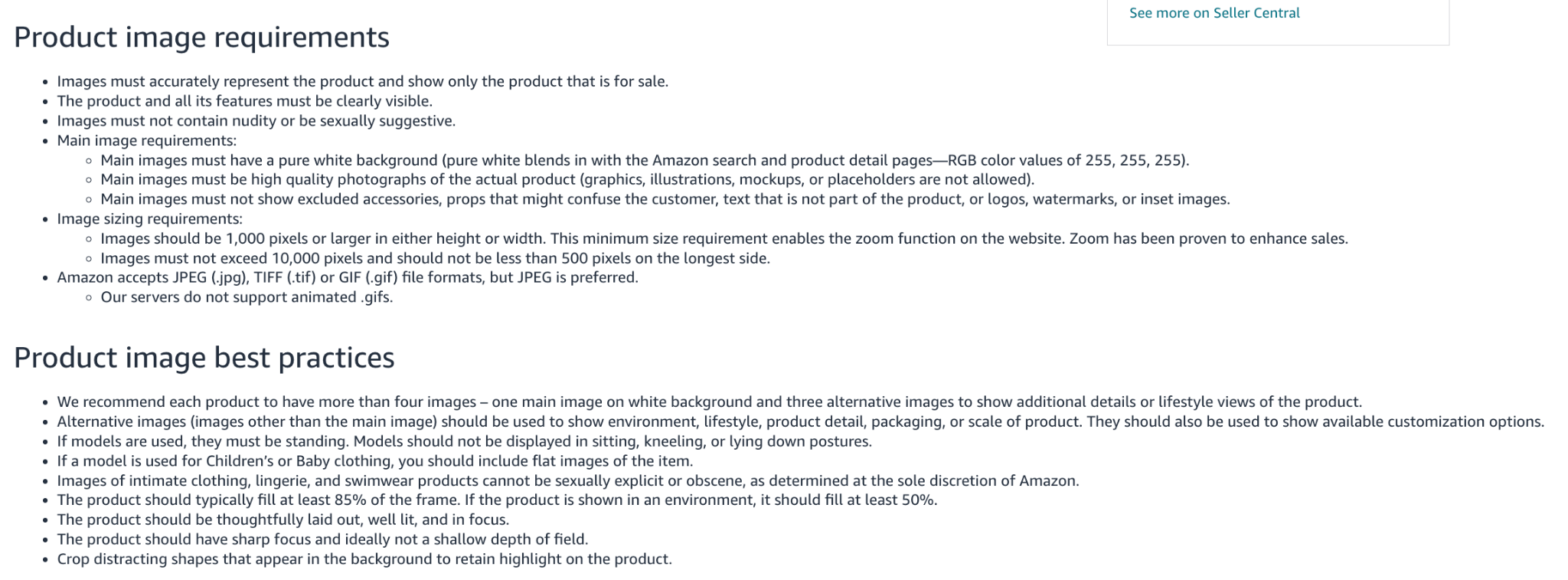
That system requirement is a specification, and Amazon's is exact. Main images need a pure white background at RGB 255,255,255, the product filling at least 85% of the frame, no text, logos, or watermarks, and a minimum of 1,000 pixels on the longest side so the image can zoom.
Miss any of it, and Amazon suppresses the listing. A photographer friend with a nice camera can shoot one great photo, but matching that specification across 300 SKUs, every quarter, is a different job entirely.
What a brand is buying comes down to three things: consistency across the catalog, accuracy against the physical product, and throughput measured in SKUs per day.
The five asset types a DTC catalog needs
Most brands price this by the shoot. The cost that matters is the asset set, and it runs bigger than the budget almost every time.
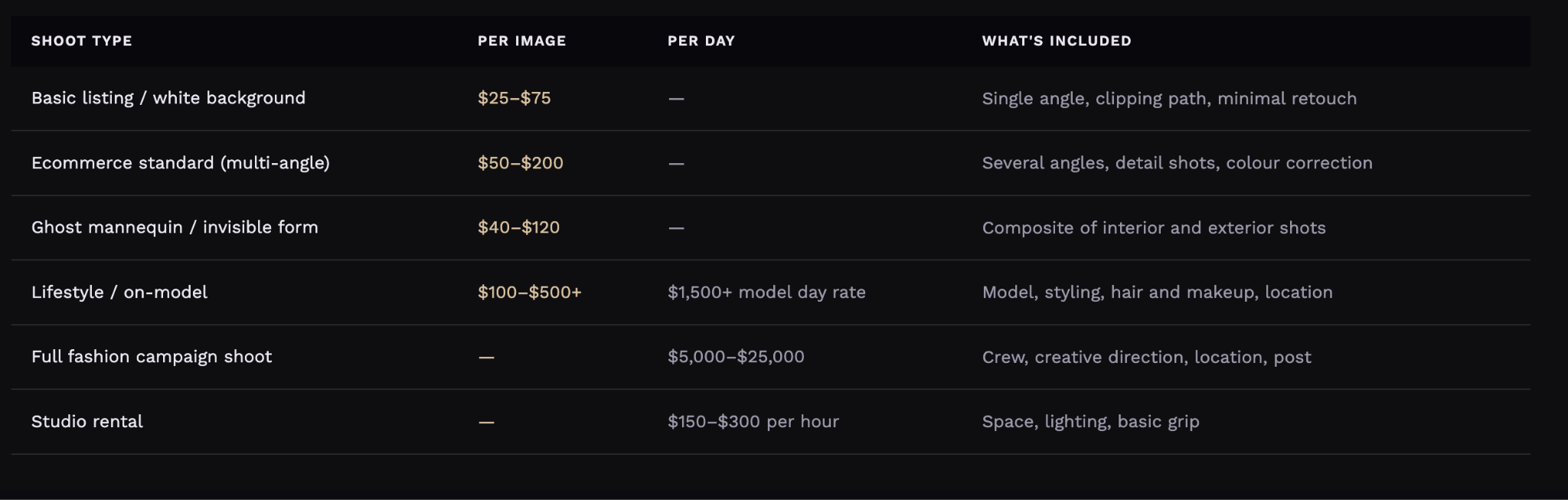
A single SKU needs a packshot for the marketplace listing, a second angle, a detail crop with something in frame for scale, and usually a lifestyle frame. That is four to six finished images before a single color or size variant. Multiply that by the SKU count in a real catalog, and the number you had in your head turns out to be a fraction of the real bill.
Source: Cost ranges compiled from published studio and retouching pricing (Squareshot, 2026; RemoveClothing, 2026; Prodofoto, 2026). These are vendor-published rates, presented here as market ranges, not independent benchmarks.
Not every asset earns its cost at every stage. Packshots are non-negotiable from day one. A 360 spin rarely earns its cost below $5M in revenue. Below that, product page traffic is usually too thin to recover $80 to $250 a sequence.
Scale is one of the cheapest problems you can fix, and one of the most commonly ignored. 42% of shoppers try to judge a product's size from its images, while 28% of sites give them nothing to judge it against: no hand, no coin, no ruler in frame, nothing to anchor the eye. A missing scale cue is the same class of product page gap a conversion owner is hired to find.
An in-scale image can cost the same as a standard packshot when it just adds a coin or a hand for reference, though cost rises if it calls for a model, set, or location. Skip it, and the saving comes back as a return.
Product photography pricing swings this widely because the delivery model sets the number, and vendor choice has less effect than most brands assume.
Brands get this wrong two ways. The first is quoting per image without counting assets per SKU. A packshot at $50 sounds affordable until you multiply the full asset set across every SKU.
A hundred-SKU launch quoted at $50 a shot looks like $5,000. Counted across the full asset set, it is $20,000 to $30,000.
Outsourced retouching runs roughly $0.70 to $3.00 per image, per Path Edits' retouching cost guide, against a US retoucher day rate of $400 to $800. On a 500-SKU catalog at five images each, that is $1,750 to $7,500 in post alone.
Budget for the line items nobody quotes up front, too. Sample shipping to an outsourced studio adds $15 to $30 or more per item for anything fragile or oversized. Reshoot fees appear when a color mismatch cannot be fixed inside the included revision round. Review cycles with an external partner routinely stretch turnaround to one to four weeks.
Every range above assumes a single delivery model. The bigger lever on cost is which one you run: in-house, outsourced, hybrid, or automated. The delivery model section below breaks down all four.
What a real production workflow looks like
Use this as an audit tool for evaluating a hire. You're not going to run this workflow yourself. You're going to ask a candidate to describe theirs, and a photographer who can't answer at this level of detail is a risk before you've paid them a dollar.
This sequence, pre-production through export, is the same shape Shopify's own photography workflow guidance recommends, and it's the shape a competent hire should already have internalized.
Pre-production. A SKU-level shot list tied to the product catalog, samples cataloged and prepped, garments steamed, glass and electronics wiped down before they ever reach the set. Dust and creases are a post-production cost you pay twice, once in editing time and once in turnaround. Prep is a budget line.
Tethered capture. Shooting straight into software on a color-calibrated monitor, checking exposure and sharpness at full crop while the sample is still on set. A problem caught here costs nothing. The same problem caught after the sample has already shipped back to the brand costs a full reshoot cycle.
Post-production. Exposure harmonization, clipping paths, color matching against physical swatches, shadow work, and cataloging with metadata, SKU identifiers, and alt text. This is where the raw capture becomes a file you can publish.
Export. sRGB color space, 2,000 to 3,000 pixels on the longest edge to support zoom, compressed enough that page load speed doesn't take the hit. A technically gorgeous 40MB file is still a file nobody should publish.
Natural light holds up for the first fifty SKUs. Then it stops. Window light shifts through the day and across the seasons, so a batch shot in March and a batch shot in July won't match, even with the exact same camera and the exact same product.
The point is not which settings, it is that they are written down. Lock focal length, aperture, ISO, light-to-fill ratio, camera height, and white balance reference into a style guide, then standardize the Lightroom or Capture One presets. A different photographer should be able to reproduce the catalog look next quarter from the document alone.
Studio setup and equipment by stage
Product photography equipment decisions start with matching the setup level to the catalog. Camera body choice comes second.
Component
Starter setup
Professional studio
Automated facility
Camera
High-end smartphone or APS-C mirrorless
Full-frame DSLR or mirrorless, 24–50MP, tethering
Integrated high-resolution camera in an automated rig
Lens
Kit zoom or 50mm prime
24–70mm zoom plus 100mm macro
Calibrated integrated zoom, motorized
Lighting
Diffused window light, foam core reflectors
Three to five studio strobes with modifiers, consistent 5500K
Source: Compiled from published equipment and studio setup guidance (LenFlash; Format, 2026). Presented as illustrative tiers for comparison.
Going from a bootstrap setup to a professional one is roughly a tenfold jump in capital, from $150 to $800 up to $5,000 to $15,000. That jump matters more than any single line item in the table. It only pays back above a certain SKU volume; below that, it's dead weight. The delivery model section below maps that threshold directionally by SKU volume.
The studio manager or photo producer owns scheduling, sample logistics, budget, and booking. Skip this role and shoot days slip. Samples go missing, and nobody notices until the shot list is already behind. It only becomes worth a dedicated hire once real throughput targets exist, well past the point of an occasional seasonal shoot.
The lead photographer owns lighting, framing, and exposure, and just as important, owns consistency against every shoot that came before. This is the first hire almost every brand makes, and usually the only one they think they need.
Tethered capture, color accuracy, file naming, and backups fall to the digital technician. This is the role skipped most often, and the most common source of catalog drift. A hero shot from last quarter doesn't quite match this quarter's, for reasons nobody on the team can point to, because nobody was checking color profiles in real time.
The retoucher or image editor owns clipping paths, color correction, color matching, and export. Outsourcing this one is usually the easy call, since the work is repeatable and specifiable enough that nobody needs to be standing on set to do it.
The product or wardrobe stylist owns sample prep, steaming, pinning, and set composition. Adding this role is frequently the cheapest quality gain available, because a prep failure on set becomes a retouching bill later.
Role
Freelance day rate
Hourly
Full-time salary
Owns
Studio manager/producer
$750–$1,200
$50–$100
$80,000–$130,000
Scheduling, SKU logistics, budget, booking
Lead photographer
$500–$3,000
$150–$350
$55,000–$95,000
Lighting, framing, exposure, catalog consistency
Digital technician
$500–$750 plus gear fee
$40–$75
$50,000–$75,000
Tethered capture, color accuracy, file naming, backups
Retoucher/image editor
$400–$800
$30–$150 (or $0.69–$3.00 per image)
$45,000–$70,000
Clipping paths, color matching, compositing, export
Product/wardrobe stylist
$600–$1,000
$50–$100
$50,000–$85,000
Sample prep, steaming, pinning, set composition
Commercial model
$400–$1,600
$50–$150 plus 15–20% agency
Per booking
Fit demonstration, scale, lifestyle context
Source: Rate ranges compiled from published market sources (Squareshot, 2026; Clippingworld, 2026; Path Edits, 2026). National wage context, US Bureau of Labor Statistics, photographers overall, 2025.
A commercial model is a per-shoot cost rather than a production role, which is why the table runs to six rows and the roles above stop at five.
The realistic first two hires for a growing DTC brand are a lead photographer and an outsourced retouching partner. The digital technician and producer arrive later, once SKU volume makes coordination the bottleneck instead of the shot count. That sequencing follows the same pattern as the rest of an ecommerce team structure, where coordination roles arrive after the doers.
Almost every brand that comes to us asks for the same hire. They want one person who can shoot, edit, and handle the design side, and they usually describe it as a photographer who understands design rather than a specialist in either one.
That request fits the stage most brands are at when they make it, and it holds until the catalog outgrows what one person can get through in a day. What almost nobody asks for is the digital technician or the producer. Those are the two roles whose absence shows up later as catalog drift and slipped shoot days. The distance between the hire brands ask for and the roles their SKU count needs is the most common mistake we see in this category. Pay bands for the adjacent production roles, art director through video editor, sit in our DTC creative team compensation data.
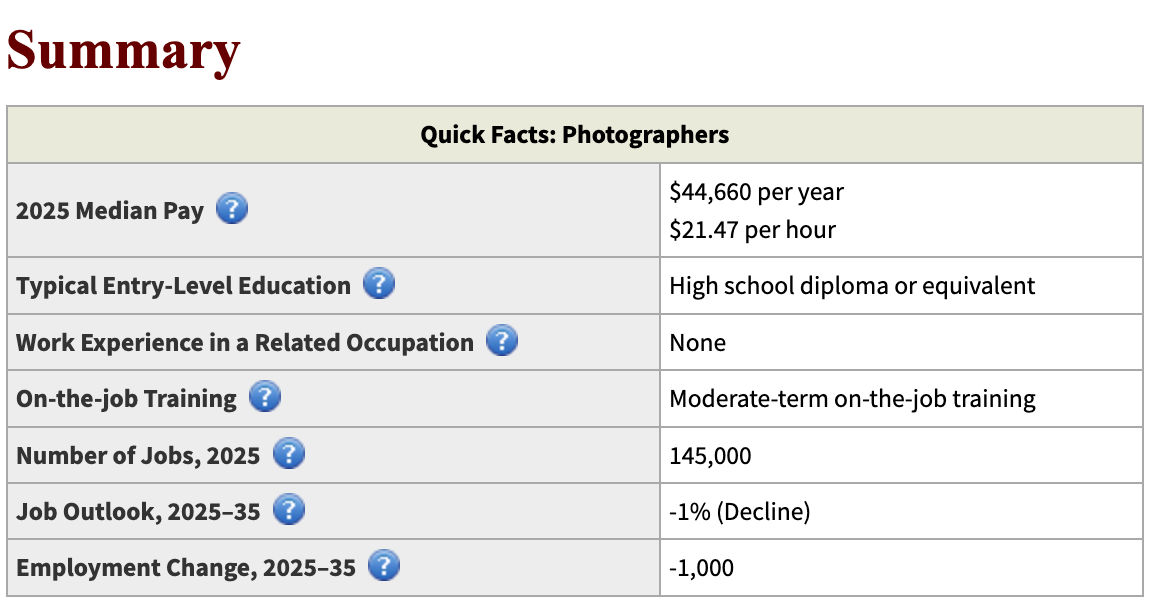
BLS reports the median wage for photographers overall at $44,660 a year, or $21.47 an hour, as of May 2025, drawn from wage data that excludes the self-employed. The top 10% earned more than $44.14 an hour. A quote for commercial ecommerce work can reach four figures a day, so the two numbers look like they describe different jobs. They do. The BLS figure blends every kind of photography: weddings, portraits, photojournalism.
Commercial ecommerce work sits well above the median, because tethered workflow, color management, and SKU throughput take a specialized skill set most photographers never need.
In-house, outsourced, hybrid, or automated
The right model is set by annual SKU volume and refresh cadence, not by budget preference or creative ambition. Buying product photography services and building the capability in-house are the same decision viewed from two ends.
An in-house studio gives full control, immediate reshoots, and brand cohesion. It runs into trouble on fixed overhead. Squareshot puts a commercial studio lease in a major market like New York at $3,800 to $6,000 a month, and that bill runs whether or not anyone shoots that week.
A fully outsourced studio turns a fixed cost into a variable one, which works well for stable or seasonal collections. The tradeoff shows up in unit cost at scale, $50 to $250 or more per image, plus sample shipping and a turnaround that can stretch one to four weeks.
Capture stays in-house under a hybrid model, while retouching goes to an outside partner. Some brands staff that post-production layer offshore, which is a different sourcing problem than a US studio hire. It's the model most $2M to $30M brands should be running. Outsourced post-production runs $0.70 to $3.00 per image, with turnaround at typical retouching partners at 24 to 48 hours, faster for a rush fee. What breaks it is internal prep discipline and file handoff, two things teams underbudget until a batch comes back wrong.
That matches what we see at intake. The $2M to $30M brands we work with are already running some version of hybrid, capturing in-house and sending post-production out, and the role they come to us to fill reflects it. They want someone who can run capture, cover the design work around it, and manage an outside retouching partner without supervision. The job description is closer to a hybrid operator than a studio photographer, which is worth knowing before you write the req
An automated studio runs on hardware rigs costing $20,000 to $60,000 or more. Orbitvu, which builds automated capture rigs, documents throughput above 100 SKUs a day on its own systems. That kind of throughput makes same-day publishing possible.
It only pays for itself above roughly 1,000 SKUs a year, and even then it only produces packshots, leaving campaign work and product videos to people. Upfront capital and machine maintenance are what you pay for the speed.
Dimension
DIY / bootstrap
Fully outsourced
Hybrid
Automated
SKU volume fit
1–50 per year
50–500 per year
200–1,500 per year
1,000+ per year
Cost per finished asset
$5–$15 in labor
$50–$200
$15–$40
$5–$20 amortized
Upfront capital
$150–$1,500
$0, variable fee
$3,000–$8,000
$20,000–$60,000+
Turnaround
Depends on the founder's own schedule
One to four weeks
Two to four days
Same-day
Main failure mode
Inconsistent lighting, manual editing
Sample shipping, reshoot fees
Internal prep quality, file handoff
Capital cost, maintenance
Source: Compiled from published operational cost data (AdForge, 2026; RemoveClothing, 2026; Orbitvu). SKU thresholds are directional guides for early scoping decisions.
Match the model to your SKU count. Under 50 SKUs a year, go freelance or DIY. Between 50 and 500, outsourced or an early hybrid setup fits. From 200 to 1,500 SKUs, hybrid is the right call. Past 1,000 SKUs a year with real turnover, automated finally earns its keep. Lifestyle and campaign work stays with people at every volume, since automation only ever covers packshots.
Can AI replace ecommerce product photography?
No, not for your main listing images, and the reason is now regulatory as much as it's technical. AI does real work on secondary and social variants generated from a real packshot. The packshot still has to exist first.
The physical capture still has to happen, even in an AI-first pipeline. Tools that generate lifestyle scenes and model variants for $1 to $5 per image work by ingesting a real studio packshot as their starting point. Take the packshot away, and there's no accurate product left to build from, so the shoot never disappears. It just shrinks. For social variants specifically, most brands buy phone-shot content from UGC creators rather than studio time.
Amazon's main image spec, already covered above, requires a realistic representation of the product on pure white filling 85% of the frame. It does not address AI as a method, which means a synthetic main image is judged on whether it depicts the actual product, not on how it was made.
Google explicitly permits AI-generated or AI-edited main images, tagged with the required source metadata, but the same accuracy rule still applies underneath: the image has to represent the actual product being sold. A synthetic image that changes what the product looks like risks rejection on either platform, tagged or not.
Article 50 of the EU AI Act, effective August 2, 2026, requires AI-generated or manipulated image content to carry a machine-readable, detectable marker, with non-compliance carrying fines up to 15 million euros or 3% of worldwide annual turnover. Content generated before that date needs no retroactive labeling, and enforcement sits with national market surveillance authorities.
Brands selling into the EU now need provenance metadata built into the asset pipeline. That is a workflow and DAM requirement, which means somebody owns it. It is not a settings toggle.
In the US, the FTC treats a materially misleading product image as a deceptive act or practice regardless of how it was produced.
The federal numbers already reflect the shift. BLS projects photographer employment to decline 1% from 2025 to 2035, and it names AI-generated images as one of the reasons, with stock photography as the category most exposed. It still expects about 10,700 openings a year over that decade, nearly all of them replacing people who leave the occupation rather than filling new roles.
That decline lands on the categories AI can substitute for. Stock and general photography take the hit. Accurate source capture for a specific catalog is a different job, and the compliance rules above are what make it harder to skip.
The hire doesn't go away. What changes is the exact skill set you're now hiring for: producing accurate source captures and keeping provenance and metadata straight, a digital technician and producer skill set. It was never a camera skill set to begin with.
How to evaluate a photographer before you hire
A portfolio shows the best work by definition, and a polished one hides exactly the failures that become costly at catalog scale. Evaluate technical execution instead.
Color consistency across a multi-color range. Pull one product in several colorways and check that hue and brightness hold steady across every frame. Drift means the lighting wasn't controlled.
Reflective and difficult surfaces. Look at glass, chrome, gloss cosmetics, or polished metal. You want clean specular lines, no blown-out highlights, and no studio reflections visible in the surface itself.
Geometry. Straight edges on boxes, bottles, and shoe soles should stay straight. Bowed lines mean a wide lens, and a wide lens misrepresents the product's proportions.
Clipping quality. Zoom into a deep-etched packshot at full size and study the edges. Jagged pixels, color fringing, or lost detail on hair and fabric all point to rushed masking.
The strongest screen available is a paid test shoot. Send three deliberately difficult items: something reflective and cylindrical, like a glass bottle with chrome detailing, a saturated textile in a hard color such as deep red or dense navy, and something symmetrical and structured, like a pair of shoes.
Pay for it. A free sample lets the photographer choose the product, the lighting, and the deadline.
The images are only part of what you are evaluating. Watch the questions a candidate asks about your style guide, delivery specs, and file naming before the shoot starts. Watch how organized they are on set, and whether the files arrive ready to publish or need a second round.
LenFlash's guidance on choosing an ecommerce photography studio ranks the same execution details above portfolio polish: category experience, retailer-spec knowledge, and turnaround reliability. The questions asked up front are the single best predictor of whether someone has run a catalog before.
A portfolio proves someone can take one great photo. It doesn't prove they can do it the same way three hundred times in a row, on a deadline, without you catching the difference. That's what the paid test settles, and it's the difference between a hire who fits your next shoot and one who fits the next two years of your catalog. Creative hiring has the identical problem, and the fix is the same: a paid test beats a polished portfolio.
What this means for your next hire
Ecommerce photography splits into five separate jobs. Treating it as a single hire is why brands either overpay for an all-purpose photographer or under budget for the real asset set their catalog needs.
The fix is matching the right delivery model and the right roles to actual SKU volume, then hiring for the specific gap that is costing money. Sometimes that is a digital technician stopping catalog drift. Sometimes it is a producer keeping shoots on schedule.
Constant Hire specializes in ecommerce and DTC recruitment, with a proprietary database of pre-vetted operators built for these exact roles. Constant Hire also delivers a first vetted candidate interview in 5 days.
FAQs
What is ecommerce product photography?
Ecommerce product photography is the production of standardized, marketplace-compliant product images that helps online brands convert traffic and reduce returns caused by inaccurate visual representation. It differs from general product photography by optimizing for repeatability across an entire catalog rather than a single shot, and by meeting the exact specifications each selling platform requires.
How much does it cost to have an ecommerce product photographed?
Professional packshots run $20 to $75 per finished image, rising to $100 to $500 or more for on-model lifestyle work. Base your budget on the full asset set per SKU. Most SKUs need four to six finished photos, so the true per-SKU cost runs four to six times the per-image figure most brands have in mind.
How much do ecommerce photographers make?
The Bureau of Labor Statistics puts the median wage for photographers overall at $44,660 a year, or $21.47 an hour, as of May 2025. Commercial ecommerce work pays well above that median, with freelance day rates from $500 to $3,000 and full-time studio salaries in the $55,000 to $95,000 range. The gap reflects the tethered workflow and color management the commercial job requires.
What equipment do I need for ecommerce product photography?
It depends on your stage rather than a fixed shopping list. A starter setup runs $150 to $800, while a professional studio runs $5,000 to $15,000 and adds strobes, tethering, and color calibration. Use this to check what a quoted setup includes rather than as a shopping list.
What is the 20 60 20 rule in photography?
It's a compositional guideline for splitting a frame into roughly 20% foreground, 60% subject, and 20% background so the shot feels balanced. It's a general photography habit unrelated to ecommerce budgeting or hiring decisions.
Connor Gross founded Constant Hire in 2024. An operator turned founder with deep experience building and scaling e-commerce brands. He previously sold an Amazon brand and generated over $30M in DTC revenue through private-label Shopify businesses. He now helps fast-growing DTC brands and agencies hire top talent across marketing, creative, ops, and sales. From E‑com Managers to TikTok Creators and Heads of Growth, he knows what great looks like, and how to recruit it.