A decision framework
Performance Marketing Agency vs In-House Hire for Ecommerce
Agency or in-house for your ecommerce brand? A neutral, spend-stage guide to agency costs, pricing models, and the exact point an in-house hire wins.

Connor Gross
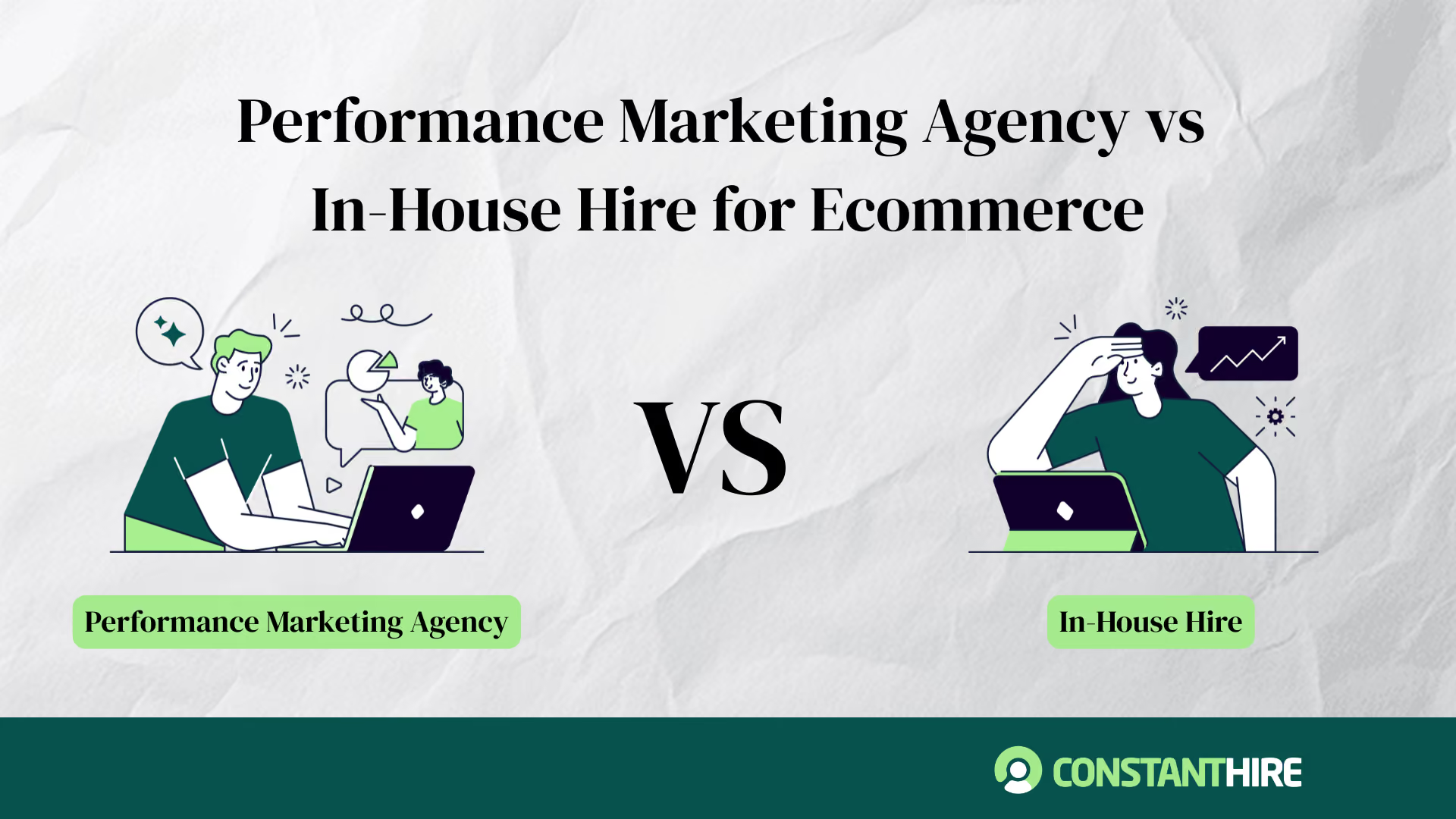
A performance marketing agency is an external team that plans, runs, and optimizes paid media and performance creative for a brand, so ecommerce operators can acquire customers profitably without building the full function in-house. Whether you should hire one or build the same capability internally is not a values question, and neither model is universally right. The correct answer is set by your monthly ad spend.
The work itself has changed. Meta Advantage+ and Google Performance Max now absorb most of the manual bidding and targeting that used to fill a media buyer's day, which moved the real job toward creative volume, clean attribution, and funnel work on the store side. That shift changes the math of building versus buying. The expensive part of the function is now the creative engine and the data behind it, not a person clicking around an ad account.
This guide answers the question with one tool, the Ad Spend Staircase, which ties the right operating model to a spend band rather than to preference or headcount ambition. Use it to find the step you are on, then read the cost math for that step before you sign a retainer or open a req.
A performance marketing agency runs the paid acquisition function for a brand and reports against outcomes like conversion rate, CAC, and contribution margin, not against activity. Scope varies by shop. Some are full digital strategy firms that also handle SEO, content marketing, email marketing, brand strategy, and web design; others focus only on paid media. Unlike traditional advertising, where a brand buys reach and hopes, performance marketing ties every dollar to a tracked action, which is what makes the build-versus-buy math possible in the first place. For an ecommerce brand, four functions do most of the work.
The first is paid media buying and account structure across advertising platforms like Meta, Google, and TikTok, plus retail media on Amazon and Walmart. This covers paid search and paid social, and increasingly affiliate and influencer marketing as niche channels.
The second is performance creative, the primary lever now that bidding is automated. Winning ads, not clever bid caps, drive scale, so a strong agency builds a testing pipeline for hooks, formats, and offers rather than shipping a monthly batch.
The third is analytics, attribution, and conversion work, including conversion rate optimization on product and checkout pages. This is where clean attribution separates real ROAS from platform-reported numbers.
The fourth is landing page and funnel optimization, the store-side work that decides whether paid traffic converts. Agencies with lifecycle marketing, email marketing, or marketing automation depth extend into retention, which changes blended economics. A B2B-rooted shop optimizing for lead generation and demand generation is a poor fit for a DTC brand, and that mismatch shows up fast.
A media buying agency is the narrower version of the model. It manages spend, bidding, and account structure across advertising platforms, and it often stops short of creative production and funnel work. That distinction matters, because brands conflate the two and buy the wrong scope. If you need creative volume and PPC management together and you sign with a pure media buying or PPC management shop, you have bought half the function and will feel the gap within a quarter.
The three models trade the same four variables in different proportions. Those variables are cost structure, platform breadth, brand depth, and creative speed. An honest comparison names the strengths on both sides, because tilting it would cost the credibility that makes the rest of this useful, and because a brand that picks a model to match its ego rather than its spend usually pays for the mistake twice.
Agencies bring shared senior talent and tool stacks, cross-account pattern recognition when a platform algorithm shifts, and higher certification rates. When Meta or TikTok changes attribution overnight, an agency running dozens of accounts can tell platform-wide volatility apart from brand-specific creative fatigue faster than a solo internal hire can.
In-house teams bring brand intimacy and creative iteration speed. Internal teams can ship a new creative variation in 24 to 48 hours after a winning hook appears, while typical agency briefing and review cycles run 10 to 14 days. Winning hooks fatigue fast, so that gap is a revenue difference, not a scheduling detail.
There is one thing agencies rarely put in a pitch deck. The percentage-of-spend fee model rewards a bigger budget, not a better margin. An agency paid on spend has a structural reason to keep spending past the point where your ROAS stays profitable.
Hybrid exists because most growing brands sit between the two extremes, where internal creative speed and external media breadth are both worth paying for. The risk in a hybrid is blurred ownership, so it works only when the split of responsibilities is written down.
The Ad Spend Staircase is a decision framework that matches an ecommerce brand's performance marketing operating model to its monthly ad spend, because the point where an in-house hire becomes cheaper than agency fees is a math problem, not a preference.
Under $25K a month, outsource to a specialist or boutique partner and treat it as a managed service. Payroll for a dedicated media buyer and designer cannot be justified at this volume, and the cash belongs in inventory and customer acquisition while you validate product-market fit. A good boutique partner also brings a repeatable go-to-market strategy for launches, which a first-time founder rarely has in-house yet.
From $25K to $100K, run a core hybrid. Hire a Performance Creative Lead or Growth Manager in-house to own on-brand assets and creative testing, and keep an agency on media buying, bidding, and tracking. Creative fatigue is the bottleneck at this tier, and an internal owner clears it faster than a briefing queue.
From $100K to $500K, move to an advanced hybrid. Bring core channels like Meta and Google, plus creative production, in-house for speed and cost, because percentage-of-spend fees at this level can run $20K to $50K a month. Keep niche channels such as Amazon PPC, TikTok Shop, affiliate marketing, and programmatic CTV with specialists.
Over $500K, build a full in-house division. Agency commissions now exceed the fixed cost of a team, and ownership of first-party data and custom attribution becomes a real edge. The crossover, the step where an internal hire is simply cheaper than the fee, sits at the $100K to $500K band for most brands. Our how to scale an ecommerce business roadmap maps the hires that follow.
Agency retainers for growing ecommerce brands run $3,000 to $15,000 a month depending on spend and scope. The number matters less than the pricing model behind it, because the model decides whose interests the agency serves.
Set that against the build cost. A single $80,000 hire runs past $115,000 fully loaded once you add taxes, benefits, and software. A full internal team lands between $407,000 and $653,000 loaded per year, against $36,000 to $180,000 for an agency. That contrast, read against your spend, is the whole decision. Fully loaded costs add roughly 25% to 35% over base salary for taxes, benefits, and onboarding.
Source: Salaries from Constant Hire placement data (average, not reflecting full market data, experience, locations and more)
Good agencies measure against profit, not platform-reported ROAS. The metrics that matter for a DTC brand are contribution margin, TACoS (total ad cost as a share of combined organic and paid sales), blended CAC, and customer lifetime value. Platform ROAS flatters the picture because it double-counts retargeted existing customers who would have bought anyway.
If an agency reports only channel ROAS, treat it as a warning sign. That number can look excellent while your margin erodes after fulfillment and inventory, and by the time a spend-based fee model has run for two quarters, the gap between reported ROAS and real profit is usually wide enough to change the decision. The cost per acquisition on a cold prospect and the CPA on a warm one are different problems, and blending them hides which campaigns actually grow the business.
A worked example makes the trap concrete. An account can report a 4x channel ROAS while blended CAC quietly climbs and contribution margin slips below 20%, because the platform counts every retargeted repeat buyer as fresh acquisition. TACoS catches this where channel ROAS hides it, since it measures ad cost against all sales, paid and organic together. An operator who watches TACoS and margin sees the erosion a quarter before the P&L does.
This ties straight back to the fee models. A performance bonus should ride on contribution margin or TACoS, so the agency wins only when the brand nets profit. That single link does more for measurable results than any dashboard.
The pages that rank for this term are mostly directories ranking large firms such as Tinuiti, Wpromote, NoGood, Ignite Visibility, Amsive, and Disruptive Advertising, or agencies ranking themselves. A directory that sells placement cannot tell you which shop fits a $2M DTC brand, and an agency ranking itself has one answer to every question. Run this checklist instead.
The best agency for a $2M brand is the one whose incentives match yours, and you see that in the contract, not the case studies.
Once a brand crosses into the $100K a month band with a steady creative testing cadence, the in-house hire usually wins on both cost and speed. Past that point you are paying agency fees for work an internal owner would do faster and cheaper, and the first-party data stays yours.
Sequence the move so you never go dark. Hire the internal strategy lead first, a Performance Creative Lead or Growth Manager, and have them audit and document the agency's workflows and account structure while the agency still runs. This overlap is the part brands skip and regret, because an undocumented handoff loses the campaign history and audience data that took two years to build. Bring creative production in-house next, and prove your iteration loops beat the agency's before you touch media management. Then move core channels over gradually while specialists keep niche channels until your team can absorb them. A skills gap analysis tells you which of those roles you are missing before you start, and in what order to fill them.
The strongest performance operators are rarely on job boards. They are placed, and they move through networks, not applications. This is where a specialized recruiter matters more than a generalist.
Agency or in-house comes down to a spend-stage math problem, and the Ad Spend Staircase tells you which step you are standing on. Under $25K, outsource and protect your cash. Between $25K and $100K, run a core hybrid and own your creative. Somewhere in the $100K to $500K band, the loaded cost of an internal team drops below what you are paying in fees. That is the crossover, and it is the moment to build.
Miss it in either direction and you pay twice. Build too early and you carry overhead before the revenue justifies it. Outsource too long and you rent a function you could own, while your first-party data sits on someone else's servers.
Find your step, read the cost math, then decide who runs the account.
Constant Hire is neither an agency nor an in-house team, which is the only position from which the agency-or-hire question gets an unbiased answer. We place pre-vetted DTC performance operators, run a first interview within 5 days of a brief, and draw from a database of thousands of candidates already screened for ecommerce.
When the Staircase says build, hire a performance marketing operator who has already scaled a DTC account in your spend band.
Interpretations vary, so treat any single definition with caution. TheThe most common version is three core messages, delivered across three channels or touchpoints, to three audience segments. For an ecommerce brand, focusing spend by growth stage matters more than counting messages, which is why the Ad Spend Staircase drives this guide.
Expect early signal within 2 to 4 weeks from creative and account restructuring, and roughly one full quarter before contribution-margin trends stabilize. Performance depends on creative testing cycles, not a switch you flip, so judging an agency or a new hire before a quarter closes usually reads noise as a verdict.
Conversion rate optimization is the practice of increasing the share of visitors who buy, through testing on product pages, checkout, and landing pages. It is one function inside a performance team, not a separate hire for most DTC brands under $5M in revenue, where an analytics or growth lead owns it alongside paid media.
A media buying agency manages spend and bidding. A performance marketing agency also owns creative, attribution, and funnel work. Buying the narrower scope when you need the wider one is a common and costly mismatch, and it is the reason a brand can pay for help and still stall on acquisition.
Top talent on your calendar in under 5 days.