Buy with Prime and Amazon's MCF Prime delivery option split work between ecommerce and marketplace teams. See who owns conversion, inventory, and margin.
Buy with Prime is an Amazon program that helps DTC brands convert Prime members on their own website by adding Prime delivery, Amazon checkout, and Amazon-run returns.
On September 24, 2026, Amazon opened a second way to show Prime on your own site. Multichannel Fulfillment (MCF) merchants can now add Prime delivery as a shipping option in their existing checkout, at no cost beyond standard MCF fees.
Among early adopters of the MCF option, Amazon reports that more than 40% of eligible orders on average have shipped with Prime delivery.
Holiday peak sets the deadline. Amazon's peak fulfillment fees start October 15, 2026 and run through January 14, 2027, so a brand that turns Prime on this month prices every order on the peak rate card from day one. Black Friday and Cyber Monday traffic arrives inside that window.
Brands running both an Amazon business and a Shopify store now face a question nobody wrote into the org chart. Offering Prime on your site splits four jobs between your ecommerce and marketplace teams, and the option you pick changes who owns each one.
Key Takeaways
Buy with Prime and Prime delivery through MCF, launched September 24, 2026, both add the Prime badge to a DTC brand's own website, but Buy with Prime hands customer service and returns to Amazon while the MCF option keeps them with the brand.
The Prime Ownership Split assigns each decision right to one named owner: the ecommerce manager owns checkout conversion and margin, the marketplace manager owns the Amazon account and inventory allocation, and post-purchase ownership depends on which option the brand picks.
Whoever owns DTC revenue is accountable for the whole program. That's the ecommerce manager in a two-manager team, or the Head of Ecommerce where one sits above both channels.
Amazon's holiday peak fulfillment fees apply to Buy with Prime and MCF from October 15, 2026 to January 14, 2027, adding about $0.32 per unit on average plus a 3.5% surcharge, so brands launching in Q4 should model margin per SKU on the peak rate card.
Amazon then stores, picks, packs, and ships the order, and it handles eligible returns. The ecommerce manager decides which product pages carry the button, and the marketplace manager decides which units stay in the network to back the promise.
Three things move the ecommerce manager's conversion rate here: saved payment and address, a known delivery promise, and returns that Amazon runs.
Amazon's internal data shows a 20% average lift in shopper conversion, measured as the increase in shoppers who ordered when Buy with Prime was available versus when it wasn't, over the same period. Treat it as Amazon's number, not an independent benchmark.
Buy with Prime vs. Prime delivery through MCF: what changed in September 2026
Buy with Prime and Prime delivery through MCF both put a Prime badge on your site. Amazon calls the new option a complement to Buy with Prime, but the two pull ownership in opposite directions.
Dimension
Buy with Prime
Prime delivery via MCF
Prime badge
Yes
Yes
Checkout
Buy with Prime button; Amazon sign-in
Shipping option inside your existing checkout
Payment
Amazon Pay, or Shopify payments through the Shopify app
No change to your processor
Fees
Service, fulfillment, payment, storage
Standard MCF fees, no added cost for the Prime option
Customer service
Amazon, 24/7 live chat
Your team
Returns
Amazon-run returns with drop-off at Amazon stores, Whole Foods Market, and UPS Stores; orders covered by the Amazon Pay A-to-z Guarantee
Your existing policy
Order tracking
Amazon account, app, email
Confirmation from you
Shopper data shared
Name, email, delivery address, phone, last four card digits
Your own checkout data
Ownership pull
Toward Amazon's account and support team
Stays with your ecommerce and CX team
Source: Amazon Sept 24, 2026 announcement; Amazon "What is Buy with Prime"; Shopify Help Center. Verified October 7, 2026.
Buy with Prime hands the post-purchase experience to Amazon, while the MCF option keeps it with you. Amazon reports the MCF option sets up more than 70% faster on average than standalone Buy with Prime. If your CX team and returns policy are part of the brand, the MCF route keeps them in house. If your team is thin and you want Amazon to carry support, Buy with Prime does that, at a higher per-order cost.
Timing changes the math on both routes. Buy with Prime adds a Prime service fee on top of fulfillment, and both options pay the peak fulfillment rate from October 15. A brand weighing them in October should compare the two on peak rates, not on the January card.
Why Buy with Prime needs a named owner
Buy with Prime touches your storefront, inventory, post-purchase experience, and margin. Amazon reports that more than 95% of independent sellers in its store sell across multiple channels. Sellers can now connect their Shopify, eBay, TikTok, and Walmart accounts to Seller Central, then fulfill a Shopify order through Amazon from inside Seller Central, with tracking flowing back to Shopify.
That moves DTC order work into the marketplace manager's daily tool, so the default owner drifts toward whoever lives in Seller Central. Amazon is rolling these tools out gradually over the coming months, so the drift happens whether or not anyone decides it should.
Shopify pulls the other way. Its Marketplace Connect app lets merchants manage Amazon, Walmart, eBay, and Target Plus listings, orders, and inventory from inside Shopify, the reverse of what Amazon now offers. A brand can run Amazon from Shopify or Shopify from Seller Central. Whichever dashboard wins tends to decide whose team does the daily work. Neither tool decides who answers for the result.
Amazon reports that US sellers using one inventory pool across MCF and Fulfillment by Amazon (FBA) cut out-of-stock rates by 19% on average. That same pool means DTC and Amazon orders draw from the same units in Q4, so one named person has to decide how many units each channel gets.
We see this drift in our own searches. In a recent search for a $20M brand doing 60% of its revenue on Amazon, the open role was titled Marketplace / Ecommerce Manager. One seat covered Amazon, Walmart, TikTok Shop, Shopify, and eBay, and the brand's outsourced CX team reported into it. The person who lived in Seller Central owned the DTC site and the customer queue too.
The Prime Ownership Split: who owns each decision
The Prime Ownership Split is a decision-rights model that assigns each part of an on-site Prime program (checkout conversion, inventory allocation, post-purchase experience, and margin) to one named owner, so a brand selling on both Amazon and its own website has a single person accountable for each number.
Which SKUs show the badge, testing against native checkout and Shop Pay, CVR reporting
Ecommerce manager
Shopify developer, CRO
Account and inventory allocation
Seller Central or MCF account, FBA inbound, which dashboard (Seller Central or Shopify) is the system of record for multichannel orders, how much of the shared pool the DTC site can draw during Prime events and Q4
Marketplace manager
Ops, supply chain
Post-purchase experience
Support, returns, tracking messages
Under Buy with Prime, Amazon executes and the ecommerce manager owns policy fit. Under the MCF option, the ecommerce manager or CX lead
The button competes with every checkout option on your site. Test a few high-margin SKUs before going sitewide, and compare each SKU's conversion rate against native checkout. That SKU-level test is core to what an ecommerce manager actually does.
Watch the test window. A conversion test that runs through Black Friday and Cyber Monday measures holiday shoppers, so read any lift from that period as a peak number. Rerun the comparison in late January before deciding on sitewide.
Where Shopify is a small share of revenue, the DTC site often gets managed as an afterthought by the marketplace seat. Buy with Prime raises the stakes on that site, so somebody has to own its conversion rate on purpose.
The inventory split belongs to the marketplace manager
Whoever holds the Seller Central login already runs FBA inbound, storage, and the Prime event calendar. That's the core of what a marketplace manager owns. Write the allocation rule down before peak week, with a forecast input and a named person who releases extra stock when the forecast changes.
Peak makes the rule urgent, because every unit sitting in Amazon's network from October to December costs more to store, and the DTC site and Amazon are drawing on it at the same time.
Post-purchase depends on the option
Under Buy with Prime, Amazon handles the customer, including live chat and eligible returns through drop-off at Amazon physical stores, Whole Foods Market, and UPS Stores. The ecommerce manager decides whether that handling fits the brand. Under the MCF option, your CX team keeps the queue, returns, and tracking.
Margin is a shared model with one signature
The marketplace manager pulls the fees, finance checks the math, and the ecommerce manager signs off. The 2026 rate card took effect January 15, 2026, and Buy with Prime fulfillment fees rose $0.24 per unit on average. Holiday peak fees then run from October 15, 2026 to January 14, 2027, adding about $0.32 per unit on average, with the 3.5% fuel and logistics surcharge on top. Sign-off has to cover both rate cards, and the order matters. Sign the peak model first, because that's the one your launch runs on. Re-check the card again after January 14, 2027, when the peak window closes.
Who is accountable for the Prime Ownership Split
One person is accountable for the program's outcome: whoever owns DTC revenue, because site conversion and contribution margin both sit on the DTC P&L. In a two-manager team, that's the ecommerce manager. Where a Head of Ecommerce sits above both channels, it's that leader. The marketplace manager runs the Amazon-side mechanics and owns the allocation call.
What Buy with Prime costs, and who should model it
Buy with Prime fees run per order and per unit, so a low-AOV SKU gives up a larger share of its price than a high-AOV bundle. That makes margin a SKU-by-SKU call, owned the way the Prime Ownership Split assigns it.
Fee
2026 rate
Applies to
Prime service fee
3% of order value (excl. tax), $0.30 minimum per order
Buy with Prime
Fulfillment fee
From $5.60 per unit, varies by size and weight
Buy with Prime
Fuel and logistics surcharge
3.5% of fulfillment fees, since May 2, 2026
Buy with Prime and MCF
Storage
$0.78 per cubic foot Jan to Sep, rising to about $2.40 Oct to Dec for standard size; rates vary by size
Both options
Payment processing
2.4% plus $0.30 per transaction with Amazon Pay outside the Shopify app; through the Shopify app, Amazon Pay fees do not apply, and Shopify payment processing fees apply instead
Buy with Prime
Amazon.com referral fee
Not charged
Buy with Prime
Prime delivery via MCF
No cost beyond standard MCF fees
MCF route
MCF Preferred Pricing
15% to 25% off fulfillment fees for the first six months
FBA sellers who enroll in Seller Central; no contract, discount applies automatically per shipment and grows with volume
Holiday peak fulfillment
About $0.32 per unit above non-peak on average, Oct 15, 2026 to Jan 14, 2027; 3.5% surcharge applies on top
Buy with Prime and MCF
Source: Buy with Prime pricing and Knowledge Center pricing pages; Amazon Seller Central "Holiday 2026" fee notice; Amazon Sept 24, 2026 announcement. Verified October 9, 2026.
MCF Preferred Pricing improves margin for six months and then ends, so model each option on the rates that apply after the discount closes. Model Q4 on the holiday peak rate card, which hits Buy with Prime and MCF from October 15, 2026 to January 14, 2027. Check your MCF Preferred Pricing start date in Seller Central too. A discount window that overlaps peak changes the comparison more than any other line in this table.
Who owns Buy with Prime, by team shape
One operator running both channels collapses the Prime Ownership Split into one person. That leaves the Q4 allocation call without a counterweight, so write the rule down and have the founder sign it.
A second pattern shows up at the same revenue stage: several senior generalists who each touch every channel. On a recent sales call with a $20M brand selling across Amazon, Walmart, and Shopify, the role being scoped as a generalist was really product, vendor, and supply chain. The conversation moved toward giving each senior person one line to own end to end.
Separate ecommerce and marketplace managers should run the Prime Ownership Split as written, plus a standing weekly inventory check from October 15 through January 14, the same window as Amazon's peak fees.
Some teams scope this as an Amazon brand manager instead, covering Seller Central and Prime work without the other marketplaces a full marketplace manager would own. Either way, the job description has to name the P&L the hire owns.
In Constant Hire's Starface search for a senior Amazon Marketplace Manager to drive omnichannel growth, the client interviewed 15 candidates and made an offer within 14 days.
A Head of Ecommerce or VP above both channels settles allocation conflicts and owns the program outcome. Constant Hire has placed this leader at RAW Nutrition, a VP of Ecommerce Growth over DTC and Amazon, and at VersaGripps, a VP of Growth owning DTC and Amazon performance. Map the reporting line before the search opens, and use Constant Hire's ecommerce team structure post as a starting point.
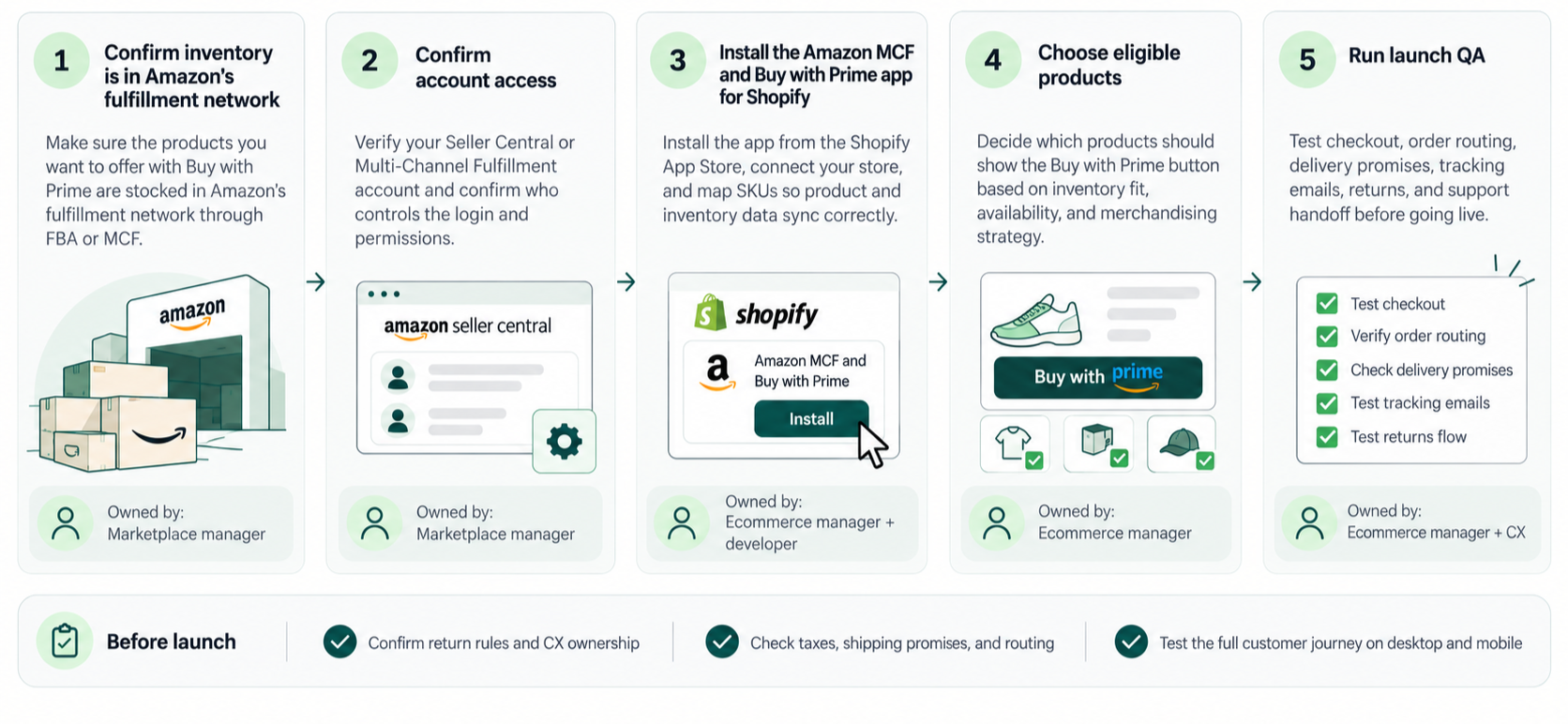
How to get the Buy with Prime button or Prime delivery through MCF (and who does each step)
Both routes start the same way, then split once you pick an option.
Write the CX response for edge cases. Amazon verifies Prime membership after the order is placed, so ask Amazon what happens when a shopper who isn't a member selects Prime delivery, and decide who answers that ticket (CX lead, with the marketplace manager).
Before launch, either way
Test checkout, order routing, and returns end to end (ecommerce manager, with CX).
Brands not on Shopify have a different path. For the MCF option, Amazon offers its Selling Partner API, with partners including Fulfil, LingXing, and WebBee launching soon. Buy with Prime has its own integrations for other platforms. Either way, the ecommerce manager budgets developer time before the build starts.
What to screen for when you hire for this
The ecommerce question is "If Buy with Prime lifted conversion but cut margin on half the catalog, what would you do?" A strong answer starts with SKU-level testing and contribution margin per SKU. Then ask, "Which SKUs would you test first, and what margin would justify going sitewide?"
For a launch this fall, add: "We're turning this on in late October. How would you read a conversion test that ran through Black Friday?" A strong candidate separates holiday lift from program lift without being prompted.
The marketplace question is "How would you split one inventory pool between Amazon and our site during peak?" A strong answer names a rule, a forecast input, and who signs off. Then ask, "What would you hold back for Amazon, and what would make you release it?" A third question tests tool judgment: "Would you run our Shopify orders from Seller Central, or our Amazon business from Shopify, and why?" There's no single right answer. A strong candidate names who loses visibility in each setup.
Constant Hire places ecommerce and marketplace operators who have run both Amazon and DTC, and your first vetted candidate interview lands within five business days. Hire a marketplace manager or hire an ecommerce manager.
Decide who owns this before Amazon decides for you
Choosing between Buy with Prime and Prime delivery through MCF is an ownership decision. Each option moves checkout conversion, inventory allocation, post-purchase experience, and margin in different directions, and a brand that never assigns owners defaults to whoever happens to live in Seller Central. With peak fees starting October 15, most brands will make this call in the next few weeks, whether or not they name an owner first.
The Prime Ownership Split fixes that by naming one owner for each of the four rights, with whoever owns DTC revenue accountable for the whole program.
Whether one operator runs both channels, two managers split the work, or a Head of Ecommerce sits above both, the next hire has to match the team shape you run today. Their job description should name which of the four rights they own.
FAQs
What is Buy with Prime?
Buy with Prime is an Amazon program for US merchants that adds the Prime badge, Amazon checkout, Prime delivery, and Amazon-run customer service and returns to a brand's online store. Inventory sits inside Amazon's fulfillment network, and shoppers sign in with their Amazon account. Someone on your team still has to own the result.
How does order tracking work with Buy with Prime?
With Buy with Prime, shoppers track orders from their confirmation email or their Amazon account and app. With the newer MCF Prime delivery option, confirmation and tracking come straight from your team. That difference decides who on your team answers the "where is my order" tickets.
Is Buy with Prime available for non-Amazon websites?
Yes. Buy with Prime only runs on participating non-Amazon websites. Shopify stores activate it through the Amazon MCF and Buy with Prime app, and other platforms use their own Buy with Prime integrations. For the separate MCF Prime delivery option, Amazon also offers its Selling Partner API. You do not need to list the product on Amazon.com to offer it on your own site.
Does Buy with Prime work for shoppers who are not Prime members?
Yes. Amazon's holiday peak fulfillment fees apply to Buy with Prime and MCF from October 15, 2026 to January 14, 2027, adding about $0.32 per unit on average, with the 3.5% fuel and logistics surcharge on top. Whoever signs off on margin should model Q4 on that card, not the standard one.
Connor Gross founded Constant Hire in 2024. An operator turned founder with deep experience building and scaling e-commerce brands. He previously sold an Amazon brand and generated over $30M in DTC revenue through private-label Shopify businesses. He now helps fast-growing DTC brands and agencies hire top talent across marketing, creative, ops, and sales. From E‑com Managers to TikTok Creators and Heads of Growth, he knows what great looks like, and how to recruit it.