Enterprise Ecommerce Platform Comparison and Who to Hire
An enterprise ecommerce platform comparison of Shopify Plus, Salesforce, Adobe Commerce and BigCommerce on cost, B2B depth and the team each one needs.
An enterprise ecommerce platform comparison is an evaluation of commerce platforms across architecture, total cost of ownership, and native capability that helps growth-stage and enterprise brands choose a system they can afford to staff as well as license.
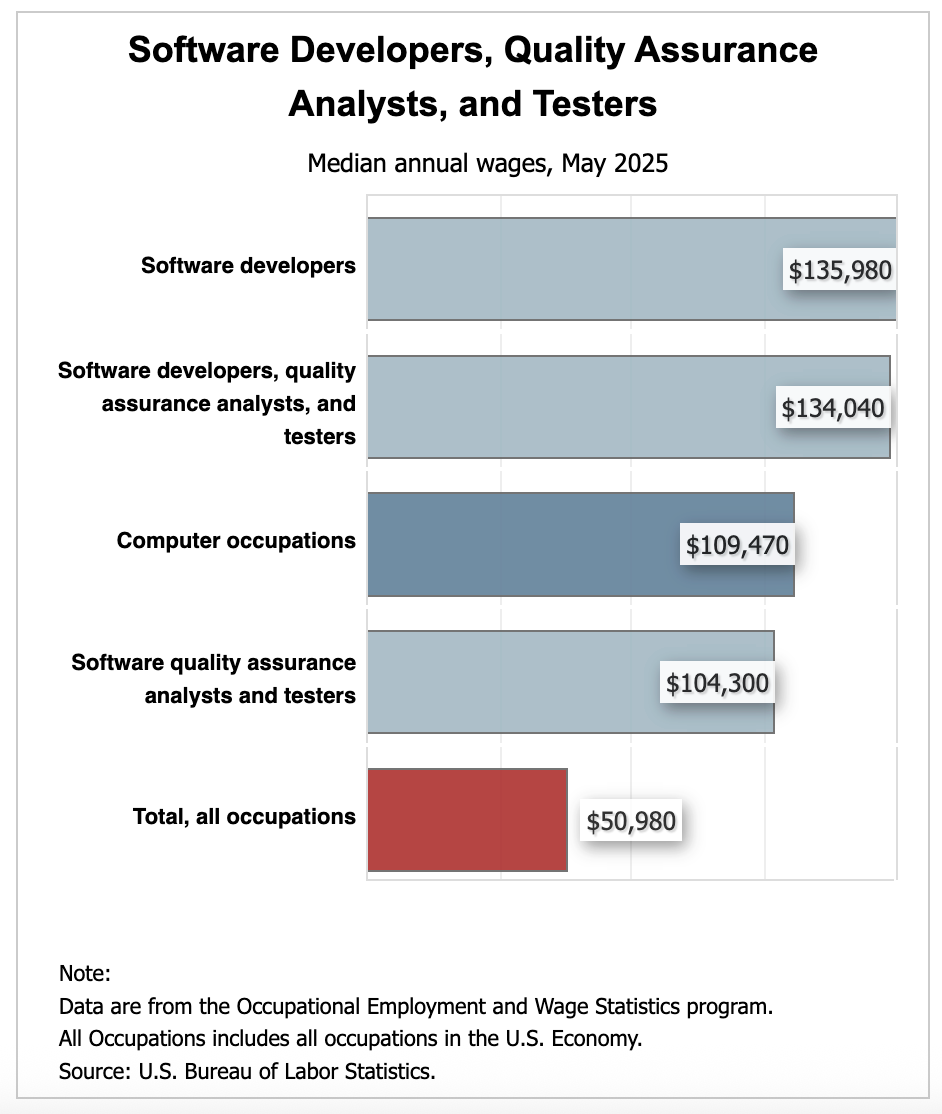
That range is just the license fee. Shopify Plus starts at $2,300 a month on a 3-year term or $2,500 on a 1-year term, $27,600 to $30,000 a year. The median US software developer earned $135,980 in May 2025, so the developer who runs that store costs 4.5 to 4.9 times the license in salary alone, before benefits and payroll taxes.
The first half compares the four on architecture, cost, features and scale. The second half turns that into a team: the stack each platform forces you to hire, what those people cost, the in-house versus agency break-even, and the order to hire in.
What counts as an enterprise ecommerce platform?
An enterprise ecommerce platform is a commerce system built for high order volume, multi-storefront operations, complex catalogs, and deep integration with ERP, PIM, and OMS systems. It's licensed on a mix of published starting prices and revenue-linked or negotiated enterprise terms.
That scope is what separates it from a WordPress site running WooCommerce or a starter Shopify store. In enterprise ecommerce, your team or a partner's team owns those integrations.
Is Shopify the same as Shopify Plus?
No. Shopify Plus is the enterprise tier of the same platform, with unlimited staff accounts, checkout extensibility, multiple expansion stores, lower card processing rates, and a lower third-party gateway surcharge, on a negotiated multi-year contract and not a published monthly plan.
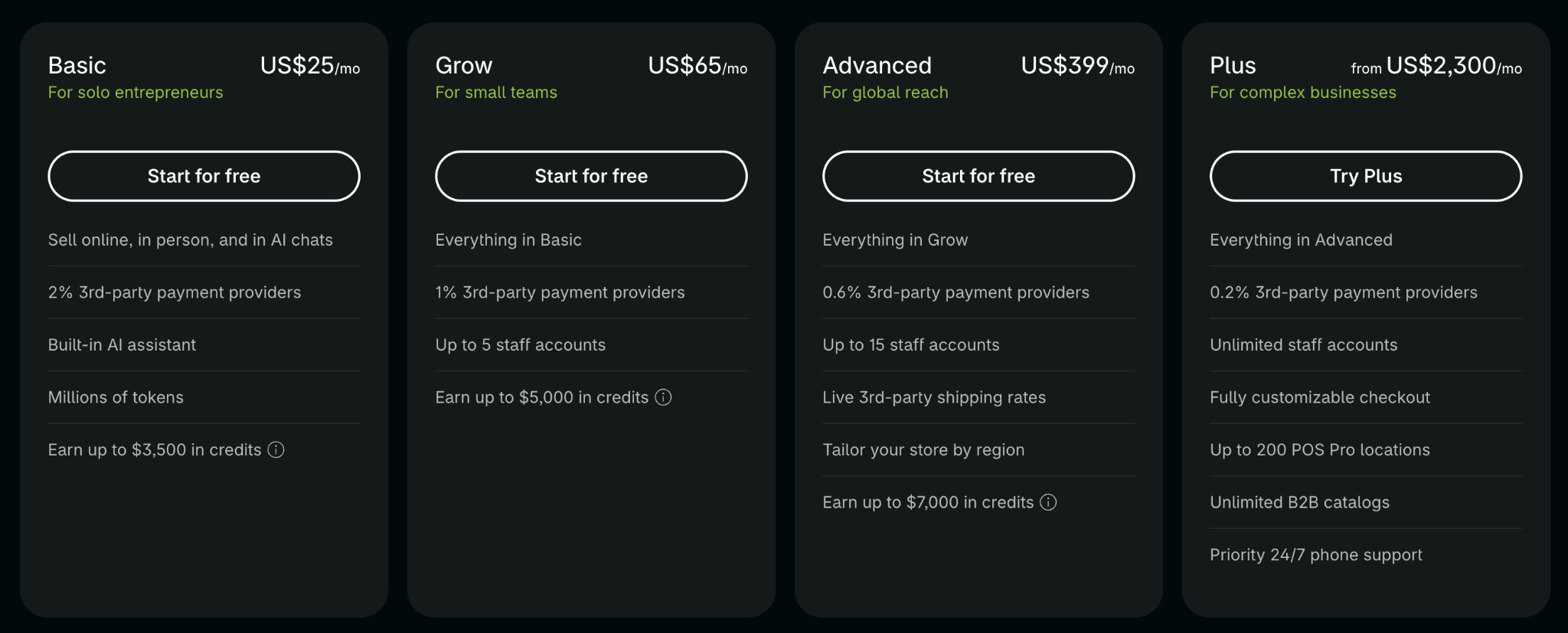
Shopify's pricing pages put numbers on the gap. Staff accounts are unlimited on Plus and capped at 15 on Advanced. Plus pays 0.20% on third-party gateways where Advanced pays 0.6%. One Plus contract covers the main store and 9 expansion stores. B2B no longer separates the two: since April 2, 2026, company profiles, payment terms and up to three custom catalogs ship on every paid plan, and Plus adds unlimited catalogs, deposits and B2B checkout customization.
Shopify Pricing Plans - Source: Shopify
That contract is a 1-year or 3-year commitment on a platform where developer-built extensions run the checkout logic. The developer relationship starts on the day you sign.
This comparison covers four enterprise ecommerce platforms for brands between $10M and $250M GMV. Composable-only vendors sit in a different evaluation, so the next section names them without comparing them.
Enterprise ecommerce platform comparison at a glance
The table sets the four side by side on seven dimensions. Three of them (hosting model, upgrade management, and infrastructure staffing) decide whether you hire engineers just to keep the platform running.
Dimension
Shopify Plus
Salesforce Commerce CloudNow Agentforce Commerce
Adobe Commerce
BigCommerce EnterpriseNow Performance
Hosting model SETS YOUR HIRES
Multi-tenant SaaS
Multi-tenant SaaS (B2C pods; CRM core for B2B)
Single-tenant PaaS (Adobe Commerce on Cloud) or self-hosted; also sold as SaaS (Adobe Commerce as a Cloud Service)
Open SaaS
Best fit profile
DTC and blended retail/wholesale, $10M to $50M
Global enterprise already on Salesforce, $100M+
Complex B2B with custom logic, $50M to $250M+
Mid-market B2B and distribution, $20M to $100M
License model
Flat fee, then GMV share above threshold
GMV percentage
Revenue and order-volume bands
Tiered by annual sales, custom on Performance; no open payment provider fee under contract
Upgrade management SETS YOUR HIRES
AutomatedAutomated and continuous
AutomatedAutomated, with cartridge compatibility testing
ManualManual on-premises; Cloud PaaS deadlines by version (2.4.4 and 2.4.5 by June 1, 2027); automatic on the SaaS package
AutomatedAutomated and continuous
Native B2B depth
ModerateNo native RFQ; store credit is native; order-review rules, quotes and custom role permissions come from apps
HighOn B2B core: CRM quoting, hierarchies
BenchmarkNative RFQ, approvals, requisition lists
Very highB2B Edition: quoting, buyer roles, invoices
Infrastructure staffing SETS YOUR HIRES
None required
None required
RequiredOn-premises and on Cloud PaaS (DevOps or cloud engineer); not required on the SaaS package, where Adobe manages hosting, upgrades and scaling
The best enterprise ecommerce platform depends on three inputs at once: commercial model, GMV and the engineering capacity you can hire.
A DTC brand adding wholesale, a mid-market distributor, and a global enterprise already on Salesforce land in different columns, and each column sets the team you have to build. If you cannot staff the row called infrastructure staffing, that row makes the choice for you. The talent pool row measures skill overlap with standard web engineering, and a broader overlap gives you more candidates when you post the first role.
Composable-only vendors such as commercetools and Elastic Path are out of scope. So is VTEX, which now sells a full native commerce core under its "Composable and Complete" positioning. SAP Commerce Cloud, formerly Hybris, is out too, because its infrastructure and licensing model sit in a heavier category than these four.
This article helps you decide what team to build, so evaluate the composable vendors after that team exists. Headless commerce separates the storefront from the commerce back end, and composable commerce goes further by letting you assemble the remaining services yourself through microservices and an API-first architecture that vendors call MACH. Both are hiring commitments before they are technology choices, and both trade one vendor relationship for several smaller ones.
Architecture and hosting: what each platform decides for you
The hosting model decides who carries infrastructure, upgrades, and security patching, and that decides what you hire.
Shopify Plus
Shopify Plus is multi-tenant software as a service (SaaS). Shopify handles hosting, security patches and upgrades, and says its stores are Level 1 PCI DSS compliant. Custom backend logic runs in Shopify Functions, inside Shopify's infrastructure.
The trade is governance. Storefront queries run through a GraphQL-only API, checkout changes go through Checkout Extensibility, and custom data extends Shopify's own models through metafields, so the schema stays Shopify's. You never hire for infrastructure, and no hire can move the platform boundary.
Salesforce Commerce Cloud
Salesforce Commerce Cloud, renamed Agentforce Commerce at Dreamforce in October 2025, is two products with two technology stacks. B2C Commerce, originally Demandware, runs on its own stack, separate from the core Salesforce platform. Storefronts use the Storefront Reference Architecture (SFRA) with JavaScript controllers, or a React front end on PWA Kit or Storefront Next, and server-side scripts run on the Mozilla Rhino engine.
B2B Commerce, originally CloudCraze, runs natively on the core Salesforce CRM platform with Apex and Lightning Web Components. If you run both, you hire into two unrelated developer markets and maintain two build pipelines.
Adobe Commerce
Adobe Commerce deploys in three ways. Two of them, on-premises and Adobe Commerce on Cloud (a single-tenant package on AWS or Azure), run PHP 8.x on Magento's open-source core, with Symfony components and data in MySQL or MariaDB on an EAV schema. The third option, Adobe Commerce as a Cloud Service, is SaaS, where Adobe handles hosting, upgrades, and scaling. The package you buy sets the infrastructure hire.
Adobe's feature comparison lists in-process PHP customization and manual patching for the on-premises and Cloud packages, so almost anything is possible in the code, and patch work falls on your team. From June 1, 2027, Adobe will stop maintaining Cloud environments on unsupported versions and may suspend their traffic, so a fixed date now drives your upgrade calendar. App Builder and API Mesh exist to move new work outside the core. On both packages, you staff infrastructure and treat upgrades as a permanent line item.
BigCommerce Enterprise
BigCommerce Enterprise is now called Performance and runs on what BigCommerce calls Open SaaS, a vendor-maintained hosted core. Its Checkout SDK can replace the checkout interface entirely, with more room than Shopify Plus's extension model, so checkout changes become frontend work you can staff.
BigCommerce webhooks push events over HTTPS to an endpoint you host, so backend extensions run in a cloud account your team owns, on a stack your team already knows. That is a quiet cost advantage: the backend hire is a general web engineer, not a platform specialist.
What an enterprise ecommerce platform actually costs
Six components make up enterprise ecommerce platform cost: license, implementation, payment and transaction fees, apps and extensions, infrastructure and environments, and the fully loaded cost of the people who run it. Vendor pricing pages omit that last line, and the introduction's wage comparison shows it can be the largest.
None of the four publishes a full enterprise rate card. Shopify and BigCommerce publish starting prices; Salesforce and Adobe publish none. Every other figure below is an estimate reported by agencies or publishers, not a price list.
Shopify Plus pricing is $2,300 a month on a 3-year term and $2,500 on a 1-year term. Higher-volume merchants move to a variable platform fee that Shopify ties to revenue and business model but does not publish. Fuel Made, a Shopify agency, reports 0.25% of monthly GMV on the 3-year term and 0.40% on the 1-year term once monthly sales pass roughly $1M, while Contra Collective, an agency, puts the threshold at $800k a month. Third-party gateways add 0.20% on top. A brand approaching $1M a month should model the variable fee before it signs a term.
BigCommerce Performance, formerly Enterprise, starts at $1,499 a month billed annually, or $17,988 a year. BigCommerce says its Open Payment Provider Fee does not apply to Performance under contracted terms. For a high-AOV business, that makes its bill more predictable than Shopify Plus or Salesforce, where fees move with GMV.
Every figure in this table comes from a company that sells the platform, builds on it or brokers the contract. None of them publishes what it costs to staff the platform you pick, which is why the second half of this article prices the team.
Third-party apps add recurring fees on top of the license, and some bill on volume. Recharge, a subscription app, lists its top published plan at $499 a month plus 1.34% per transaction. That is how a cheap platform becomes an expensive one. Price the app stack before you call Plus the cheaper option.
Salesforce carries a higher first-year systems integration commitment than Shopify Plus. Contra Collective reports $500k to $1.5M for mid-market SFCC builds, and $2M+ for complex ones, against $300k to $900k for Shopify Plus, usually before MuleSoft's middleware licensing on top, from $2,000 a month with a $50k minimum on its pre-commit model.
What features to compare when choosing a platform
The platforms differ most in five areas, and each one ends on a seat you have to fill or a backlog you have to own.
Native B2B depth
Adobe Commerce is the benchmark. Adobe's B2B documentation lists company accounts and hierarchies, shared catalogs, requisition lists, negotiable quotes, and purchase order approval rules. BigCommerce's B2B Edition covers comparable ground natively. It offers buyer roles including Admin, Senior Buyer, and Junior Buyer, and a Buyer Portal supporting quotes, invoices, and multiple company users.
On Shopify Plus, every missing B2B workflow lands on a developer's backlog.
Headless and API extensibility
All four support headless, through BigCommerce's GraphQL Storefront API, Adobe's GraphQL schemas and Edge Delivery Services storefront, Salesforce's PWA Kit on Managed Runtime, and Shopify's Hydrogen, which Shopify rebuilt in 2026 to run on any React stack, including Next.js. What it costs you differs. Shopify's themes use an integrated CMS, so decoupling there adds a headless CMS, another vendor, and another skill set to staff.
Headless on any of the four means hiring React, Next.js, and TypeScript skills on top of platform skills.
Multi-store and international
Adobe Commerce vs Shopify Plus on multi-store depends on what your stores share. Adobe's scope hierarchy runs global, website, store, and store view, and BigCommerce's Multi-Storefront runs multiple websites from a single catalog, so one team runs catalog management for the whole footprint on either. Salesforce manages all sites and locales from Business Manager with catalogs shared between sites. Shopify runs multiple markets from one store and points brands with independent local teams toward separate expansion stores, 9 of which come with Plus.
Fragmentation is an operations headcount cost, because someone has to handle inventory management, reporting, and promotion calendars by hand across every store.
Salesforce's cost is the GMV percentage in its license, and Adobe's sits in the license band and the infrastructure. The surcharge is a finance line, but changing gateways is developer work.
Marketing and SEO tooling, and what you have to staff for
The useful question is which capability the platform supplies and which one a person has to supply.
Past those defaults, the SEO work is code. Shopify needs a robots.txt.liquid template in theme code, and BigCommerce markup sits in Stencil or Catalyst. Technical SEO is developer work on all four, and the marketing tools need an operator every day, so budget both seats before launch. If Amazon or Walmart is in your channel plan, marketplace manager recruitment is a separate search.
Functional area
Shopify Plus
Salesforce Commerce Cloud
Adobe Commerce
BigCommerce Enterprise
Native B2B workflows
Companies and catalogs; quotes via apps
B2B Commerce on the Salesforce core
Company accounts, quotes, PO approvals
B2B Edition: buyer roles, quotes, invoices
Checkout extensibility
Checkout UI extensions and Functions
B2B checkout built as a Flow Builder flow
One-page checkout by default; custom checkout extensions
Checkout SDK for custom checkout pages
Multi-store management
Markets plus 9 included expansion stores
Shared product catalog plus a site catalog per site
Scale has two ceilings, the platform's and your team's, so the real constraint is whether you can staff the platform at the pace your GMV grows.
Shopify's own case study says BRUNT Workwear scaled to over $300M in annual revenue, with most sales flowing through Shopify. Salesforce's customer stories page says Siemens uses Commerce Cloud to process up to $10B in annual GMV on the B2B side.
For Adobe Commerce and BigCommerce, ask the vendor for a reference customer at your GMV, then ask that customer how many engineers run the platform.
Shopify Plus stops being the right answer when you need database-level customization, formal RFQ and approval workflows, legal entities and catalogs that must be fully separate rather than shared, or checkout logic that Functions cannot express. In a Shopify Plus vs Magento decision, those four triggers tip the choice toward Adobe Commerce, and toward hiring an architect. Until one of them shows up, stay on Plus.
Adobe Commerce earns its place when your business logic cannot fit inside a SaaS boundary and you can fund a permanent internal engineering team, one that also owns the upgrade calendar Adobe now enforces on Cloud. Adobe is worth it when you can staff it. A brand that buys it without an in-house architect is buying a permanent agency dependency that no license quote prices.
The engineering stack each platform forces you to hire
Choosing a commerce platform is a hiring decision disguised as a procurement decision, because the platform sets your tech stack and the labor market you will be recruiting from for the next three to five years.
Layer
Shopify Plus
Salesforce Commerce Cloud
Adobe Commerce
BigCommerce Enterprise
Templating/storefront
Liquid; Hydrogen (React) on Oxygen
SFRA + ISML cartridges; Storefront Next or PWA Kit (React)
Luma or Hyva (Alpine.js, Tailwind) (PaaS packages); headless PWA or Edge Delivery Services
Stencil (Handlebars); Catalyst (Next.js)
Backend language
Any language that compiles to WebAssembly (Functions)
Server-side JavaScript (Rhino) for B2C; Apex and LWC for B2B
PHP 8.x, Symfony components (PaaS packages); Node.js in App Builder
Services you host, fed by webhooks
Data layer skills
None. Abstracted by vendor
Proprietary B2C engine; Salesforce object model for B2B
MySQL or MariaDB with EAV schema tuning, OpenSearch, Valkey, Varnish, Fastly on Cloud (PaaS packages)
None. Abstracted by vendor
APIs
GraphQL Storefront and Admin
SCAPI Shopper APIs; SOQL/SOSL on B2B
REST and GraphQL; API Mesh
REST and GraphQL; rate limits set by plan
Deployment
Shopify CLI and GitHub
Managed Runtime; cartridge code versions deployed by CLI
Manual version migrations on-premises; Cloud PaaS deadlines by version (2.4.4 and 2.4.5 by June 1, 2027); automatic on the SaaS package
Stencil CLI pushes themes to the store; Catalyst on Vercel or another Next.js host
Certifications to screen for
Shopify Verified Skills badges (Liquid Storefronts for Theme Developers, Developing Apps for Shopify, Creating Solutions for Shopify Checkout); agency partner tiers Plus, Premier, Platinum
B2C Commerce Developer; B2C Commerce Architect (last exam August 31, 2026, still valid); Platform Developer and Platform Developer II; Accredited B2B Commerce Developer Professional (partner access); MuleSoft Developer
AD0-E724 Developer Professional and AD0-E725 Developer Expert (both include Cloud content); AD0-E722 Architect Master
BigDev Certification Courses
Infrastructure hires needed
No
No
Yes on-premises and on Cloud PaaS; no on the SaaS package, where Adobe manages hosting, upgrades and scaling
No
Sourced from vendor documentation and certification pages as of September 2026. The architecture section's sources also apply. BigCommerce Enterprise is now called Performance.
Shopify Plus and BigCommerce draw from standard web engineering, meaning JavaScript, React, Next.js, and TypeScript plus one platform layer, Liquid or Handlebars. A competent frontend engineer already holds most of that stack, so the platform layer is the main thing left to learn.
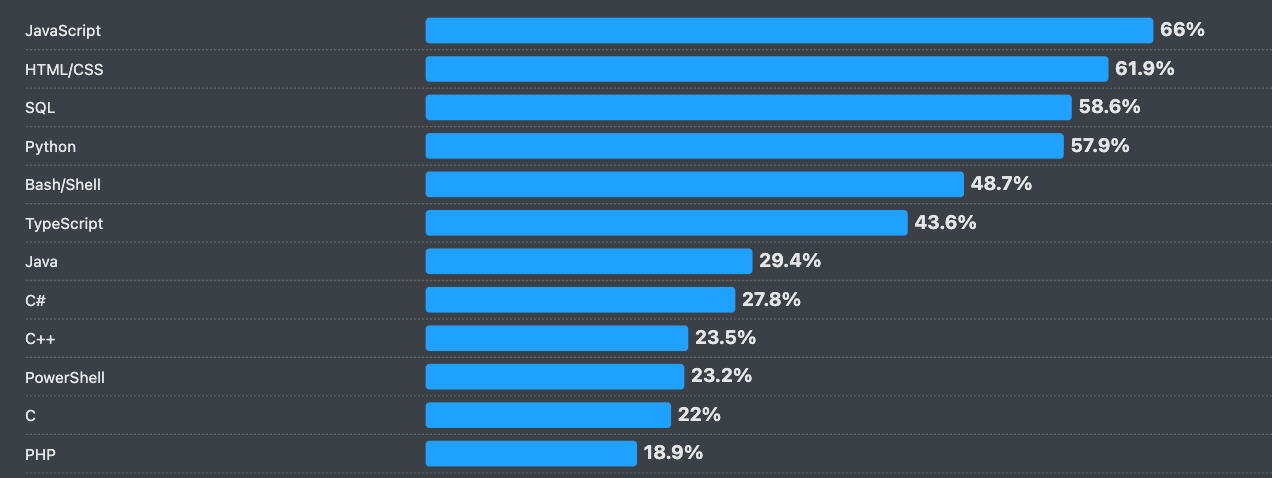
In Stack Overflow's 2025 Developer Survey, 66% of respondents used JavaScript, 18.9% used PHP and 4% used Symfony, the framework layer Adobe Commerce builds on. The survey is self-selected, so treat it as the shape of the general pool rather than a count of candidates.
Source: Stack Overflow
Source: Stack Overflow
Salesforce Commerce Cloud (SFCC) and Adobe Commerce draw from narrower pools. Engineers learn SFRA, ISML and server-side JavaScript on Rhino (B2C) or Apex (B2B) on the job, and the same goes for Adobe's Magento-specific framework. PHP is not the constraint. Magento experience is. Start the search in integrator teams and their alumni before the open market.
Salesforce Ben's reporting on the 2025 10K Talent Ecosystem Report found technical architect demand grew 27%, solution architect demand rose 21%, and developer demand fell 12% year over year across Salesforce as a whole, which points to the architect as the scarce seat.
A narrow pool should mean a longer search, a higher offer, and a harder replacement when someone leaves. On Adobe and Salesforce, single-person dependency comes built into the platform choice, and no management practice fully removes it.
Screen for current credential names. Shopify's Verified Skills badges cover apps, Liquid storefronts and checkout but not headless, and its partner directory has Plus, Premier and Platinum tiers. BigCommerce offers BigDev Certification Courses. Ask each candidate for the badge and the work behind it.
Adobe certifications must be renewed every two years, so check the renewal date, and treat a resume citing only an older code such as AD0-E711 or AD0-E709 as a prompt to ask which version the candidate has shipped on.
Salesforce candidates hold B2C Commerce Developer for B2C, Platform Developer and Platform Developer II plus the Accredited B2B Commerce Developer Professional for B2B, and MuleSoft Developer for integration engineers.
Salesforce has closed new exams for the B2C Commerce Architect and B2B Solution Architect credentials. Its 2027 retirements FAQ sets August 31, 2026, as the last exam date and February 1, 2027, as the retirement date, and confirms a retired certification stays valid. No new candidate can earn either, so screen architects on shipped architecture work.
A certification proves platform literacy. It says nothing about commercial judgment, and on the SaaS platforms, shipped work tells you more.
What each platform costs you in salary
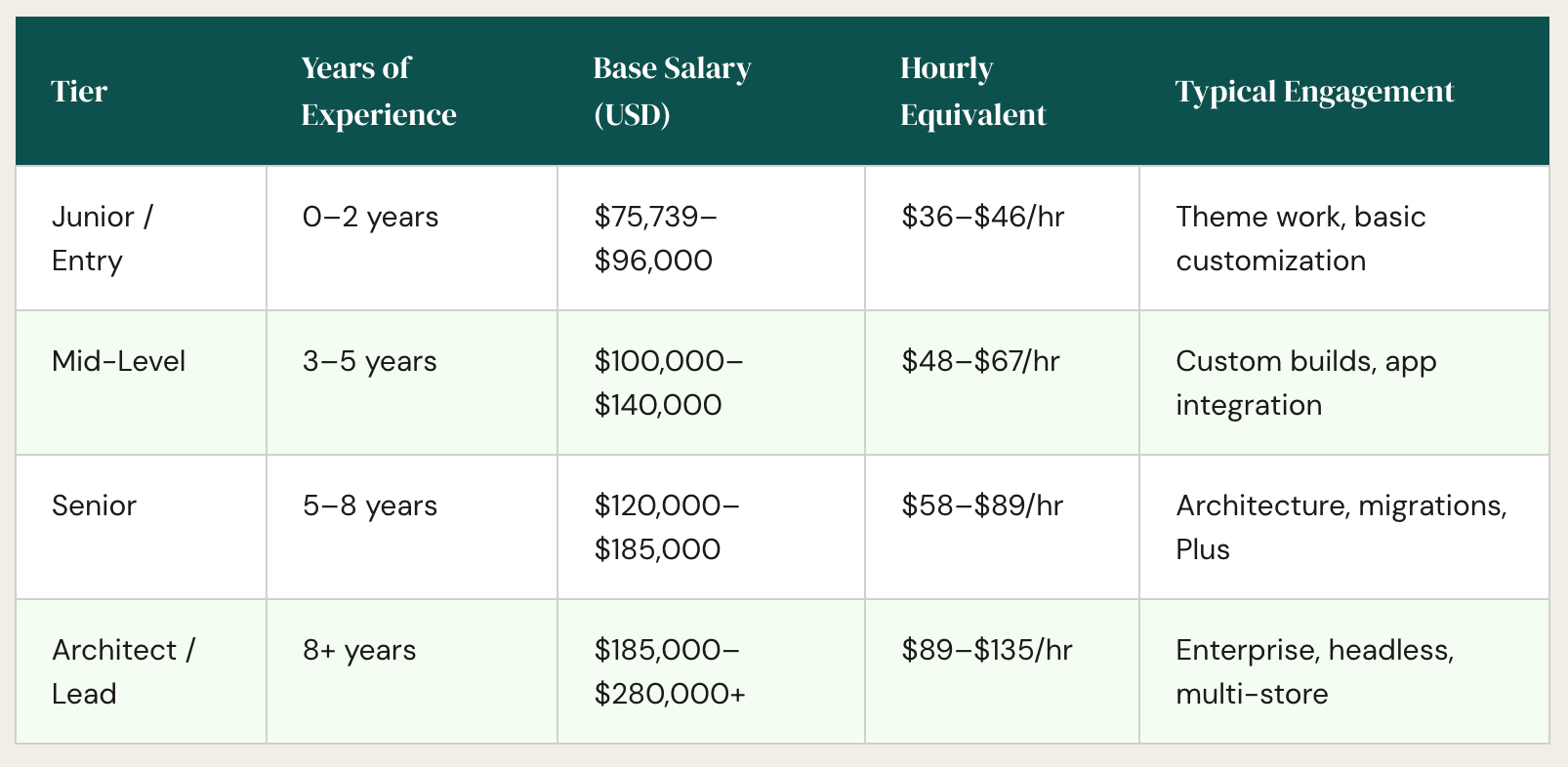
The platform you choose changes what your first hire costs. Shopify Plus starts with an Ecommerce Operations Manager, while Adobe Commerce and Salesforce start with an architect. BLS has no architect occupation, so the closest proxy is the 75th to 90th percentile for software developers, $171,980 to $214,670. Constant Hire's candidate data puts the operations manager at a $140,000 median expected base, a gap of $31,980 to $74,670 a year.
Across three years, that gap is $95,940 to $224,010 for one seat. Salesforce Ben separately puts the SFCC Solution Architect median at $192,500, a gap of $52,500 a year against the operations manager, or $157,500 over three years.
On the license side, Contra Collective, an agency, reports Commerce Cloud licenses at $150k a year. Against Shopify Plus at $27,600, that is a gap of $122,400 a year, or $367,200 over three years. The pay delta and the license delta are the same order of magnitude.
BLS and Salesforce Ben publish no US pay by commerce platform, so the table below anchors most seats with occupation-level and Salesforce-wide figures. The Shopify rows are the exception: they come from Constant Hire's own candidate interviews.
Role and platform
US annual wage
Basis of the figure
SFCC Solution Architect
$192,500 median
Salesforce Ben senior architects, technical and solution combined; Salesforce-wide, not Commerce Cloud specific
SFCC Senior Developer
$140,000 median
Salesforce Ben senior developers; Salesforce-wide, not Commerce Cloud specific
Adobe Commerce Architect
$171,980 to $214,670
BLS software developers, 75th to 90th percentile; BLS has no commerce or software architect occupation
Adobe Commerce Senior Developer
$135,980 median; $171,980 at the 75th percentile
BLS software developers, all seniority levels
Shopify Plus Senior Developer
$120,000 to $185,000
Constant Hire candidate data, 5 to 8 years of experience; $120,000 to $140,000 for senior Liquid developers with Plus experience, $150,000 to $185,000 for headless Hydrogen
BigCommerce Senior Developer
$135,980 median; $171,980 at the 75th percentile
BLS software developers, same occupation as the Adobe row
Ecommerce Operations Manager
$140,000 median expected base; middle half $120,000 to $155,000
Constant Hire candidate data, US based managers, 2025 to 2026; BLS general and operations managers median $105,770 for comparison
Sourced from the U.S. Bureau of Labor Statistics OEWS, May 2025 (software developers, general and operations managers; all industries, occupation level, not platform specific), Salesforce Ben's 2025 to 2026 salary surveys (developers, architects; Salesforce-wide) and Constant Hire's own candidate salary data, 2025 to 2026. None of these sources publish US pay by commerce platform.
Source: Constant Hire proprietary candidate data, 2025–2026
Benefits and payroll taxes add 25% to 30% on top of base pay, so a $150k base runs $187,500 to $195,000 before tooling.
The clearest signal in the data is a supply constraint. Salesforce Ben's reporting on 10K's research puts technical architects at 1% of global Salesforce talent supply, with supply up 4% in 2025, against the 27% demand growth for technical architects. Budget the architect seat first.
The five roles that run an enterprise commerce platform
Build each job description from the scopes below. Our guide to ecommerce team structure maps the whole team at each revenue stage.
The Commerce Technical Architect owns data schemas, integration architecture with ERP, PIM, and OMS systems, performance budgets, and technical governance. On Adobe and Salesforce, this is the first hire, not a later one, because every later engineer inherits the architect's decisions.
The Lead Platform Developer writes the platform-specific backend, meaning custom APIs, core application logic, and the release branches. If your platform commands a premium, it lands in this seat, because developers learn those backend skills inside the platform.
The Frontend or Headless Engineer builds the customer-facing interfaces, the design system, Core Web Vitals, and any React, Next.js, or Hydrogen application, and is the most portable of the five roles across platforms. BLS puts the median wage for web developers, the closest occupation it measures, at $92,650 in May 2025.
The Systems Integration Engineer builds and monitors the middleware pipelines that sync inventory, orders, customer master, and accounting data between the storefront and the ERP. On Salesforce, this seat is often a MuleSoft-certified specialist, and MuleSoft's license, priced in the cost section, is a separate line item.
The Ecommerce Operations and Merchandising Manager runs the platform consoles daily, covering promotions, catalog tagging, localized landing pages, and app coordination. It is the most underrated hire on the list and the correct first hire on Shopify Plus. It sits alongside the broader Ecommerce Manager role, which owns revenue, site performance and profitability.
No single hire covers UX, backend module architecture, checkout security, and database indexing. A brand that tries to buy all four in one person is exposed on whichever one that person covers least, so put that skill on a second hire or a partner before the build starts.
In-house, agency or hybrid
The break-even between an in-house hire and an agency retainer sits between roughly 45 and 90 hours a month of steady development work, and the agency's rate decides where. A mid-level Shopify developer costs $130,000 to $165,000 a year fully loaded, or $10,800 to $13,750 a month. Agencies bill $150 to $250 an hour on retainer, so that monthly cost buys between 43 and 92 agency hours.
Below about 45 hours a month, the agency is cheaper at any rate in that range. Above about 90, the in-house hire is cheaper at any rate. Between the two, compare your agency's actual rate against the salary. For brands with continuous development work, Constant Hire's data shows the in-house model usually pays for itself within 12 to 18 months of the hire.
Dimension
Dedicated in-house team
Specialized agency or SI
Hybrid
Core strengths
Institutional memory, ERP edge-case knowledge, fit with commercial priorities
Multi-disciplinary coverage and surge capacity
Internal direction with external delivery capacity
Cost structure
$130,000 to $165,000 fully loaded for a mid-level developer, at 25% to 30% loading
$150 to $250 an hour on retainer; $5,000 to $15,000 a month at mid-market; $75 to $200 an hour on projects
One internal salary plus project fees for bounded work
Breadth of skills
Deep on your platform, thin across design, security and infrastructure
Design, backend, QA and project management under one contract
Internal architecture depth, external breadth on delivery
Operational risk
Single-person dependency; a 30 to 60 day ramp before first output
Account management overhead; context decay when staff rotate
The Agency Handoff Tax: an in-house hire spending more than 20% of their time decoding undocumented agency code
Break-even trigger
Over about 90 hours a month
Under about 45 hours a month
45 to 90 hours a month, decided by the agency's rate
Sourced from Constant Hire's Shopify developer vs. Shopify agency analysis, 2026, which draws on ZipRecruiter, Shero Commerce, Elsner, Qikify and Constant Hire DTC placement data. Break-even range is Constant Hire analysis.
In-house buys institutional memory, ERP edge-case knowledge, and fit with commercial priorities. The costs are single-person dependency and the loading covered in the salary section.
An agency buys multi-disciplinary coverage and surge capacity. The costs are account management overhead and context decay when its staff rotates.
For most brands at $20M to $100M in GMV, the answer is a hybrid. One internal architect or lead owns direction and standards, and external specialists execute. The failure mode is what Constant Hire calls the Agency Handoff Tax: an in-house hire spending more than 20% of their time decoding undocumented agency code. The lead's first job is the documentation standard that prevents it. That lead is a hire too, and a specialist ecommerce recruitment partner is one way to run that search.
Platform choice and hiring sequence by business profile
These four profiles show the order of hires for each platform. On three of the four, the first hire comes before implementation starts.
Operational profile
Platform
First hire (and when)
Second hire
Partner role
High-growth DTC adding wholesale, $10M to $50M
Shopify Plus
Ecommerce Operations Manager, at or before launch
Full-stack Shopify developer once the backlog passes about 90 hours a month
Plus partner on retainer, $5,000 to $15,000 a month at $5M to $20M, $10,000 to $20,000+ above $20M
Mid-market B2B manufacturer or distributor, $20M to $100M
BigCommerce Enterprise, now Performance (B2B Edition)
Technical Product Manager or Commerce Lead, before implementation starts
Frontend and API integration developer, post-launch
Certified BigCommerce SI for ERP integration and portal build
Complex enterprise B2B with custom logic, $50M to $250M+
Adobe Commerce (on Cloud or self-hosted)
Enterprise Solutions Architect, before signing the SI contract
Senior Adobe developer plus DevOps or cloud engineer, 3 to 6 months post-launch
Adobe Solution Partner for core builds and migration
Global enterprise standardized on Salesforce, $100M+
Salesforce Commerce Cloud
Principal Salesforce Commerce Architect, before implementation
MuleSoft integration engineer during build; senior SFCC developer post-launch
Tier-1 global SI for multi-cloud deployment
Sourced from Constant Hire analysis and Constant Hire's Shopify developer salary benchmarks, 2025 to 2026.
Scenario 1: High-growth DTC adding wholesale ($10M to $50M GMV)
On Shopify Plus, the first hire, at or before launch, is an in-house Ecommerce Operations Manager running merchandising, promotions, service, and native B2B company profiles. BRUNT Workwear followed this path, launching wholesale on Shopify B2B in February 2024 and growing from 110 stores to about 2,000 in two years.
Development starts outsourced to a Shopify partner covering custom Liquid, checkout extensions, and ERP integration through a pre-built iPaaS connector. Constant Hire's benchmarks put a Plus partner retainer at $5,000 to $15,000 a month for $5M to $20M brands and $10,000 to $20,000+ above $20M. Once the backlog passes about 90 hours a month, hire a senior full-stack Shopify developer and keep the agency for redesigns and headless work.
Set the 90-hour trigger now, before the first request for an in-house developer arrives.
Scenario 2: Mid-market B2B manufacturer or distributor ($20M to $100M GMV)
This profile runs on BigCommerce Performance with B2B Edition, and the first hire comes before implementation starts. A Technical Product Manager or Commerce Lead defines requirements, maps the ERP integration, and owns the deliverables while a certified BigCommerce integrator builds and orchestrates the middleware. After launch, a frontend and API integration developer maintains the customer portal and handles daily technical requests.
Scenario 3: Complex enterprise B2B with custom business logic ($50M to $250M+ GMV)
For Adobe Commerce, on Cloud or self-hosted, the Enterprise Solutions Architect comes in before you sign the implementation contract, validating the integrator's data model instead of inheriting it and keeping custom work out of the core software through App Builder and API Mesh. Adobe's Architect Master exam recommends 3 to 5 years' experience leading Commerce projects, which tells you how senior this seat is.
Within three to six months of launch, add a senior Adobe developer for patching and module work, plus a DevOps or cloud engineer for infrastructure, OpenSearch, Valkey, and CI/CD. On the SaaS package, skip that last hire, because Adobe manages hosting, upgrades, and scaling.
Scenario 4: Global enterprise standardized on Salesforce ($100M+ GMV)
This profile runs on Salesforce Commerce Cloud, chosen for Customer 360 data architecture spanning Sales Cloud, Service Cloud and Marketing Cloud, instead of commerce functionality alone. Hire an in-house Principal Salesforce Commerce Architect before implementation to govern standards across clouds. During the build, add a MuleSoft-certified integration engineer for ERP, warehouse, and finance data flows. After launch, a senior SFCC developer covers cartridges and Lightning components, supported by an administrator and merchandiser running Business Manager and Einstein.
What the four profiles share
Across all four, hire the person who defines and checks the work before the party that carries it out, and add the people who execute when a measured trigger says the work exists. A license is a purchase you can revisit, but a data model an integrator sets without your architect sits under everything built after it.
The wrong order costs money in both directions. Hire the architect after the contract, and the search runs while the integrator builds. Hire the developer before the work exists and, at 30 hours of monthly demand, a $130,000 to $165,000 fully loaded developer costs $3,300 to $9,250 a month more than buying those 30 hours from an agency at $150 to $250 an hour, roughly $40,000 to $110,000 a year in idle capacity.
How to select an enterprise ecommerce solution
Here is how to choose an ecommerce platform when the team matters as much as the license. Run these six steps against any of the four.
Write down the non-negotiable business requirements, separate from the preferences, before you make a single vendor call.
Model total cost of ownership across all six components over three years, not the license fee over twelve months.
Establish your realistic monthly development demand in hours, because that number decides in-house versus agency before it decides anything else.
Check the talent market for the platform you are leaning toward. If you cannot name three credible candidates for the lead role, that is a finding about the platform.
Price the team, loaded, over the same three-year window you priced the license over, and put the two numbers side by side.
Decide the hiring sequence and the first hire before you sign the implementation contract, not after go-live.
Step 4 needs a baseline. SHRM's 2026 benchmark puts the median time to fill a nonexecutive role at 39 calendar days, and Constant Hire's searches for nonexecutive ecommerce roles average 34 days. A narrow platform pool runs longer than either, so a search that starts at signing lands the hire a month or more into the project.
Brands that regret replatforming rarely regret the platform. They regret discovering after launch that they cannot hire the people to run it at a price they will pay, and by then the switching cost is a second data migration and a second replatform.
Hiring the platform team with a specialist recruiter
With the platform settled, the team is your next decision. A generalist recruiter can read a resume but cannot tell a Liquid developer who ships checkout extensions from one who only edits themes, or judge an Apex, SFRA cartridge, EAV schema or Shopify Functions answer, so the search fills with candidates nobody can rank.
Constant Hire is a specialist ecommerce and DTC recruiter that delivers first interviews within five days and fills nonexecutive ecommerce roles in 34 days on average. To hire a Shopify developer for a Shopify Plus build, or to sequence the first hire once you have chosen a platform, book a strategy call.
FAQs
What is the best enterprise ecommerce platform?
No single platform ranks first for every brand. Shopify Plus suits DTC speed, BigCommerce native B2B on a predictable fee, Adobe Commerce deep custom logic when you can staff an architect, and Salesforce brands already standardized on Salesforce. Match the platform to the team you can hire.
How much does an enterprise ecommerce platform cost?
Shopify Plus starts at $27,600 to $30,000 a year, BigCommerce Performance at $17,988, and Adobe Commerce reportedly at $22,000. Agencies put Salesforce B2B at 1% to 2% of GMV and B2C Commerce at $150k to $500k+ a year. None publishes a full rate card, and implementation and staffing can exceed the license.
Is Shopify the same as Shopify Plus?
No. Plus is Shopify's enterprise tier, with checkout extensibility, expansion stores, unlimited staff accounts, lower card and gateway fees (the third-party gateway fee is 0.20%), and a negotiated multi-year contract. Core B2B tools now ship on every paid plan, so choose Plus when checkout logic, more than three B2B catalogs, or several storefronts outgrow the standard plans.
Which enterprise ecommerce platform is easiest to hire for?
BigCommerce and Shopify Plus, because both sit closest to standard web engineering. Adobe Commerce and Salesforce Commerce Cloud draw from narrower, certification-gated pools, which means longer searches and harder replacements, and on Salesforce, higher offers. Name three credible candidates for the lead role before you commit to the platform.
Should I hire an in-house developer or use an agency?
Monthly hours decide it. A mid-level Shopify developer costs $130,000 to $165,000 a year fully loaded, which buys 43 to 92 agency hours a month at $150 to $250 an hour. Below about 45 hours, use the agency. Above about 90, hire. Most brands at $20M to $100M in GMV fit one internal lead plus bounded agency projects.
Connor Gross founded Constant Hire in 2024. An operator turned founder with deep experience building and scaling e-commerce brands. He previously sold an Amazon brand and generated over $30M+ in DTC revenue through private-label Shopify businesses. He now helps fast-growing DTC brands and agencies hire top talent across marketing, creative, ops, and sales. From E‑com Managers to TikTok Creators and Heads of Growth, he knows what great looks like, and how to recruit it.