An Amazon ecommerce business is a brand that sells directly to consumers through the Amazon marketplace, operating inside a closed system where fulfillment rules, algorithmic discovery, and working capital decide performance more than acquisition spend does.
Fulfillment policy decides what you can sell at all. The algorithm decides who sees it. And working capital decides whether you can restock before either one turns against you. If you're researching this, you want a startup cost number. If you already run one, you want to know why growth stalled once the catalog got too big to track in your head. Both questions have the same answer, and the answer is operating structure.
This article covers what it costs to start, how your fulfillment model sets the org chart before you post a job, and the three pillars, five roles, and hire order that keep the business running once it exists.
Key takeaways
An Amazon ecommerce business is an org-design problem, not a product research problem. Whether you private label, run retail arbitrage, or sell with Amazon through Vendor Central, the same three accountability pillars decide the outcome: Marketplace Visibility, Asset Integrity, and Operational Finance.
Your fulfillment model sets your org chart. FBA needs a demand planner, FBM needs a fulfillment operations lead, and the AWD hybrid needs someone who can model both buffers at once.
Five roles cover the three pillars: brand manager, demand planner, PPC specialist, creative director, and a catalog and compliance specialist who owns Amazon Seller Central hygiene and Amazon Brand Registry claims. One person can hold three of them under $1M. Nobody holds three at $5M.
Hand off Operational Finance first. A stockout costs organic rank and Buy Box position that take months to rebuild. Wasted ad spend costs money you can stop spending tomorrow.
What is an Amazon ecommerce business?
An Amazon ecommerce business, often just called an Amazon store, operates entirely inside Amazon's marketplace instead of a site the seller owns. The platform sets fulfillment rules, ranks listings algorithmically, and dictates how fast a seller can restock.
A direct-to-consumer brand works the opposite way, running its own funnel. It owns the site, the ad accounts, and the retention emails, and it pays for every visitor it earns.
An ecommerce business on Amazon skips that funnel entirely. Buyers arrive with high purchase intent already attached. Your job narrows to three things. Stay visible to the algorithm, stay compliant on fulfillment, and keep enough cash in inventory that you never run dry.
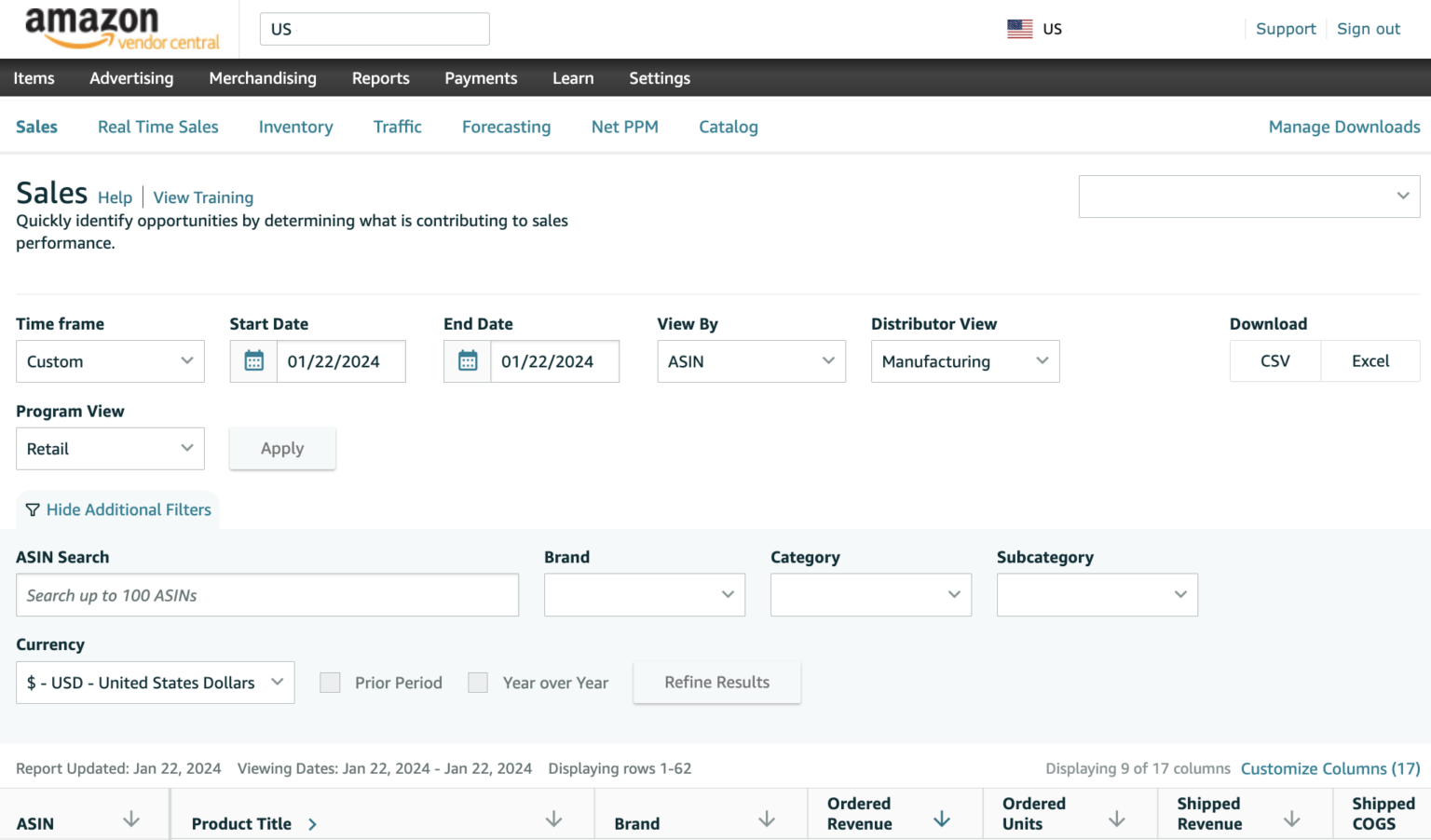
The Amazon business model you choose decides which path you take through that system. Seller Central keeps the brand in charge of pricing, listings, and inventory risk. Vendor Central hands that control to Amazon, which buys wholesale and sets the retail price.
Most growth-stage direct-to-consumer and CPG brands run Seller Central or a hybrid of the two. Vendor Central trades away pricing control for a relationship that looks more like account management than marketplace operations. Whichever model you pick changes who you need to hire next.
What it costs to start an Amazon ecommerce business
Before any of that hiring math matters, you need the business to exist. Anyone researching how to start an Amazon business, or opening an Amazon seller account for the first time, runs into the same five cost lines: selling plan, referral fee, fulfillment, initial inventory, and tooling.
Cost category
What it covers
Range or detail
Selling plan
Amazon's account fee
Individual plan $0.99 per item, or Professional plan $39.99 per month
Referral fee
Amazon's cut per sale, by category
6-45%, most categories land near 15%
FBA fulfillment fee
Pick, pack, and ship per unit
Varies by size and weight tier, revised annually, plus periodic fuel and logistics surcharges layered on top; no fixed figure across categories
Initial inventory and MOQ
First production run and supplier minimums
The dominant Stage 1 cost driver, scales with unit economics, no fixed figure
Those five lines set the entry price. None of them decides whether the business survives. "Can I make $1,000 a month on Amazon" is the wrong question. What matters is net contribution, the money left after referral fees, fulfillment, and ad spend. That number rarely turns positive until the catalog and structure both outgrow a single SKU.
The margin picture is worse than most independent sellers expect walking in. Over 50% of sellers report being less profitable than the year before. 67% raised prices to cover FBA fee hikes, and nearly 60% of those who raised prices still watched profits fall anyway.
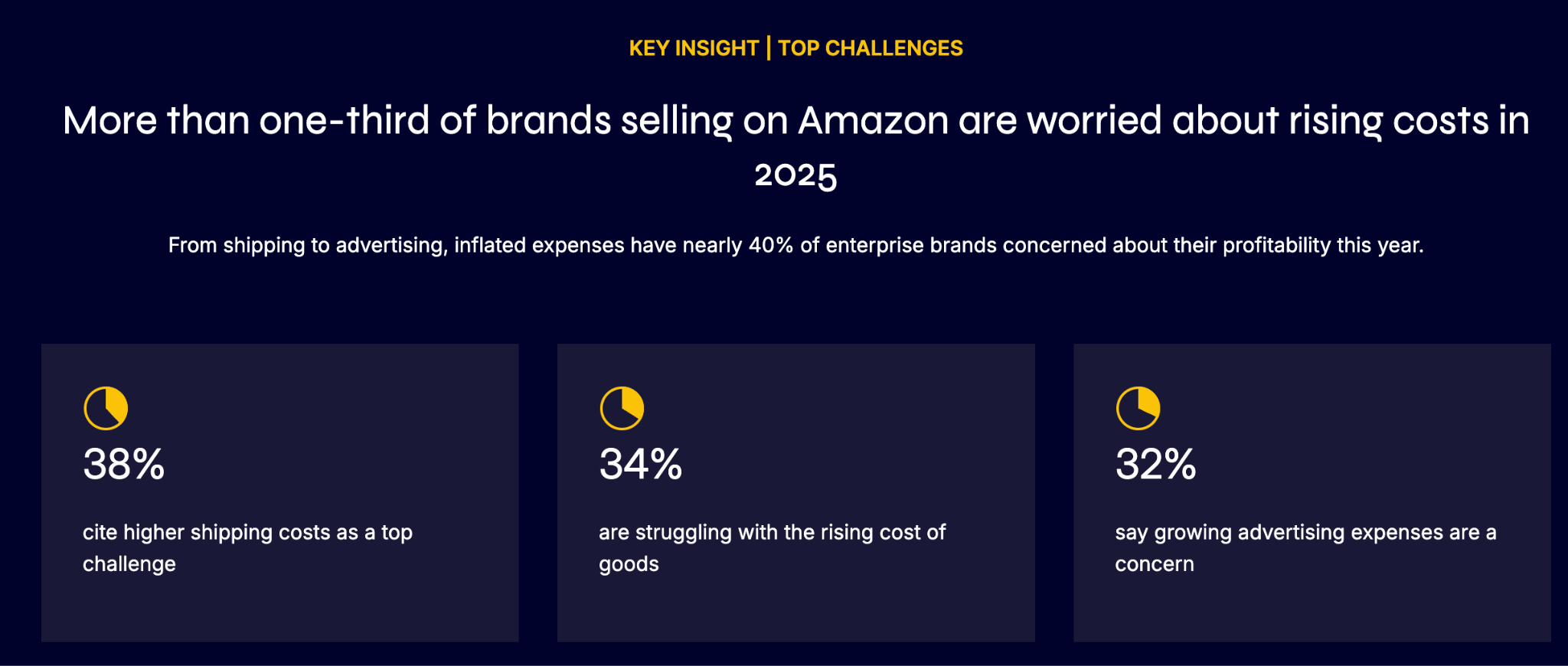
The pressure reaches enterprise sellers too. Nearly 40% of enterprise brands cite profitability as a direct concern, driven by rising shipping and advertising costs on top of the FBA fees already squeezing margin.
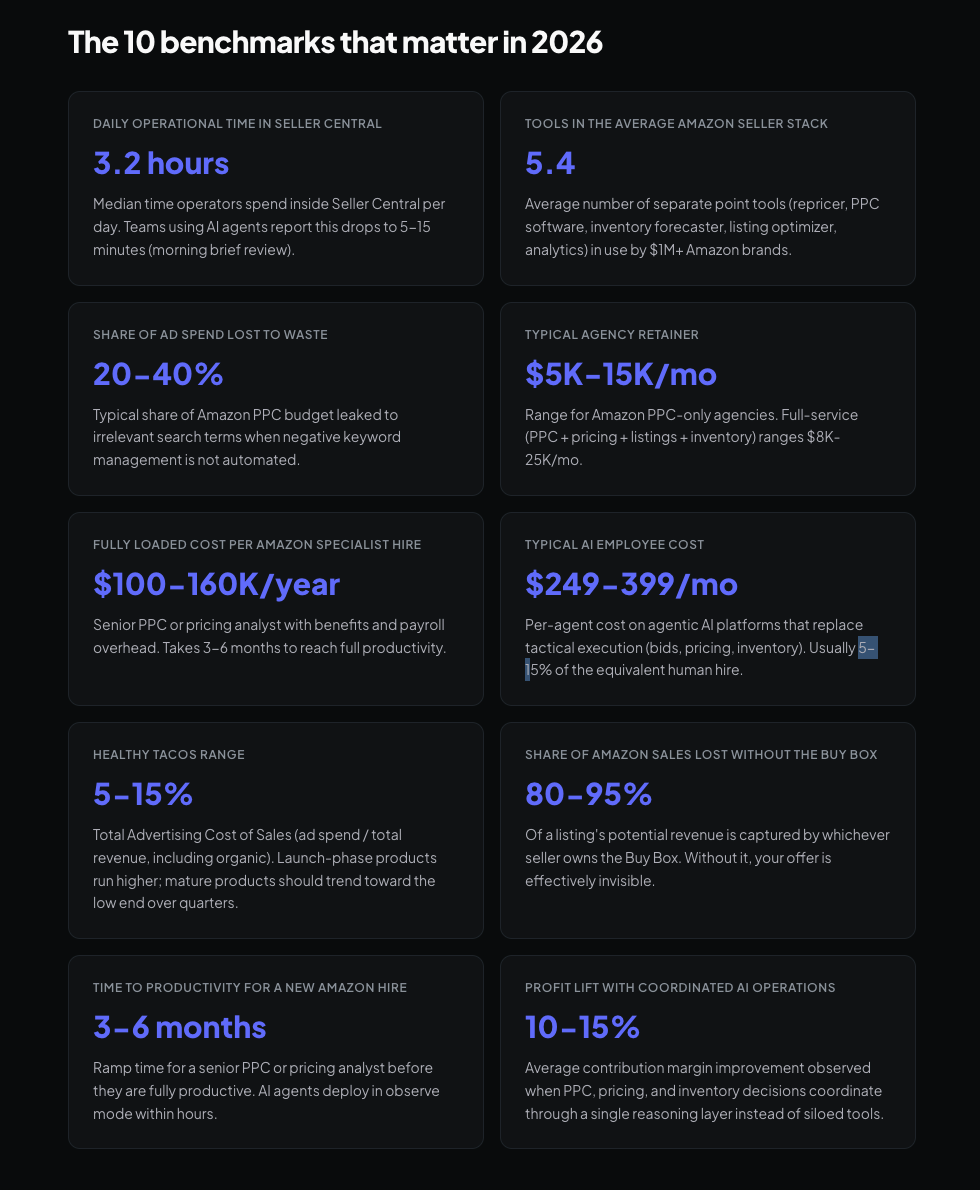
Whatever the exact numbers, the startup-cost question already has a well-published answer. The question that decides whether the business works is who owns the account once it's running. Brands that coordinate advertising, pricing, and inventory through one owner report a 10–15% average profit lift over brands running those three functions separately. That figure is the argument behind everything that follows.
FBA, FBM, or hybrid: the choice that sets your org chart
The fulfillment model is an organizational decision that goes well beyond shipping preference. Most owners researching how to sell on Amazon treat it as a logistics question, then hire against the answer they never questioned.
Under FBA (Fulfillment by Amazon), Amazon absorbs warehousing, picking, packing, shipping, and most customer service. That pushes the real burden upstream, onto supply chain finance and demand planning, instead of a warehouse floor.
The main risk is a stockout or an Inventory Performance Index penalty, rather than a shipping error. This calls for a demand planner, since a warehouse manager solves the wrong problem.
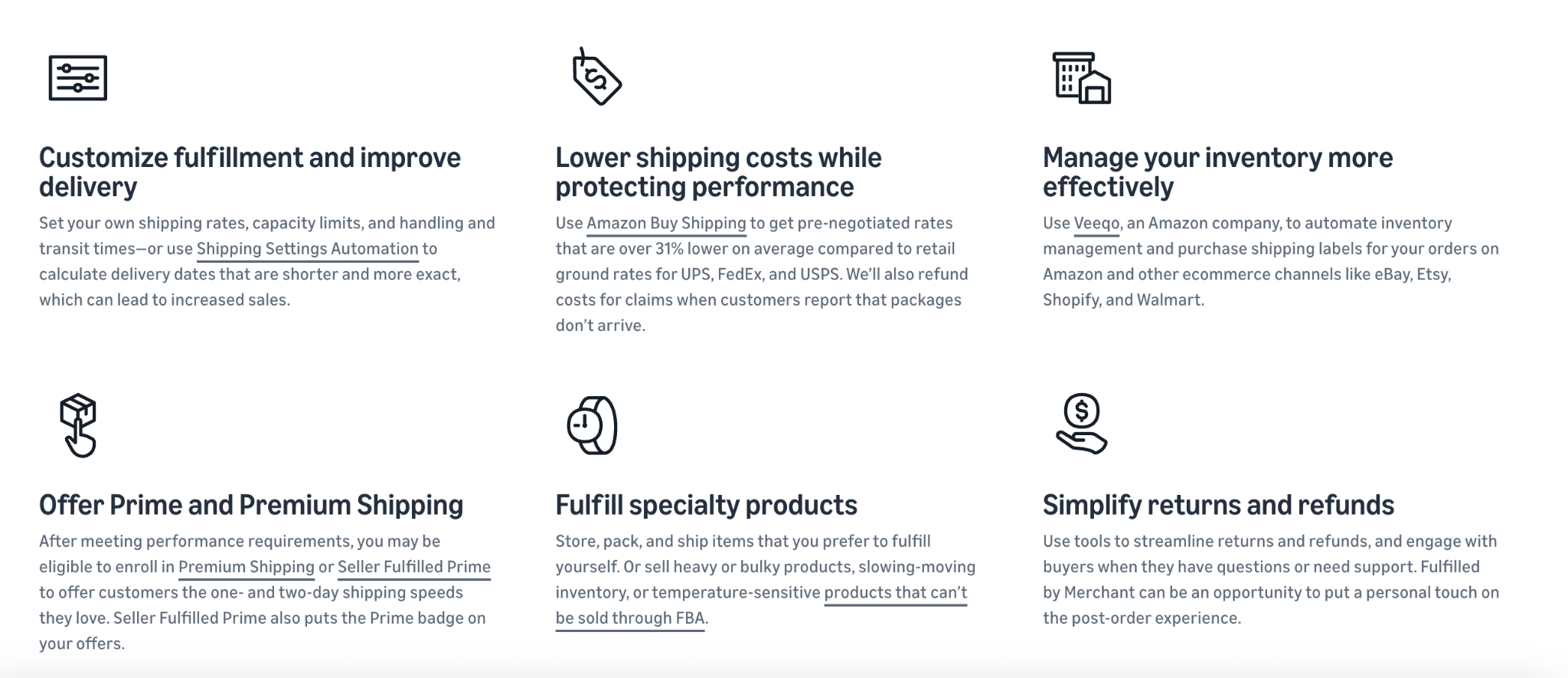
FBM, or Fulfilled by Merchant, makes the brand its own logistics operation. Warehouse systems, carrier relationships, and pick-pack throughput all become your problem. Late Shipment Rate and Valid Tracking Rate become account-health metrics you monitor daily. Miss them and you risk listing suppression or suspension. The hiring implication is a dedicated fulfillment operations lead, since a marketing hire with logistics bolted on won't do the job.
A third path pairs Amazon Warehousing and Distribution with FBA. It moves bulk inventory upstream and runs auto-replenishment against smart storage rates. That buffer absorbs manufacturing lead-time variability and port congestion.
Constant Hire sees it most often at the growth stage, and it is the hardest of the three to staff, since one person has to model both buffers at once.
Model
What Amazon absorbs
What you staff
Compliance metric that matters
FBA
Warehousing, pick-pack-ship, most CX
Demand planning, IPI management
Inventory Performance Index
FBM
Nothing logistical
Warehouse, carriers, packing, CX
Late Shipment Rate, Valid Tracking Rate
AWD + FBA hybrid
Upstream bulk storage, auto-replenishment
Dual-buffer inventory modeling
IPI, storage utilization
Source: Constant Hire analysis, based on Amazon's fulfillment documentation.
Decide the fulfillment architecture before you write a job description. They are the same decision.
The Marketplace Ownership Triad
Most Amazon-first businesses that stall run into something more basic than a shortage of tactics. Product lines pull in three directions on the same ASIN. A live campaign drains stock nobody flags in time. A listing goes stale because three people each assume someone else owns it.
The Marketplace Ownership Triad is an organizational model that assigns every Amazon marketplace responsibility to one of three accountability pillars, helping DTC and CPG operators reach a state where no ASIN has two owners and no metric has none.
Stockouts, a lost Buy Box, cash stuck in dead stock
Source: Constant Hire framework.
Take the Operational Finance row. A stockout during a live campaign costs more than most sellers expect. Losing the Buy Box costs the 80–95% share of a listing's revenue that comes with it, on top of the sale itself.
That's the cost of a pillar with no name on it. At $2M in revenue, these three pillars are three hats on two people. At $20M they are three departments. The accountability is identical at both ends.
Run the Triad against your own org chart right now. Write a name next to each pillar. No name next to one means that's your next hire. Three names on one person means that's your next reorganization.
The five roles an Amazon-first business needs
Call it Amazon Brand Manager or Amazon Marketplace Manager, but either way, this isn't a scraped job title list. Each of these five roles maps onto one of the three Triad pillars, and early on, one person can hold three of them at once, though the role stays fixed even when the headcount doesn't.
Unit session %, CTR, video completion rate, return rate
Catalog, Compliance and Account Health Specialist
Flat-file uploads, listing resolution, Brand Registry IP claims
Seller Central Catalog API, flat files, case logs, Brand Registry portal, Account Health dashboard
Account Health Rating, stranded inventory %, policy compliance defect rate, case time
Source: Constant Hire analysis.
Amazon brand manager or director of ecommerce
The Amazon Brand Manager owns the marketplace P&L against a four-part scorecard covering traffic, conversion, reviews, and net margin. This person runs cross-functional execution across advertising, creative, and inventory, and owns the product launch and promo calendar too. Everything that touches the P&L eventually lands on this desk.
Demand planner or supply chain manager
This role owns inventory flow and working capital efficiency, and coordinates directly with suppliers.
This person runs the S&OP process that reconciles marketing, advertising, and operational forecasts into one demand plan, and manages factory lead times, container freight, and restock limits across AWD, third-party logistics, and FBA. Inventory Performance Index is the number that says whether the job is working.
Amazon PPC and programmatic media specialist
The Amazon PPC specialist builds campaign architecture: multi-tier structures, automated harvesting funnels, intent-based conquesting, full-funnel DSP retargeting across Amazon Ads. The differentiator is working directly with the demand planner to adjust spend against real-time stock, so a high-velocity ASIN stays supported without ever running dry. A campaign should never be the reason a best seller runs out.
Creative director or visual SEO specialist
This is the most under-scoped role on the list. Brands hire for aesthetics. Amazon's algorithms grade for machine readability. That mismatch is why strong creative underperforms without anyone on the team knowing why. The job translates technical specs into assets a machine can also parse, including mobile-optimized infographics, Premium A+ interactive modules, comparison tables, and OCR-indexable video.
Catalog, compliance and account health specialist
This role owns backend catalog maintenance inside Seller Central: flat-file taxonomy uploads, stranded and suppressed listing resolution, IP claims through Brand Registry, and case management with Seller Support. Done right, it shows up directly in revenue.
Done well, this work shows up in revenue. Consolidating a fragmented catalog under correct parent listings can lift sessions and order volume inside weeks. Done badly, it stays invisible until it is catastrophic. 35% of sellers have experienced an account suspension, and sellers in the $100k to $1M band are the most affected. That is also the stage least likely to have anyone owning account health.
Why COSMO and Rufus changed who you need to hire
Amazon's search ranking moved off lexical keyword matching, and two roles got harder overnight. A9 and A10 scored how closely your listing text matched the shopper's query, word for word.
COSMO replaced that logic with a semantic knowledge graph built from search queries, browsing behavior, and purchase patterns. Rufus layers a conversational, retrieval-augmented generation system on top of it, drawing on catalog metadata, reviews, and community Q&A.
COSMO decides what's relevant, and Rufus explains the decision in plain language.
The effect shows up in what Amazon infers, before any result renders. Search for a camping tent, and waterproofing spray, ground stakes, and a thermal sleeping pad can surface too, though none of those words appear in the tent's listing. The graph indexes meaning rather than words.
Keyword stuffing now works against you, because it dilutes the signal a semantic system reads. Listing work has become structured-data work. That means complete backend attributes, bullets ordered outcome then feature then use case, a full 2,000-character description, and typography large enough for OCR to read reliably.
Listing component
Legacy protocol
Semantic protocol
Why it matters
Product titles
Keyword-dense, disconnected phrase strings
Semantic noun-phrase structure, primary keyword inside the first 80 characters, the portion that fully displays on mobile
Lets conversational models parse product identity and handle voice queries
Backend search terms
Repeated terms, stop words, punctuation
Strict 250-byte use, pure spacing, no stop words, no punctuation, deduplicated
Maximizes token efficiency inside the non-indexed limit
Bullet structure
Keyword-dense feature lists
Outcome, then feature, then use case
Matches how Rufus explains a recommendation
Backend attributes
Optional, often incomplete
Full completeness across materials, compatibility, care instructions, and target audience
Feeds the knowledge graph directly
Description length
Short, keyword-focused
Full 2,000-character description covering edge-case compatibility, maintenance, and box contents
Gives COSMO more entity data to work with
Visual assets
Lifestyle photography, no machine-readability consideration
Ask a listing candidate what changed about Amazon search in the last two years. A keyword-focused answer describes a job that stopped existing.
The Founder Handoff Sequence
A founder can't chase every algorithm shift and still run the P&L alone.
The Founder Handoff Sequence is the order in which an Amazon-first founder transfers ownership of each Triad pillar as revenue scales, and the specific hire that closes each handoff.
Stage
ARR
Org configuration
Pillars handed off
Primary operational risk
Stage 1
$0–$1M
Founder holds all three pillars, offshore assistant on admin
None, admin relief only
Founder burnout, working capital constraints, single-ASIN stockout disruption
Stage 2
$1M–$5M
Demand planner, PPC specialist, and brand manager each own a pillar
Operational Finance, then Visibility, then Asset Integrity
Director of Ecommerce over category managers, centralized departments
All three, departmentalized
International compliance failures, channel margin erosion, organizational bloat
Source: Constant Hire analysis.
At Stage 1, you hold all three pillars yourself. An offshore assistant absorbing case logs and reimbursement tracking is administrative relief, not a handoff, no matter how much time it frees up. Stage 1 overlaps with the band where suspensions concentrate. Sellers between $100k and $1M in revenue are the most affected, and nobody at that stage owns account health. The goal at this stage is organic rank velocity with inventory buffers intact, nothing more.
At Stage 2, Operational Finance goes first. A demand planner takes over S&OP and AWD auto-replenishment, then Marketplace Visibility passes to a PPC specialist who owns TACoS directly. The brand manager takes Asset Integrity last, along with the P&L itself.
At Stage 3, a Director of Ecommerce sits over category brand managers. Centralized supply chain, media, and analytics departments pipe data through Seller Central APIs into internal warehouses. A quarterly Organization and Leadership Review checks output against overhead. At this scale, coordination is the constraint rather than capability.
Operational Finance goes first for a specific reason. A stockout costs organic rank and Buy Box stability that take months to rebuild. Wasted ad spend costs money you can stop spending tomorrow. One of those failures compounds, and the other one doesn't.
The complexity trap between $1M and $5M
Between $1M and $5M, complexity compounds faster than headcount does. You, or one generalist hire, can hold listings, PPC, replenishment, and customer support at $1M. By $4M the same person is triaging instead of operating. An administrative layer expands quietly underneath: case logs, stranded inventory reconciliation, flat-file errors, manual bid adjustments. None of it is strategic, and all of it is urgent.
That imbalance compounds in a predictable order. A missed replenishment cycle leads to inefficient ad spend propping up a thinning catalog, which leads to decaying organic rank. Eventually it costs you the Buy Box outright, and each failure makes the next one more likely.
The fix is SOP development plus a recurring Organization and Leadership Review that checks whether management overhead is eating your output. Brands fall into this trap by hiring another generalist instead of handing off a pillar, which makes it a sequencing problem the Handoff Sequence already answers.
How to increase sales on Amazon (and who owns each lever)
Four levers move sales on Amazon, and each one belongs to a specific pillar.
Semantic listing completeness is Asset Integrity's job: complete backend attributes, outcome-first bullets, and OCR-readable creative. That is the standard COSMO and Rufus grade against.
Marketplace Visibility's job is structured campaign design, since bid tinkering doesn't scale. A healthy TACoS sits in the 5-15% range, holding it there is structural work.
Inventory availability is a ranking input, not only a fulfillment metric, and Operational Finance owns it. A stockout costs the ASIN its rank position on top of the sale.
Suppression and suspension are the largest single-day revenue risks on the platform, which is why Asset Integrity owns account health as a sales lever rather than an admin task.
Every one of these levers is available to every seller on the platform. The variable is whether somebody owns it.
Should you hire in-house, offshore, or with an agency for your Amazon business?
Offshore specialists work well inside a defined, procedural scope: case management, flat-file updates, reimbursement tracking, listing maintenance. They work badly as pillar owners, because ownership means making P&L tradeoffs. Clearing a task queue is a different job.
Agencies work when the gap is a capability you won't build in-house, most often DSP or programmatic media. They work poorly as a Brand Manager substitute, since you're paying the vendor for activity rather than outcome.
In-house becomes the right answer the moment a pillar needs an owner making tradeoffs against the other two. That is almost always the Brand Manager first. The demand planner follows.
The shortage was never tactics. It was ownership. Economics, fulfillment model, and semantic search all land in the same place: someone has to be accountable for each of the three pillars, and a founder cannot hold all three forever.
That's the gap a specialized hire closes. Constant Hire recruits only for DTC, ecommerce, and CPG roles. Candidates are screened against IPI management, TACoS ownership, and Buy Box stability, which is not what a general staffing brief asks about.
At Constant Hire, we build our database from operators who have already managed the tradeoff between ad spend, inventory, and margin. That is the judgment a generalist recruiter's database was never built to screen for. Clients interview their first vetted candidate inside five days.
If you’d like to hire in-house or discuss the next steps of your Amazon business, book a call with us.
FAQs
What is an Amazon ecommerce business?
An Amazon ecommerce business sells directly to shoppers through the Amazon marketplace, not through its own storefront. It runs inside a closed system. Fulfillment rules, the algorithm, and working capital decide performance more than acquisition spend does, which is the opposite of how a direct-to-consumer brand operates.
What roles do you need to run an Amazon business?
Five roles map onto three accountability pillars. Marketplace Visibility needs a PPC and programmatic media specialist. Asset Integrity needs a creative director or visual SEO specialist, plus a catalog and compliance specialist. Operational Finance needs a demand planner. A brand manager or director of ecommerce owns the P&L across all three.
Is an Amazon ecommerce business still worth it in 2026?
What are the disadvantages of an Amazon FBA business?
IPI-driven holding penalties hit first. Fall below Amazon's inventory health threshold, and storage limits and fees follow. Stockouts cost organic rank and Buy Box position on top of the lost sale. Referral, fulfillment, and surcharge fees compound together. Suspension risk peaks in the $100k-$1M band. And the brand never owns the customer relationship; Amazon controls it.
Connor Gross founded Constant Hire in 2024. An operator turned founder with deep experience building and scaling e-commerce brands. He previously sold an Amazon brand and generated over $30M in DTC revenue through private-label Shopify businesses. He now helps fast-growing DTC brands and agencies hire top talent across marketing, creative, ops, and sales. From E‑com Managers to TikTok Creators and Heads of Growth, he knows what great looks like, and how to recruit it.