Agentic commerce, AI discovery, and recommendation flows explained for DTC brands.
What Is Agentic Commerce? The Three Layers and Who Owns Them
Agentic commerce, AI discovery, and recommendation flows explained for DTC brands. What each layer actually lifts as of September 2026, and who owns it.
Agentic commerce is a model of online buying in which an AI agent handles product discovery, comparison, and sometimes the transaction itself on a shopper's behalf, so brands compete for the agent's recommendation rather than the shopper's click.
That shift changes who a DTC brand is selling to on a growing share of its traffic. Three layers make up agentic commerce, and they sit at different stages of maturity.
The layer every headline chases, an agent placing the order on its own, already had one public false start, and the retreat from it is still playing out. The two layers underneath it, discovery and recommendation, are the ones paying off for a brand as of September 2026.
This guide separates AI commerce into three layers, states plainly what each one lifts as of September 2026, and ends on who inside your team should own each layer.
Key takeaways
Agentic commerce is three layers, not one: AI discovery, recommendation flows, and agentic checkout. Constant Hire calls this the AI Commerce Stack.
Discovery and recommendation pay today, checkout does not. AI-referred traffic grew 62% year over year and converted 60% better than non-AI traffic in July 2026 (Adobe). Agentic checkout is still rebuilding after OpenAI wound back Instant Checkout in March 2026.
Structured product data gates all three layers. 39% of retail homepages are not machine-readable. An agent cannot buy a product it cannot read.
Brands lose this channel to ownership gaps, not technology gaps. In most ecommerce teams, no one owns any of the three layers. Under $5M in revenue, the fix is clean product data. Between $5M and $20M, it is a named owner.
What is agentic commerce?
A shopper states what they want in plain language, something like waterproof hiking boots under $150 that arrive by Friday. The agent takes it from there, searching, comparing options against those constraints, checking real-time availability, and either returning a shortlist or completing the purchase outright, depending on how much authority the shopper granted it.
None of this happens on a results page a brand can rank on.
For the brand on the other end, there is no results grid, no ad position, and no impression to buy. The metrics an ecommerce team has always tracked, including rankings, click-through rate, and page views, stop applying once an agent does the searching.
Paid placements and product carousels can still appear inside AI conversations, but they do not follow the same ranking model as a traditional results page.
A product that never lands in the agent's shortlist may never be seen in that interaction, and a standard analytics dashboard may not explain why it was excluded. That gap is where most of the confusion about this channel comes from.
Conversational commerce puts a chat interface, whether a scripted chatbot, a voice assistant, or a live agent, in front of a human who still makes every decision. Agentic commerce hands part of that decision, and increasingly the execution, to the system itself.
That distinction is the one most explainers on this topic blur, and it matters because the second model needs your product data to be readable by a machine, not persuasive to a person.
Agentic AI vs agentic commerce
Agentic AI is the general capability, artificial intelligence software built on large language models (LLMs) that plans, uses tools, and takes multi-step action toward a goal without needing a person to walk it through each step. Agentic commerce is that same capability, applied to buying and selling.
One is a category of technology, broad enough to cover a coding assistant or a scheduling tool. The other is a category of transaction, narrow enough to have a real, measurable effect on a brand's revenue this quarter.
A brand cannot do much about agentic AI as a general technology trend. It can influence whether the AI agents doing commerce can read its catalog, trust its data, and complete an order against the brand. That is the entire practical difference, and it is the pivot the rest of this guide is built around.
The AI Commerce Stack
The AI Commerce Stack is the three-layer model of AI-driven ecommerce, separating how products are found, how shoppers are converted, and how transactions are executed, so brands can invest in the layer that pays today instead of the layer that gets the headlines.
A brand that reads a headline about a multi-trillion-dollar opportunity and responds by building for autonomous checkout is investing in the least mature layer of the three. The same budget spent on machine-readable product data and on-site recommendation produces a measurable return this quarter, not a hypothetical one two years out. The three layers are sequential, and their maturity follows the same order.
Layer
Function
Primary metric
Status, Sept 2026
Layer 1: AI Discovery
Being surfaced when a shopper asks an AI assistant a buying question
Qualified sessions, share of citation
Live. Traffic up 62% year over year (Adobe, July 2026).
Layer 2: Recommendation Flows
On-site and in-chat personalization after arrival
CVR, AOV, LTV
Live and measurable. Highest confirmed return of the three.
Layer 3: Agentic Checkout
An agent completing the transaction
Completed agent-initiated orders
Rebuilding. First major implementation withdrawn March 2026.
Layer 1 is where the traffic originates, and Layer 2 is where that traffic converts. Once an agent trusts the merchant enough to hand over payment, Layer 3 is where the transaction eventually settles.
The order is not a preference. It is a dependency. An agent cannot buy a product it cannot find, and it cannot find a product whose price, stock, and attributes it cannot read. Every protocol in Layer 3 assumes the catalogue underneath it is already accurate and already parseable, which means a brand that skips the first two layers has bought infrastructure that has nothing to run on.
That is not a theoretical risk. It is what happened to the first serious attempt at Layer 3, and the reasons it happened are documented later in this guide. The brands that got the most out of AI commerce in 2026 spent the year on product data, not on checkout integrations.
Layer 1, AI discovery
Shoppers used to type three-word searches into a box. Now they hand a constrained, multi-variable question to AI agents built into ChatGPT, Gemini, Perplexity, and a growing list of retailer apps, and get back a shortlist instead of ten blue links. The brand's job is no longer ranking on a page. It is being the kind of citable source those agents trust enough to include.
Adobe's own tracking puts numbers on that shift. AI-referred traffic to US retail sites grew 62% year over year as of July 2026, up 1,219% since October 2024, when Adobe began tracking it. The same shift holds at global scale.
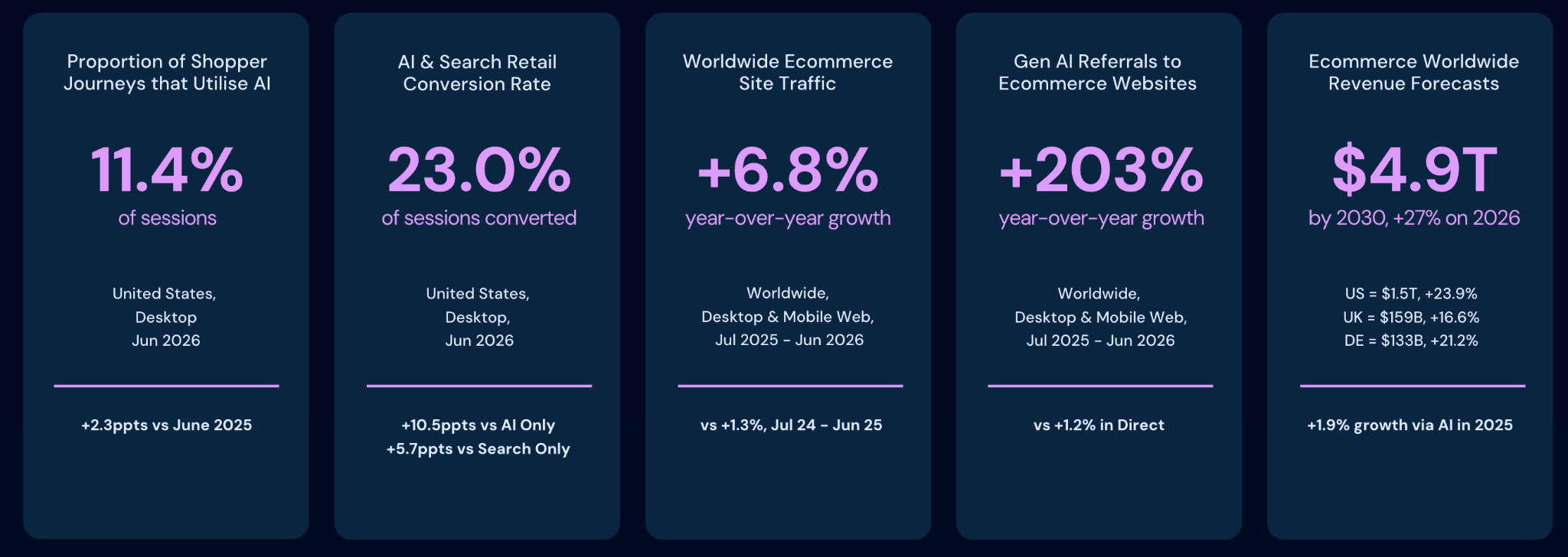
Gen AI referrals to ecommerce sites worldwide grew 203% year over year, against 1.2% growth in direct traffic, per Similarweb's State of Ecommerce 2026 report, published 10 September 2026. Similarweb's figures are panel estimates and not audited census data.
Source: Similarweb - State of Ecommerce 2026: at a glance
As of July 2026, 39% of homepages in Adobe's expanded retail cohort scored as not machine-readable, on panel data drawn from retailers running Adobe analytics instead of a census of US retail. Other factors affect AI visibility too, but this is a lever a brand controls directly: making its digital properties and product content easier for machines to parse, without waiting on a platform change or a competitor's content budget.
Structured product data done properly is the operational fix. That means a Product record with a nested Offer carrying price and availability, plus brand and aggregateRating fields, a stable identifier for every SKU, one canonical URL per product, and consistent naming between the storefront and the feed. That list sounds basic until someone audits a real set of stores. Devin Concannon, founder of Shopify growth agency Golden Digital, checked 13 of the stores his team runs: "Six of the 13 Shopify stores we checked this week didn't have a GTIN on a single product. That's the barcode number platforms use to know two listings are the same product. A human shopper doesn't pay attention to that. An agent usually does."
It also means live APIs rather than batch exports wherever possible, with pricing and availability accurate in real time, since last night's sync leaves an agent reading stale stock.
Shopify put a number on the difference on its Q2 2026 earnings call. AI searches running against Shopify Catalog, its structured index of over a billion products, converted at roughly twice the rate of AI searches relying on scraped product data, and about 80% above traditional organic search. Same shoppers, same intent, same platform. The only variable is whether the agent read a structured record or guessed from a web page.
AI discovery rewards legibility over optimization.
ChatGPT Ads and why they belong in this layer
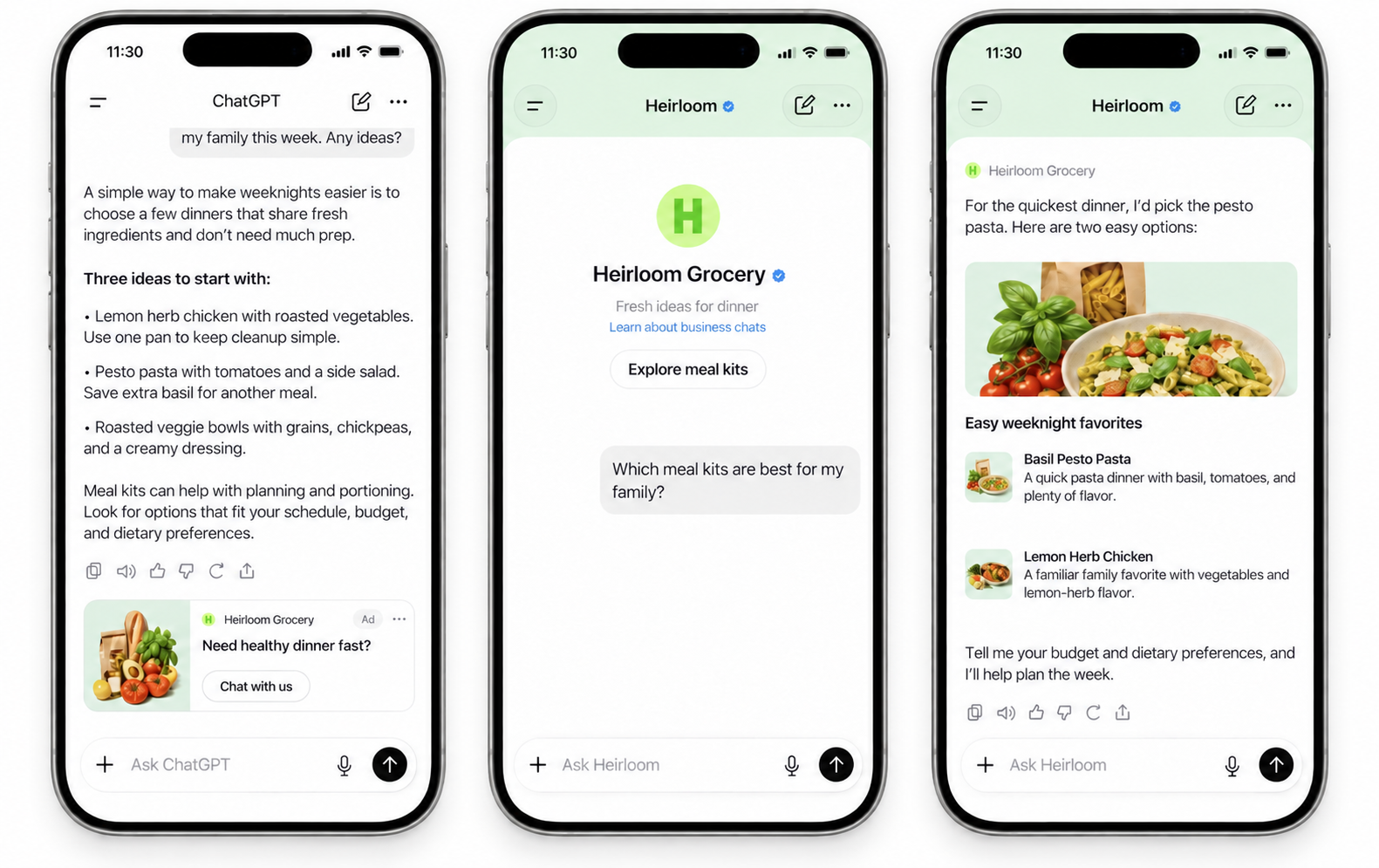
Paid and organic run on the same product data, and OpenAI's 16 September 2026 announcement makes that explicit. US Shopify merchants can now create and manage ChatGPT ad campaigns through a ChatGPT Ads app in the Shopify App Store, and their products are already integrated through Shopify Catalog, so merchants can start running these ads and tracking performance immediately. The app reaches other ChatGPT Ads markets on 23 September 2026. One structured catalog feeds both the ad and the organic recommendation.
Source: Search Engine Roundtable
OpenAI began testing ads in ChatGPT in the US on 9 February 2026, on the Free and Go tiers only, and has expanded steadily since: Canada, Australia and New Zealand from late March, then the UK, Mexico, Brazil, Japan and South Korea on 11 August, then direct Ads Manager buying across India, Europe, the Middle East and North Africa in late August. The platform reported a $1 billion annualised revenue run rate in under 200 days, with tens of thousands of advertisers. Paid subscription tiers remain ad-free.
On 26 March 2026, OpenAI said it would expand to Canada, Australia, and New Zealand in the coming weeks, then confirmed the pilot had launched in the United Kingdom, Mexico, Brazil, Japan, and South Korea on 11 August 2026. In late August it opened direct Ads Manager buying across India, Europe, the Middle East, and North Africa, and reported that ChatGPT Ads had reached a $1 billion annualized revenue run rate in under 200 days, with tens of thousands of advertisers.
According to its ad policy page, updated 11 August 2026, ad delivery weighs conversation topic and intent alongside advertiser-provided context hints, which can include keywords, though not as exact-match targeting, and ads will not appear near health, mental health, or political topics, or reach users it predicts are under 18.
A brand used to Meta-level attribution is buying into a channel where campaign performance is visible, but the underlying conversation is not. OpenAI is closing part of that gap fast: conversion optimization, 30-day click windows, and cross-platform targeting all landed in Ads Manager in September 2026. The conversation itself stays hidden. That is a measurement problem before it is a media buying one, and it needs someone who can build attribution around the part that stays dark rather than someone who can only optimize inside an ad account.
"When an AI agent finds and buys a product for someone, there is no click for standard tracking to attach the sale to, so a brand can see revenue appear with no attribution trail at all. What people get wrong is assuming the platform running the AI agent will report this honestly. It will not, for the same reason ad platforms do not now: they are incentivised to claim the sale." - Olam Sule, Founder, Dolphin Analytics
Layer 2, AI product recommendation flows
When most people say AI personalization ecommerce, this is the layer they mean, even though checkout agents get all the headlines. It also has the clearest measured return of the three layers, and the least attention. That clarity comes from where the measurement happens: Layer 2 sits inside your own analytics, so a brand can test recommendation changes against its own numbers.
Two reasons explain the gap. This work is unglamorous next to an agent placing an order, and it happens entirely on your own site, so no platform issues a press release announcing it on your behalf.
The lift shows up in three metrics. Conversion improves because a generic browsing session gets replaced with a shortlist that already reflects a real constraint. The comparison happened inside the chat before the shopper ever landed on your site.
Average order value improves through context-aware cross-sell and bundle logic that shows up at the point of decision, where a generic cart widget arrives too late.
Lifetime value moves more slowly and is harder to isolate in a single report, but the mechanism is straightforward. Reorder timing, replenishment prompts, subscription management, and post-purchase flows tuned to the individual shopper compound over repeat purchases in a way a single quarter of data will not show you.
The numbers back the first two. The channel-level numbers show what that pre-qualified traffic is worth before any on-site work: AI-referred visitors converted 60% better than non-AI traffic and generated 53% more revenue per visit as of July 2026, an 11th consecutive month of outperformance. That premium describes the visitors AI sends you. What you do with them once they land is the part you control, and it is the part almost nobody is measuring separately.
Similarweb's State of Ecommerce 2026 report backs the same point from a different angle: 23.0% of sessions that combined AI and search touchpoints converted, the best-performing path the report tracks. Its lead author frames this as stacking over switching, with 89% of consumers who use AI in shopping research also using search. Correlation, not proven causation: the most deliberate shoppers may simply use more tools.
Shopify's Q2 2026 earnings call on 5 August 2026 gave the strongest platform-level reading available. AI-driven traffic and orders to Shopify stores each tripled year over year, and conversion on searches powered by Shopify's Catalog ran roughly twice that of searches using scraped data and about 80% above traditional organic search. Roughly half of AI-referred sessions land directly on product pages against about 20% for traditional search, and new buyers arrive through AI channels at nearly twice the rate of other channels. These are company-reported figures from a platform with an interest in AI referrals looking additive.
The landing-page split changes how DTC teams should treat the PDP. If most of your AI-referred traffic lands on a product page and not a category page or your homepage, the product page is the landing page for this entire channel, and most DTC brands have never once treated it that way.
Layer 2 recommendation systems can run on product and sales data alone, independent of how a shopper arrived. But the same structured product data that makes you findable to an AI shopping agent also strengthens on-site recommendation once the shopper arrives, so one investment pays out twice.
Layer 3, agentic checkout
OpenAI's Instant Checkout rollout, an early bet on autonomous purchasing inside the chat itself, launched and then pulled back within six months.
What happened to in-chat checkout
ChatGPT shopping through Instant Checkout looked, for about six months, like agentic commerce's proof point. OpenAI launched Instant Checkout with Etsy sellers on 29 September 2025, built on the Agentic Commerce Protocol it co-developed with Stripe, with more than a million Shopify merchants described as coming soon.
Forrester analysts Emily Pfeiffer and Sucharita Kodali reported on 7 March 2026 that Shopify confirmed to Forrester that the live merchant count was closer to 30 and climbing, still a small fraction of the million once promised.
The pullback traces to specific, documented reasons. Forrester's own analysis points to inventory visibility gaps, payment complexity, and unproven in-chat buying, not the protocol or merchant appetite. Storefront data quality is a related constraint, since an agent still cannot assemble a cart with confidence from a feed it cannot parse, which is where the first two layers of this stack come back into the picture.
The protocol picture as of September 2026
You do not need to implement a protocol to run a DTC brand. What matters is recognizing that none of the three camps in the table below has settled on a single approach to transaction execution. A separate, earlier layer, discovery protocols like Anthropic's Model Context Protocol, is still settling too, and agentic payments still have to solve for fraud detection, payment providers, and interoperability between systems that were never designed to talk to each other.
Most merchants already have a protocol endpoint and do not know it. Ethan Marsh, growth director at ecommerce consultancy Freeman NYC, found it while auditing a client's robots.txt: "Shopify has shipped the plumbing to ordinary merchants without most of them noticing. Pull the root sitemap of a Shopify store today and sitemap_agentic_discovery.xml is listed ahead of products, collections, pages and blogs. Merchants have an AI discovery surface whether they asked for one or not, and almost none of them are measuring it."
Initiative
Backers
Position taken
Status
ACP (Agentic Commerce Protocol)
OpenAI, Stripe
The assistant is the storefront. Transaction completes in chat.
Open source since Sept 2025. Original Instant Checkout implementation wound down March 2026.
UCP (Universal Commerce Protocol)
Google, Shopify, plus Amazon, Amex, Etsy, Mastercard, Meta, Microsoft, Salesforce, Stripe, Target, Walmart, Visa
The merchant keeps checkout, discounts, tax, and business logic. The agent negotiates against declared capabilities.
Launched 11 January 2026 at NRF; updated to protocol v2026-08-25 on 25 August 2026, with a Payments Technical Council seated 2 September 2026. Current center of gravity.
Claude Commerce Agents
Anthropic, with Shopify, Visa, Mastercard, and Accenture named at launch
The merchant runs the agent on its own property. Nothing in the reference implementation places an order or charges a card.
The three positions are the assistant as the storefront, the merchant keeping checkout, and the merchant running its own agent. UCP has drawn the most support of the three. Shopify said on its Q2 2026 earnings call that dozens of retailers and platforms have adopted the protocol it co-developed with Google, and the spec reached version 2026-08-25 on 25 August 2026, with payments lifted out of shopping into a cross-vertical namespace.
As of 2 September 2026, Anthropic reported carts up to 35% larger and shoppers 60% more likely to complete a purchase, though Angela Jiang, Anthropic's head of product for the Claude platform, told Reuters the cart figure came from a single partner, with no retailer names, sample sizes, or methodology published. Treat both as company-reported figures, not benchmarks.
What a DTC brand should actually do here
Make your catalog machine-readable. Every one of these protocols depends on it, whichever one wins. Do not build a custom integration against UCP, which launched in January 2026 and shipped a breaking structural rewrite in August. Watch which surface your own AI-referred traffic actually arrives from, and let that decide where you invest next.
How agentic commerce differs from traditional ecommerce
Traditional ecommerce optimizes for a human looking at a page, and most of the metrics a brand owns assume an impression reached a pair of eyes. When AI agents do the searching and comparing on the shopper's behalf, there is no grid to rank on, no position to bid for, and no impression to count.
Dimension
Traditional ecommerce
Agentic commerce
Unit of competition
The page
The product record
How shoppers arrive
Keyword search, ads, social
Constrained natural-language request answered by an assistant
Where comparison happens
Across browser tabs on your site and competitors'
Inside the chat, before any click
What the brand controls
Layout, copy, merchandising, ad position
Data accuracy, structured attributes, availability, checkout reliability
The practical consequence is that the unit of competition shifts from the page to the product record. A beautiful storefront with an incomplete feed can stay invisible in this channel, while a plain storefront with a clean feed still surfaces.
Design still matters for the shopper who lands on your site directly, though agent discovery relies more on structured product and merchant data before that visit ever happens.
How big is agentic commerce, really?
Relative lift and absolute share measure different parts of the channel, so they should not be read interchangeably.
AI-referred traffic already converts better and generates more revenue per visit than the rest of a retail site, and that outperformance streak hasn't broken yet.
The absolute scale is a different picture. Contentsquare, drawing on 99 billion sessions across 6,500 sites and 22 millions customer conversations, measured AI-referred visits at 0.2% of all visits in 2025, with an absolute conversion rate of 1.3%, below email at 1.9%. Adobe reports a relative premium, and Contentsquare reports an absolute share. Both are sound; they measure two different things.
Similarweb adds a third lens. Where Contentsquare counts visits that arrive with an AI referrer, Similarweb counts shopping behaviour that touches AI at any point: 11.4% of sessions involve AI somewhere in the shopper journey. A recommendation given in a chat and acted on an hour later shows up in one measure and not the other, which is why the two numbers are 50x apart and both defensible.
Source: Similarweb - State of Ecommerce 2026
Similarweb puts worldwide ecommerce revenue growth via AI at 1.9% in 2025. That is a slice of total ecommerce revenue growth, not the agentic-commerce-specific market size the forecasts later in this section address.
One operator has the same tension in her own numbers. Gabriella Timea Sinka runs marketing and AI visibility for SMB brands at TimeSaver, and has 3.5 months of citation data on a gift webshop client, measured in Microsoft Clarity's AI visibility module: 593 citations, a 19.1% share of authority against every other cited domain on those queries, and 17 AI-referred sessions, which is 0.04% of the site's total.
This is a small, fast-growing, high-quality channel. That combination justifies making your catalog legible and your product pages sharp, well before it justifies rebuilding checkout or adding dedicated headcount at every revenue stage, a point the ownership section below makes concrete. "Nearly 600 citations produced almost no traffic. AI discovery in 2026 is not a traffic channel, and anyone selling it as one is overselling it. It is a presence channel. If you measure it on sessions, you will kill the programme before it pays." - Gabriella Timea Sinka, Founder, TimeSaver
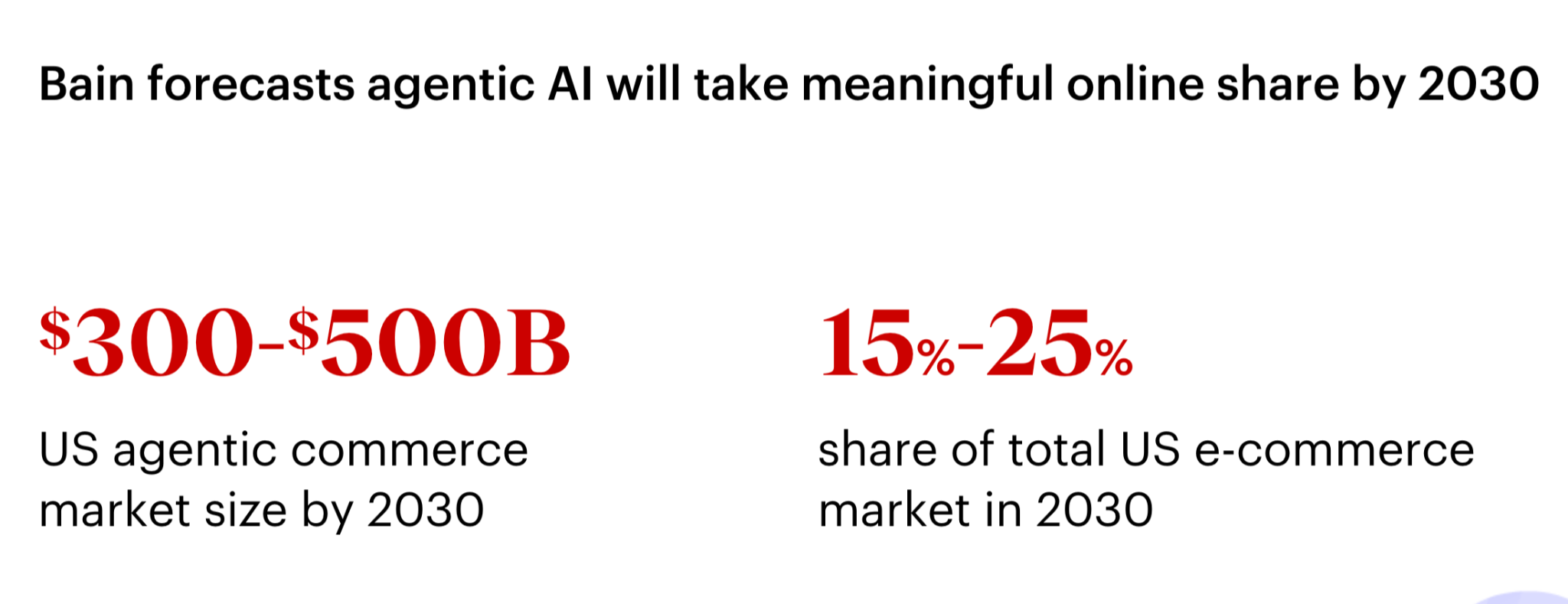
Held to the same geography, the US forecasts still diverge by a factor of five. Morgan Stanley puts US impact at $190 billion to $385 billion by 2030, Bain at $300 billion to $500 billion, and McKinsey at up to $1 trillion, against its $3 trillion to $5 trillion global figure.
Source: Bain - Bain’s agent AI forecast
A spread that wide inside one market is itself the useful fact. Treat any single headline figure with caution, and build for the channel you can already measure.
How agentic commerce changes consumer buying behaviour
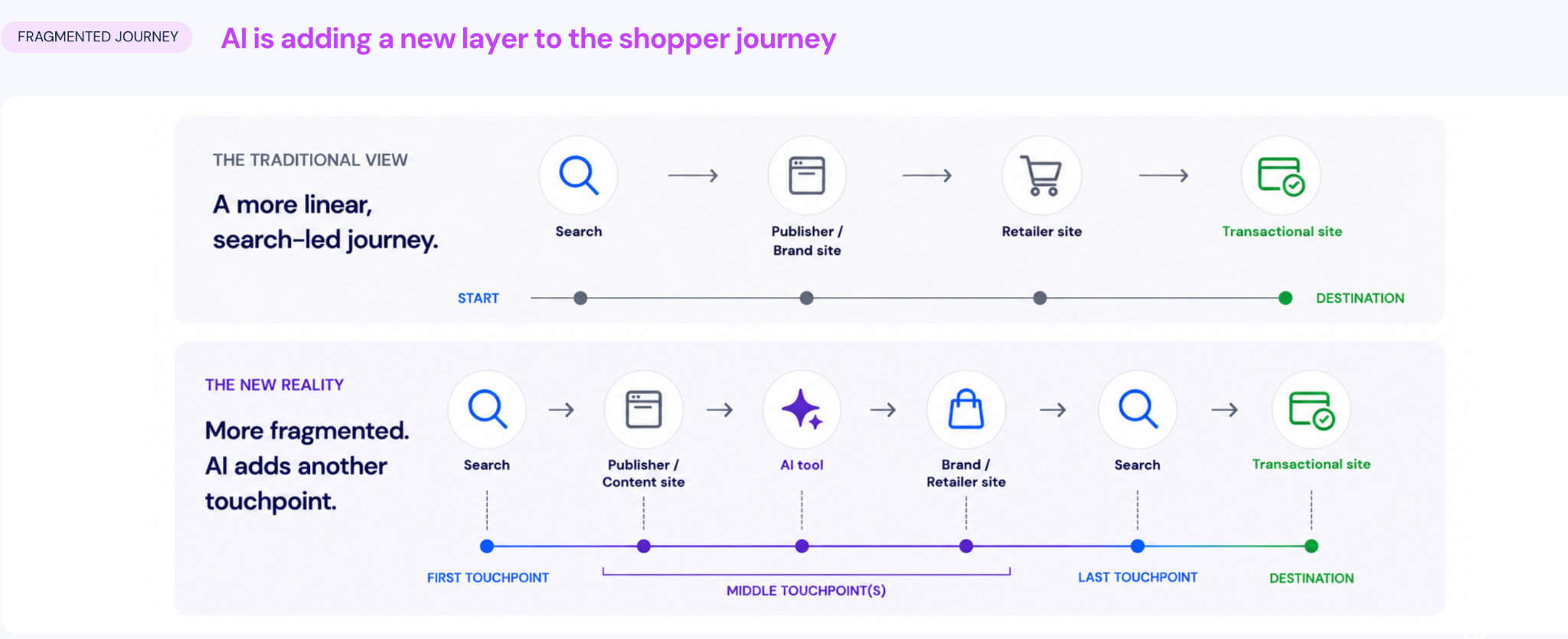
More of that comparison now happens off your site first, even for shoppers who still use a search engine before purchase. The customer journey compresses. A shopper narrows options inside the chat, then arrives at the product page already closer to a decision than a browsing session would have left them.
Your comparison content is competing for the agent's attention now as much as the shopper's, and the product page itself functions more as a confirmation page than a persuasion page.
Constraints now sit alongside keywords rather than replacing them. Shoppers can state a budget, a delivery date, a size, and a material in one AI request, while still typing a plain search term elsewhere in the same buying process.
Attributes you never bothered to structure, dispatch time, certification, exact fit, are now the filters an AI request checks before a human ever sees your product.
Brand recall weakens at the point of selection. A shopper who never browses past a three-item shortlist never sees your name often enough to remember it, and the brand that never got returned was never considered at all.
Similarweb measured what being the named brand is worth. When AI recommended Capital One, 14.2% of users visited Capital One within seven days against 3.8% who visited American Express. Reverse the recommendation and the gap narrows but holds, at 7.2% to 3.1%. The pattern repeats across travel and beauty. Presence inside the answer now matters more than preference inside someone's head.
Who owns each layer of the AI Commerce Stack
In most ecommerce teams, none of these three layers has a named owner. Answer engine optimization, or AEO, has no established home on the enterprise org chart, sitting in the gap between SEO, content, brand, and digital marketing, and work that sits in a gap does not get done.
The market has not settled on a title for this either, and some postings pair AEO with generative engine optimisation, or GEO. In a 17 July 2026 review of live postings, writer and ecommerce analyst Kaleigh Moore found AEO paired with existing job functions, including AEO and SEO Manager at Experian, Director of Discoverability, AEO and SEO at ADT, and AEO and GEO Marketing Manager at Stripe. Job titles move fast, and these were live as of that date.
When a function shows up under three different titles at three different companies, the market has agreed the work exists and has not agreed who does it.
The budget arrived before the title did. In Conductor's January 2026 survey of more than 250 enterprise CMOs and digital leaders, 94% said they planned to increase answer engine and generative engine optimisation investment in 2026, and 93% said they were building the capability in house rather than outsourcing it. Conductor sells AEO software and drew the sample largely from its own customers, so read it as directional. The broader signal is less contestable: Indeed Hiring Lab found the share of US job postings mentioning AI or AI-related terms up more than 130%, reaching 5.9% of all postings by June 2026, past the prior peak of 3.3% in 2022.
Layer
Symptom that it is unowned
Who usually owns it well
What breaks without an owner
Layer 1: AI Discovery
Nobody can tell you what share of sessions came from AI assistants last month
SEO or content lead with an explicit AEO mandate and product-data access
Competitors get cited in answers you never see. The loss is invisible in standard analytics.
Layer 2: Recommendation Flows
PDPs are treated as a design surface, not a landing page, despite most AI traffic landing there
Ecommerce or CRO lead working against structured product data
The highest-intent traffic you receive lands on your weakest converting experience.
Layer 3: Agentic Checkout
Product feed accuracy is nobody's job, and inventory or pricing drift goes unnoticed for days
Engineering or platform, as a roadmap item rather than a role
You are unable to participate when a protocol matures, and integration becomes a project rather than a switch.
Source: Constant Hire analysis.
Ownership rarely means a new title. It usually means naming the person who already sits closest to the data, SEO for Layer 1, ecommerce or CRO for Layer 2, and giving them the mandate the table above describes.
A rough threshold follows from Constant Hire's own placement work across revenue stages. Below $5 million in revenue, all three layers are owned part time by whoever already owns the storefront, and the realistic goal is clean product data, not a new hire.
The case for a dedicated owner strengthens as revenue grows. Between $5 million and $20 million, Layer 1 and Layer 2 justify a named owner, usually a single hire who sits between ecommerce and growth instead of fully inside either.
Above $20 million, Layer 1 and Layer 2 typically split into separate roles. Layer 3 becomes an engineering roadmap item, rather than a job title anyone gets hired into.
Revenue is the rough guide. Two signals override it. If AI-referred sessions cross roughly 3% to 5% of total sessions, or AI Overviews and AI Mode trigger on more than a quarter of your category queries, Layer 1 has stopped being an experiment and needs a permanent owner regardless of what the revenue line says. If you are selling across several agent surfaces at once, each with a different take rate and different data-sharing terms, the blended margin analysis alone is a job.
"If an agent completes the purchase, the brand never gets an email address. No welcome flow fires. And the second order goes right back through the agent, where the brand is competing on price again. So the agentic hire is really a retention hire." - John Surabian III, Brand Growth Strategist, Clickable Impact.
In Constant Hire's experience, the most common mistake is hiring a generalist AI person with no defined layer to own. That role has no metric attached to it, so it produces activity instead of revenue.
The second most common mistake is assuming your SEO owner absorbs Layer 1 by default. They may be exactly the right person for it, but only if the mandate, the measurement, and the actual product-data access come with the title. Naming the role alone accomplishes nothing.
The fix is ownership
Unreadable product data, checkout friction, and a paid-media measurement gap look like three separate problems. They share one root cause: nobody owns the work. Brands lose this channel for that reason. Constant Hire specializes in ecommerce and DTC recruiting, drawing from a pool of 1,000+ pre-vetted ecommerce professionals. For roles touching these layers, that means screening for product-data fluency and channel measurement, not a generic line about AI on a resume.
That screening is why Constant Hire delivers a first vetted interview within five days, on a contingency model. Brands pay only when they hire. Book a call with us and let's chat about your next hire.
FAQs
What is agentic commerce?
Agentic commerce is a model of buying where an AI agent handles product discovery, comparison, and sometimes the purchase itself on a shopper's behalf. It happens across three layers, discovery, recommendation, and checkout, each at a different stage of maturity. The competitive test is the same at every layer. What matters is the agent's shortlist, not a results page.
What is the difference between agentic AI and agentic commerce?
Agentic AI is the capability, software that plans and takes multi-step action toward a goal on its own. Agentic commerce is that capability applied to buying. One is a technology category, the other a transaction category. What a brand can influence is narrower: whether an agent can parse its catalog, verify its data, and complete the purchase against it.
Can you give an example of agentic commerce?
A shopper asks an agent for wireless earbuds under $80 that ship within two days. The agent searches, compares, checks stock, and returns a shortlist or completes the order. One dated example: Anthropic open-sourced Claude Commerce Agents on 2 September 2026, letting a merchant run a shopping agent while keeping checkout in-house.
Should a DTC brand invest in agentic commerce now?
Yes for discovery and recommendation, both measurable as of September 2026, with real traffic and conversion gains showing up if you know where to look. Not yet for building custom agentic checkout, since the protocol picture is still unsettled and a major implementation already had one public retreat. The answer is sequencing, not a flat yes or no.
Who should own AEO in an ecommerce team?
AEO usually sits with the SEO or content lead, but only where the mandate carries real product-data access and a named metric, such as share of sessions from AI assistants. Naming the role alone changes nothing. The common failure is hiring a generalist AI person with no defined layer, which produces activity instead of revenue.
Does agentic commerce work for small DTC brands?
Yes, and specialised catalogues have an advantage. Shopify reported that 75% of AI-attributed purchases in the second quarter of 2026 came from outside its top 100 product categories, because agents match specific constraints to specific products. Below roughly $5 million in revenue, the work is clean product data rather than a new hire.
How do you track AI traffic in Google Analytics?
Imperfectly, as of September 2026. GA4 added a native AI Assistant channel in May 2026, but it misses Google AI Overviews and AI Mode traffic, which stays bundled into organic. Many AI referrals also arrive with no referrer header and land as Direct. Treat any AI session count as a floor.
Connor Gross founded Constant Hire in 2024. An operator turned founder with deep experience building and scaling e-commerce brands. He previously sold an Amazon brand and generated over $30M+ in DTC revenue through private-label Shopify businesses. He now helps fast-growing DTC brands and agencies hire top talent across marketing, creative, ops, and sales. From E‑com Managers to TikTok Creators and Heads of Growth, he knows what great looks like, and how to recruit it.