A marketing director job description has to say which marketing director the brand is hiring, because at a direct-to-consumer (DTC) brand the same title covers two different jobs. Post it without a reporting line and the shortlist splits between people built for one job and people built for the other.
A marketing director is a senior marketing leader who runs acquisition, retention and creative, and helps DTC brands grow customer lifetime value without giving back contribution margin.
Of the two jobs, the first is the top marketing seat. It reports to the CEO, it is often the first marketing leader the brand has hired, and it owns the plan along with whoever executes it. The second version is a functional seat that reports to a VP of marketing or a chief marketing officer (CMO) and runs channels inside a plan someone else wrote. The reporting line decides the scope, the band and the shortlist, so it belongs at the top of the posting.
The template comes first. After it, we cover the title and reporting line decision, then what changes at a consumer brand, where the agency and freelancer bench, customer acquisition cost (CAC), lifetime value (LTV) and retention all reshape the job. This is one of a set of ecommerce job description templates we maintain.
Key takeaways
A marketing director job description should state the reporting line first. At a DTC brand, the same title covers two jobs: the top marketing seat under the CEO, and a functional seat under a VP of marketing or CMO.
The key responsibilities at a DTC brand are acquisition, retention and lifecycle, creative testing, and the agency and freelancer bench. Strategic planning and the budget are measured against contribution margin, not platform-reported ROAS.
Keep required experience to four items: budget ownership across acquisition and retention, fluency in CAC payback and LTV by cohort, directing agencies to a scorecard, and hiring specialists.
Specific digital marketing skills such as SEO, content marketing and project management belong under nice to have, because a strong operator picks them up within a quarter.
The marketing director job description template
This marketing director job description assumes a brand that runs most of its marketing through a small in-house team plus agencies and freelancers. Copy the block, replace every bracketed field, and cut any line that doesn't fit your channel mix. It uses return on ad spend (ROAS), user-generated content (UGC) and conversion rate optimization (CRO), which in this article always means site conversion work.
Field
Detail
Role
Marketing Director (or Director of Marketing), reporting to the CEO, COO, VP of marketing or CMO
What you own
Blended contribution margin across paid and owned channels, with accountability for new-customer CAC and repeat purchase rate. Owns paid acquisition, retention and lifecycle, the creative testing program and the agency and freelancer bench that executes it
What you do not own
Product roadmap, pricing and wholesale accounts, though the role works with all three on every launch
Team
Two to four specialists across media buying, lifecycle and content, plus agencies and freelancers for paid media, CRO and creative production
Required
Ownership of a marketing budget at comparable spend on a consumer brand, across acquisition and retention. Fluency in CAC payback, LTV by cohort and contribution margin. Experience directing agencies to a scorecard. Experience hiring and managing specialists
Preferred
Amazon, TikTok Shop or retail exposure. Subscription experience. Category experience
The table is the short version for an approval thread. The full posting follows.
Marketing Director
Reports to
[CEO, COO, VP of marketing or CMO]
Location
[Remote US / Hybrid, City]
Band
[$X to $Y base]
Team
[direct reports, plus agencies and freelancers]
Replace every bracketed field before you post. The reporting line is the field candidates read to decide which version of this job it is, so never leave it as "leadership team".
The number you ownBlended contribution margin on [monthly marketing spend], with new-customer CAC at [CAC target] and repeat purchase rate at [repeat rate]%.
Measured byContribution margin after marketing spend, CAC payback period, LTV by cohort, repeat purchase rate, and the share of spend running on concepts tested in the last 90 days.
About [Company Name]
[One line on what you make and who buys it. One line on traction: revenue stage, channel mix, or a number a candidate would find notable.]
Name your channels here. A brand selling only on its own site and one selling across Shopify, Amazon and retail are hiring for different jobs.
What you will own
Acquisition across [Meta, Google, TikTok], with budget allocated against contribution margin rather than platform ROAS.
Retention and lifecycle across email, SMS, loyalty and [subscription], run as a revenue line with its own LTV target.
The creative testing program and the UGC pipeline that feeds it, briefed in-house and produced with [designers, editors, creators or a creative agency].
The agency and freelancer bench: who is on it, what each partner is measured on, and when work comes in-house.
The marketing budget and forecast, [annual marketing budget], tracked weekly against ROAS and contribution margin targets.
The team: [hiring a media buyer and a lifecycle manager in year one / managing X specialists].
The launch calendar with product, operations and finance, so campaigns go live when inventory does.
What this role does not own
[Product roadmap, pricing, wholesale and retail accounts, customer service]. The role works with all of them and decides none of them.
Agency boundary
[Paid media agency, CRO agency, freelance editors] report to this role. [Brand partnerships, PR] stay with [the founder].
Fill this line in. Leaving it blank means the agencies keep reporting to whoever hired them, and the new marketing director inherits accountability without authority.
What we are looking for
You have owned a marketing budget of [monthly budget floor] or more at a consumer brand, in-house, across both acquisition and retention.
You read the business in CAC payback, LTV by cohort and contribution margin, and you can say which channel you would cut first and why.
You have directed agencies and freelancers to a written scorecard, and you have replaced at least one that was not earning its fee.
You have hired and managed specialists in at least two of paid media, lifecycle, creative and analytics.
Four requirements, no more. Required covers what someone cannot learn in their first quarter.
Nice to have
[Amazon, TikTok Shop or retail] channel experience.
Subscription experience, including churn and save flows.
[Category] experience.
Your first 90 days
30 days: every agency and freelancer reviewed against cost and output, plus a contribution margin read by channel that you built and can defend.
60 days: retention targets set and the lifecycle program running against them, and one agency decision made: kept, replaced or brought in-house.
90 days: new-customer CAC at [CAC target] on [monthly marketing spend] and repeat purchase rate at [repeat rate]%, or a written case for why the target should move.
This role suits a marketing leader who wants the acquisition number and the repeat number in the same set of hands.
State the band in the job post. The case for doing that, with the evidence behind it, sits in our ecommerce job description templates hub, so this page sticks to reference points. Director-level marketing postings on our ecommerce jobs board in October 2026 give three of them. None carries the marketing director title, and each prices a narrower channel or growth seat than this template describes.
A Director of Performance Marketing at a protein muffin mix brand carries a $140K to $160K band
A Director of SEM at a supplement brand is posted at $150K to $160K
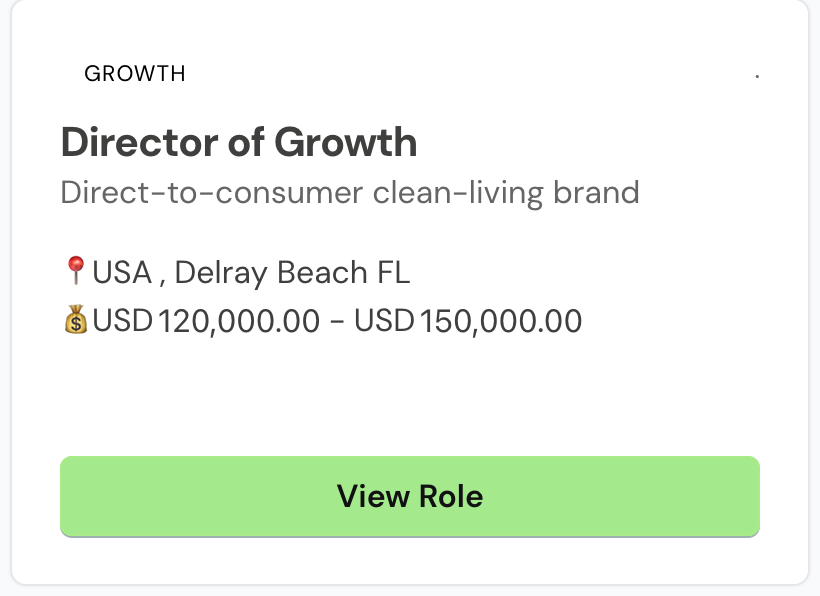
A Director of Growth at a clean-living brand sits lower, at $120K to $150K
The nearest federal category is much broader. Marketing managers had a median annual wage of $166,790 in May 2025, with the lowest 10% earning under $90,260 and the highest 10% above $293,610. That data covers every industry. Use it as a boundary on your band, not as a DTC benchmark. For a placed director, our fractional CMO versus full-time guide reports director of marketing base pay of $150,000 to $220,000.
Choosing the title and the reporting line
Settle the reporting line first, write the scope to fit it, then post the title that matches both. A marketing director job description for a seat under the CEO describes a different job from one for a seat under a CMO, and the reporting line is the first thing a candidate uses to tell them apart.
The title on its own reaches only part of the pool. In our candidate database, 24 people hold the exact title head of growth and 12 hold director of marketing. Counting seniority and specialty variants, head of growth reaches 48 and director of marketing 28, level with performance and acquisition directors.
Current title group
Candidates
Head of growth
48
CMO, including fractional
34
Director of marketing
28
Performance or acquisition director
28
Head of marketing
25
VP of marketing, including fractional
23
Source: Constant Hire candidate database, October 2026. Candidates whose current title matches each group, including seniority, specialty and fractional variants. Groups can overlap; one candidate appears in both the CMO and head of marketing groups. Counts describe our database, not the whole market.
Brands hire this job under several titles, and head of growth is the most common of them in our database. A posting called "marketing director" with a vague scope misses the people who carry growth, performance or head of marketing titles. Whether you post it as a marketing director or a director of marketing job description, the scope has to carry what the title can't.
When the role reports to the CEO, the marketing director is usually the brand's first or only marketing leader, running channels through agencies and a small team. That seat sits close to the head of marketing tier on our CMO executive search page.
The functional version looks different. In a VP of Marketing search we're running for a candle brand past $7M, the VP's team of four includes a Marketing Director. That seat owns execution inside a plan someone else sets. If that matches your structure, name the VP as the reporting line and narrow "What you will own" to the channels this person actually runs.
Order matters here too. The Lunchbox Packs founder asked for a head of growth, and an evaluation of his marketing department moved the brief to head of marketing before sourcing began. Constant Hire then evaluated 997 candidates and sent 5. Decide the title after the scope.
What changes at a DTC brand
A generic marketing director description lists brand strategy, marketing campaigns, market research, market trends, social media marketing and public relations, often with lead generation as a core duty. That last one comes from B2B. A consumer brand measures new customers and repeat orders, and the responsibilities of a marketing director shift in three places that each belong in the posting.
The agency and freelancer bench
In a protein baking mix search, the brand's first in-house marketing hire reports to the two co-founders and leads a CRO agency, an Amazon agency, a TikTok Shop agency, a photographer, freelancers and UGC creators.
A clean-living brand set its search up differently. The brief put finance in charge of the budget and the hire in charge of optimizing against it, then listed what the hire would not do, including working inside the ad accounts or editing creative.
If most of the work runs through partners, the description has to say which partners report to this role and how each one is measured. That is what the "Agency boundary" line in the template is for. Skip it and the partners keep answering to whoever signed their contracts.
CAC, LTV and contribution margin
A DTC marketing director answers to CAC payback, LTV by cohort and contribution margin after marketing spend. Reach and platform-reported ROAS don't belong on that list, although the template still tracks ROAS as a working metric.
The reason is accountability. A candidate who has only reported on ROAS may never have been answerable for whether the spend paid back. Platform-reported ROAS is what an ad platform credits itself with. CAC payback is how long the margin from a new customer takes to cover what it cost to acquire them, and contribution margin says whether the business kept anything after the marketing bill.
That is why the template opens with "The number you own" and makes contribution margin the governing figure. Put a real target in that line. It gives every later interview a number to test against.
Retention as a revenue line
In this template the marketing director owns retention end to end, including email, SMS, loyalty and subscription economics. That is the main difference from our head of growth job description, which leaves lifecycle execution as an option.
A leader judged on LTV needs authority over the channels that move repeat purchase. Move email marketing and marketing automation to a separate team and the director carries the LTV target without the levers that change it.
If the brand already has a retention lead, the description should say that person reports to this role.
Where the role stops: CMO, head of growth and marketing manager
A CMO owns the marketing P&L, brand strategy and the leadership bench underneath, and sits in the C-suite. Below a CMO, a marketing director usually owns channel execution and the team that runs it, and a job description for this seat should say so in the reporting line. Our CMO executive search page lays out the full ownership matrix, and how to hire a CMO covers scoping for anyone hiring above this seat.
A head of growth is acquisition-led, with retention optional. The marketing director carries retention and brand awareness inside the same role, so a brand that wants one person accountable for the first order and the fifth should post this template.
A marketing manager runs programs inside a plan. The director sets the marketing strategy and the budget behind it. Brand manager and marketing coordinator roles sit below both and show up in this posting only as hires the director will make.
Required versus preferred experience
Keep required to four items in a marketing director posting. The rule the series uses is that required covers what someone cannot learn in their first quarter, and everything else moves to nice to have.
Some requirements shrink the pool without anyone noticing. Asking for a bachelor's degree in marketing filters out operators who came up through finance, analytics or a founder seat, and a master's degree requirement removes more. A named category ("five years in pet food," for illustration) limits you to people who worked for your competitors. Category knowledge does help a candidate read customer needs faster, which is why it sits under preferred.
Agency-only and brand-only backgrounds each cover half the job. Agency operators may never have owned a budget line inside a business, and brand operators may never have directed partners to a scorecard. Read the career path for both.
The skills that predict performance here are budget management across acquisition and retention, unit economics, directing partners and hiring specialists. Tools and channels transfer quickly. A strong operator learns a new analytics setup or ad platform within a quarter.
Turning the description into interview criteria
Turn the marketing director description into interview criteria by starting from the number the role owns. Ask the candidate to walk through one of the marketing plans they built and ran: what it was meant to move, which target audiences it went after, what it cost, what they cut when the data disagreed, and which partners delivered it.
A strong answer names a specific brand (anonymized is fine), a number that moved and a decision made against the plan. Strategic thinking shows up in the cuts. An illustrative answer such as "we pulled prospecting spend in week six because payback had slipped" tells you more than a list of social media marketing campaigns with no number attached.
If you would rather see a shortlist than write the posting, Constant Hire scopes the role with you on the intake call and puts first interviews on your calendar within 5 business days, or 10 for executive searches.
FAQs
What is a marketing director?
A marketing director is a senior marketing leader at a brand, responsible for acquisition, retention and creative, and for the budget and team behind them. At a DTC brand the role also directs the agencies and freelancers doing much of the work, and is judged on CAC, LTV and contribution margin rather than reach.
What is the difference between a marketing director and a CMO?
A CMO sits in the C-suite and owns the marketing P&L, brand strategy and the leadership bench beneath it. A marketing director usually owns channel execution and the team that runs it, reporting to the CEO when it is the top marketing seat, or to a VP or CMO when it is a functional one. Our CMO executive search page sets out the full split.
What should a marketing director job description include?
Lead with the number the role owns and who it reports to, then the salary band. List what it owns across acquisition, retention, creative, budget and team, name what it does not own, and state which agencies and freelancers report into it. Keep required experience to four items and add 30, 60 and 90 day outcomes.
What skills should a marketing director have?
At a DTC brand the skills that predict performance are financial and managerial: reading CAC payback, LTV by cohort and contribution margin, directing agencies to a scorecard, running retention as a revenue line, and hiring specialists across paid media, lifecycle and creative. Specific tools and channels matter less, because a strong operator picks them up within a quarter.
Connor Gross founded Constant Hire in 2024. An operator turned founder with deep experience building and scaling e-commerce brands. He previously sold an Amazon brand and generated over $30M in DTC revenue through private-label Shopify businesses. He now helps fast-growing DTC brands and agencies hire top talent across marketing, creative, ops, and sales. From E‑com Managers to TikTok Creators and Heads of Growth, he knows what great looks like, and how to recruit it.