Trade marketing for DTC brands: what it covers, who to hire
What trade marketing covers once a DTC brand sells through retailers, how it differs from shopper and brand marketing, and who should own trade spend first.
Trade marketing is the retailer-facing side of a consumer brand's marketing that helps brands selling through stores win distribution, shelf position, and sell-through by funding promotions, displays, and retailer programs.
On sales calls, the question we hear from brands that just landed Target, Costco, or Walmart is who to hire, because nobody has built a marketing plan for retail.
The short answer, at first, is usually your sales lead. Below is what trade marketing pays for, how it differs from DTC, shopper and brand marketing, and when the job outgrows that person.
Key takeaways
Trade marketing is the money and programs aimed at the retailer: price promotions, slotting and free fills, displays, retailer media, and the deductions that follow.
Vita Coco’s 2025 10-K books trade promotions as a reduction of revenue instead of a marketing cost, so whoever owns trade needs to read a P&L alongside the marketing dashboard.
At DTC brands entering retail, the first trade owner is usually the sales lead. At Constant Hire, none of the 46 candidates we’ve matched to trade work in Stardex (October 2026) currently holds a trade-titled role.
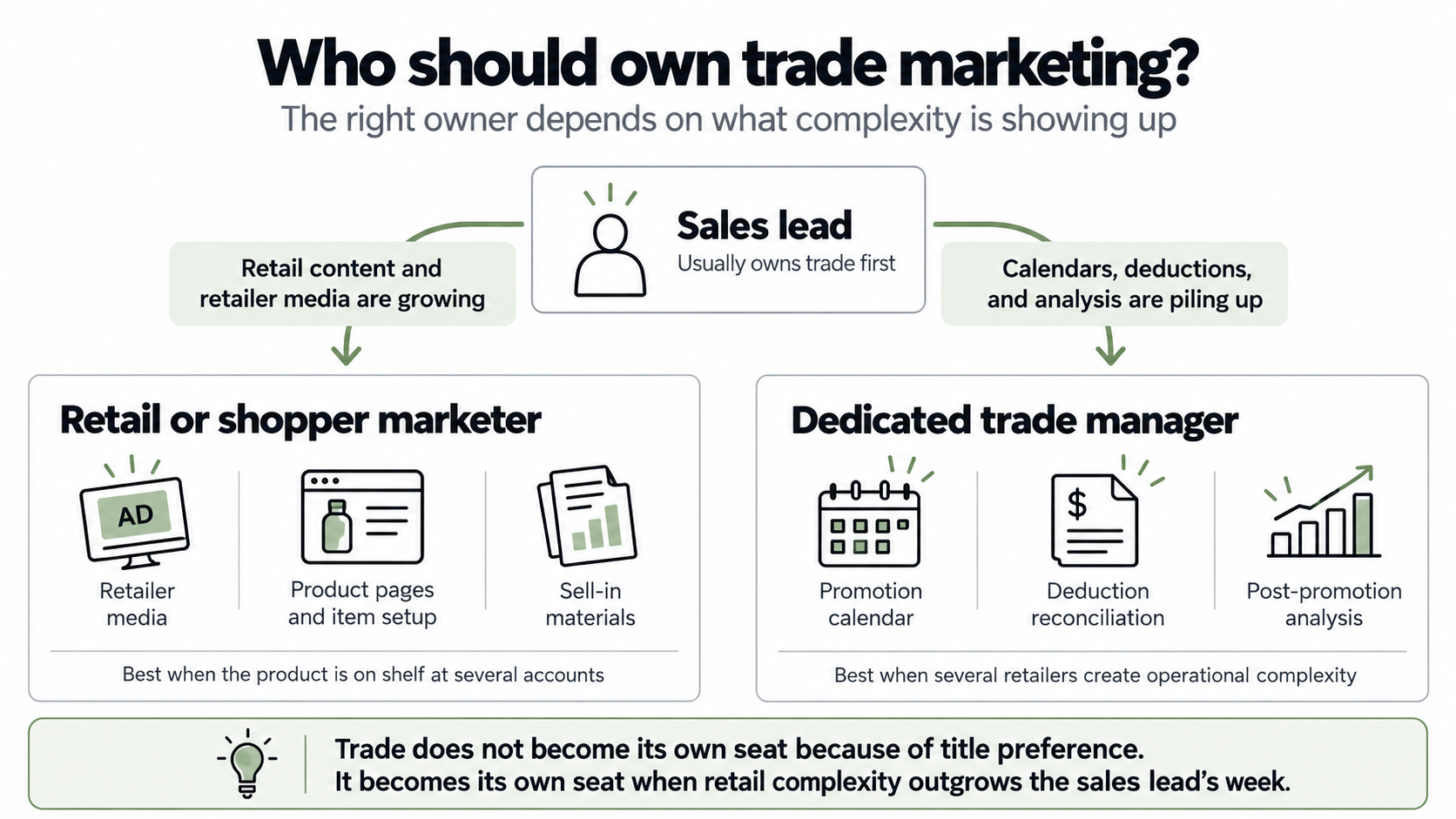
Hire a dedicated trade marketing manager when calendars, deductions and post-promotion analysis across several retailers outgrow the sales lead's week.
What trade marketing covers once you sell through retailers
Trade marketing is everything a brand pays the retailer, wholesaler or distributor to get, keep and move product on the shelf.
Temporary price reductions and promotional allowances
A lower shelf price for a set window, funded by the brand
Trial and short-term velocity
Slotting fees and free fills
A place on the shelf for a new item, paid in cash or free product
Distribution for product launches
Displays and features
Endcaps, secondary placements and retailer ad circulars
Product visibility outside the home shelf
Retailer media and co-op
Ads and placements the retailer sells, online and in-store
Traffic to the brand's listing or shelf
Demos and sampling
In-store tastings and samples
Trial, mostly in food and beverage
Deductions and post-promotion analysis
Reconciling retailer and distributor claims, then reading what each event returned
Margin protection and next year's calendar
Rows reflect standard CPG practice as framed by Constant Hire. Vita Coco's 2025 annual report names displays, shelf space, distribution payments, and price discounts.
Trade promotion management software exists to automate that reconciliation and reporting. It speeds the work up, but someone still has to own the decisions it feeds.
Displays and features are the merchandising side of trade spend, the part that gets a product seen outside its regular shelf. Endcaps, point-of-sale displays near checkout, and spots in a retailer’s ad circular put it in front of a shopper who wasn’t looking for it. The brand rents that visibility. It doesn't own it, and pays for it again every time the calendar turns over.
How trade marketing differs from DTC marketing
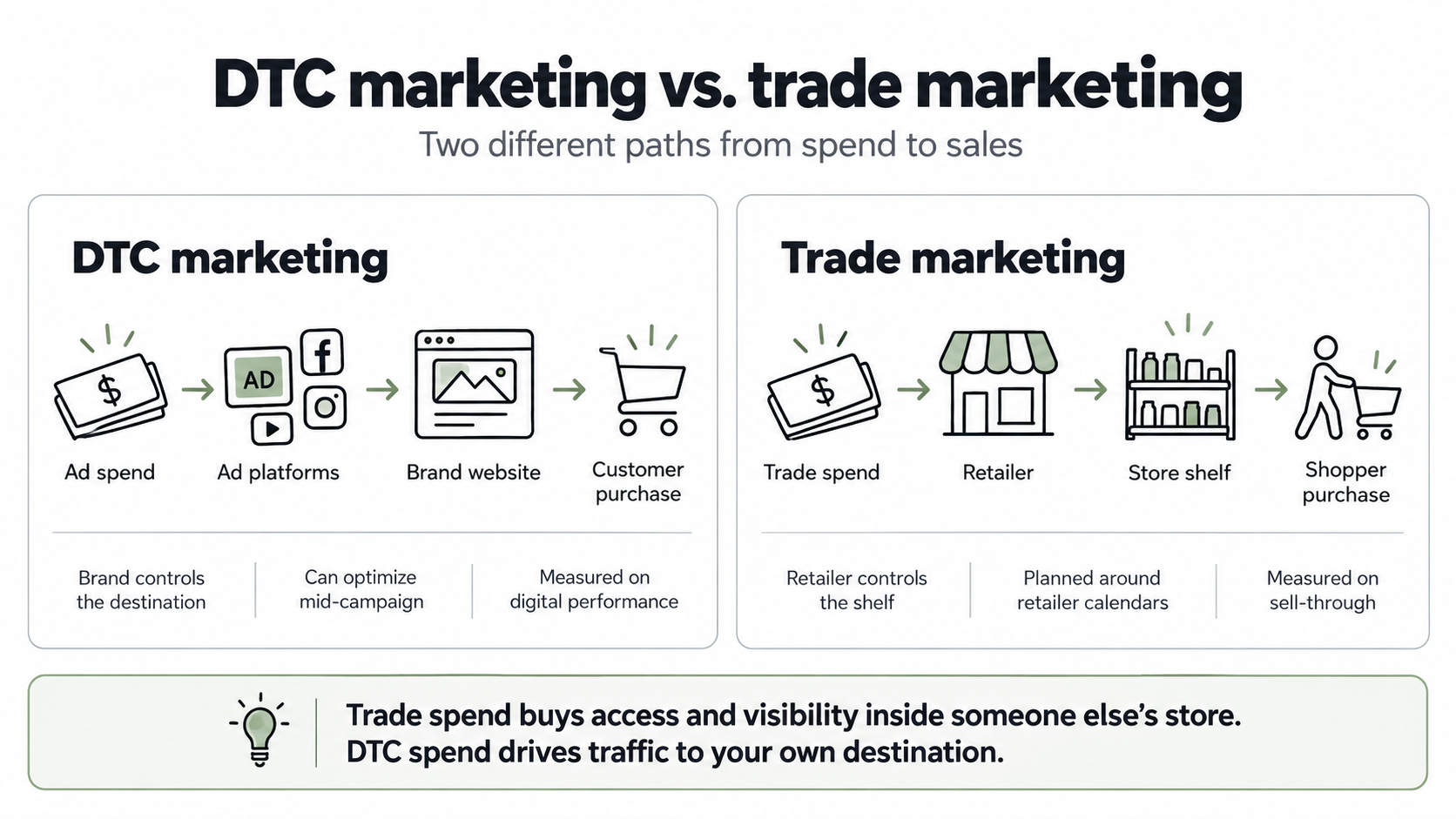
Four differences separate trade spend from DTC marketing spend. First, the dollars go to a retailer, and the brand’s own media budget rarely touches them.
Second, the money comes off revenue. Vita Coco, for example, books trade promotions primarily as a reduction of revenue because they don’t buy a distinct service from the retailer, so they never show up in the marketing line a DTC team reports against.
Third, a retailer’s promotion calendar locks the spend in months ahead, with little room to adjust once an event starts. Fourth, the scoreboard is sell-through at the shelf, where a DTC team would watch return on ad spend.
A 2019 McKinsey article put CPG companies’ trade promotion spend at about 20% of revenue worldwide. Citing 2016 Nielsen research, it reported that 59% of promotions lost money, and 72% in the US.
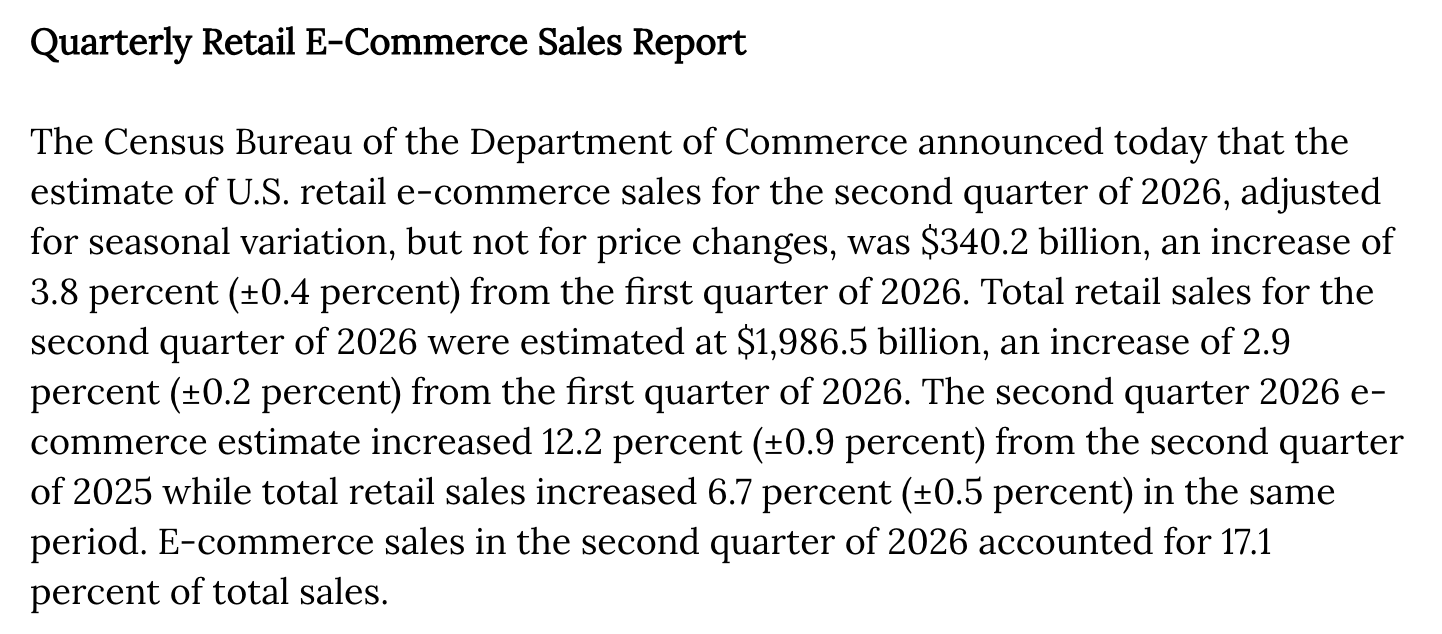
According to the US Census Bureau, ecommerce was 17.1% of total US retail sales in Q2 2026, seasonally adjusted. That leaves 82.9% outside ecommerce. The base covers all US retail, autos and fuel included, so read it as a market-wide figure.
Excerpt from the US Census Bureau report
A DTC growth marketer who is strong on paid social and brand strategy is working a different lever on a different clock. Trade spend buys shelf space inside somebody else’s store. Paid social buys impressions that send shoppers to the brand’s own site.
Trade marketing vs shopper marketing vs brand marketing
Trade marketing aims at the retailer and distributor, funding price promotions, slotting, and displays to win sell-through. Shopper marketing turns to the shopper already in the aisle or on a retailer's website, funding retailer media, in-store creative and merchandising, and product content.
Brand marketing is the consumer marketing most DTC teams already run. It reaches the consumer wherever they are, and its spend goes toward paid social, creative, PR, and creator partnerships.
The person in the aisle or on the retailer's website
Retailer media, in-store creative, product pages and content
Conversion at the shelf, retailer media return
A retail or shopper marketer
Brand marketing
The consumer, wherever they are
Paid social, creative, PR, creators
Awareness, demand, DTC acquisition
The existing growth or brand team
Constant Hire's categorization.
Retail media, shopper and retail marketing roles already make up 11 of the 46 current titles in our trade-adjacent candidate pool, a separate title family from trade itself. At a small brand the three disciplines often sit with different people. Sometimes one person covers all three, and none of them well.
Trade marketing ends up with the sales team by default. Sales already owns the retailer relationship.
As the business grows, the sales lead usually keeps the trade budget and the retailer relationship, and a shopper or retail marketer picks up retailer-facing content and retail execution once there’s enough of it to need an owner. The two get measured differently, as the table shows, but both answer for what moved product at the shelf.
Who owns trade marketing before a dedicated hire?
Usually the sales leader who owns the retailer relationship owns trade marketing too, because trade spend gets negotiated in the same conversations as distribution.
Our candidate data backs this up. Of 46 Stardex profiles matched to trade marketing responsibilities, 19 hold sales and account titles, 11 hold retail media, shopper or retail marketing titles, and 16 hold brand, growth or ecommerce leadership titles. Twenty-one describe trade spend, trade programs or trade marketing by name in their role descriptions.
None of the sample currently holds a trade-titled role. Two held one earlier in their careers, both at large, established CPG companies.
A Director of Sales, Retail and Wholesale search we ran in September 2026 for a supplement brand carried a $130,000 to $150,000 base budget. The seat folded trade spend, free fills, promotions, retailer deductions and broker management into the sales role, on top of winning and growing the accounts. That is a role budget, not a salary benchmark.
Our full retail launch hiring sequence covers the timeline, including the national account manager who takes on trade at the first retailer.
In our view, a sales leader judged on sell-in tends to treat trade spend as the cost of winning placement and defending market share instead of a budget to manage. Teams book the promotions and rarely go back to read the results.
Which trade marketing profile to hire first
Match the hire to the stage of the retail business. The job title matters less. Three profiles can carry trade at a growing brand, and hiring the wrong one for your stage is an expensive way to learn the difference.
A brand with one retail account and a sales lead already carrying trade does not need a dedicated trade marketing manager yet. The sales lead can manage that retailer's promotion calendar, reconcile deductions with finance, and review results without adding another full-time role.
The budget does more as sales capacity that wins the next account. A seat built for complexity that doesn’t exist yet would spend most of its week idle.
The opposite mistake costs more. A brand running overlapping calendars across five retailers, with a sales lead still doing the reconciliation by hand, is paying the cost of a trade marketing manager's job without hiring for it.
Deductions pile up faster than one person can dispute them. Nobody has time left to check which of last quarter's promotions paid back, so the same losing promotion runs again next year.
A brand that is still winning its first handful of accounts needs a closer. A brand that already has the accounts needs someone managing the back end of all of them at once.
Profile
Best fit when
What they own
What to check
Where they usually come from
Sales leader who carries trade
One to a few retail accounts; distribution still being won
That they have read post-promotion results, not only booked promotions
Sales and national account roles at food, beverage and supplement brands
Retail or shopper marketer
Product is on shelf at several accounts, and retailer media and content are growing
Retailer media, item setup and product pages, ratings and reviews, sell-in materials, broker marketing
Programs run across more than one retailer type (mass, club, grocery) and some DTC context
Brand, shopper and retail media roles
Dedicated trade marketing manager or analyst
Several retailers with overlapping calendars, and enough trade spend that post-promotion analysis pays for itself
Promotion calendar, trade budget, post-promotion analysis, deduction reconciliation
Comfort with syndicated data (SPINS, Circana, NielsenIQ) and the P&L
Usually larger CPG companies; rare in Constant Hire's candidate pool
Constant Hire's categorization, informed by our candidate data and recent searches.
The sales leader who carries trade fits a brand still winning distribution, one or a few accounts at a time. This profile usually comes from sales or national account roles at food, beverage, or supplement brands. The September 2026 supplement-brand search described above is built around this profile.
The real test is whether that person reads the sales data behind each promotion. Booking the next one, on its own, proves nothing.
Once a brand sits on the shelf at several accounts, with retailer media and content worth a dedicated owner, the retail or shopper marketer is the right fit.
A first dedicated retail marketing search we ran for a kids supplement brand (October 2026) is this seat. It reports to the SVP of brand and the chief revenue officer and owns retail media, item setup, product pages, ratings and reviews, sell-in decks, and broker marketing communications.
The dedicated trade marketing manager or analyst fits a brand running several retailers with overlapping calendars, where the volume of trade spend justifies someone who owns the trade budget, the promotion calendar, deduction reconciliation, and the post-promotion analysis behind it.
This profile rarely shows up in our candidate pool. When it does, the person usually learned the job at a larger CPG company that trained them into it.
What to screen for in a trade marketing hire
These five questions separate candidates with direct trade marketing experience from those who only know the terminology.
Question
A strong answer includes
Red flag
Walk me through a promotion you ran and how you judged whether it paid back.
The retailer type, discount depth, lift against baseline, and what changed in the next calendar
Reports only units shipped during the event
How do you handle a deduction you think is invalid?
Matching it to the agreement, the dispute window, and who in finance signs off
Treats deductions as a cost of doing business
How did you split budget between price promotions and retailer media?
A split tied to the specific retailer and the brand's stage there
The same answer for every retailer
What does DTC customer data tell you about retail, and where does it mislead?
Uses DTC data for flavor or bundle decisions and knows retail shoppers behave differently
Assumes DTC best sellers will sell through in stores
Which syndicated or retailer data have you worked with?
Names SPINS, Circana or NielsenIQ and retailer portals, and what each was used for
Cannot name a data source
Example answers are illustrative, written by Constant Hire. They are not quotes from candidates.
A promotion pays back when the extra margin it brings in is worth more than it cost. Three numbers cover most of that judgment: sell-through rate (what share of the units shipped sold at retail), lift against baseline (sales during the promotion minus what the item would have sold anyway), and cost per point of distribution (what it cost to add each new store-and-item listing).
A candidate who can walk through all three is managing trade spend like a budget. One who only reports units shipped is still treating it as a cost of doing business.
A sales leader can run trade marketing strategy alongside selling for a while, but not indefinitely. Four signals show up before the breaking point.
The first signal is time. The sales lead spends real hours each week reconciling deductions, hours that would otherwise go to selling. The second is the calendar, once promotion calendars at more than one retailer start overlapping and competing for the same inventory, and every event needs a supply chain plan behind it.
The third is the budget. Nobody can say how much of each retailer’s trade money is already committed. The fourth costs the most: nobody checks which promotions paid back, so last year’s losing events run again.
Trade moves to a dedicated owner once enough product sits on the shelf to measure results, the same constraint that governs when to hire for each retail role. Once a brand sells through several distribution channels, the ownership question extends past trade into team structure across departments.
If your retail launch has a sales plan and no trade marketing strategy, book a call. At Constant Hire, we present first interviews within 5 business days for standard roles, and within 10 for executive searches such as a VP of sales.
FAQs
What is trade marketing?
Trade marketing is the retailer-facing side of a consumer brand’s marketing. It covers price promotions, slotting fees, displays, retailer media, and the deductions and post-promotion analysis that follow. It targets channel partners such as retailers and distributors, the businesses between the brand and the shopper, and it is judged on sell-through and on what each promotion returned.
What does a trade marketing manager do?
A trade marketing manager plans and funds a brand's retailer promotions, runs the trade budget and promotion calendar, reconciles retailer deductions, and reads post-promotion results to decide what runs next year. At DTC brands new to retail, a sales leader often covers these tasks until several retailers and overlapping calendars justify a dedicated hire.
What is the difference between trade marketing and shopper marketing?
Trade marketing aims at the retailer through price promotions, slotting, displays, and the trade budget. Shopper marketing aims at the person in the aisle or on the retailer's website through retailer media, in-store creative, and product pages. Trade is judged on sell-through and promotion return, while shopper marketing is judged on conversion at the shelf.
Who should own trade marketing at a DTC brand entering retail?
Usually the sales leader who owns the retailer relationship, since trade spend is negotiated alongside distribution. As retailer media and content grow, a retail or shopper marketer can own those programs while the sales lead keeps the trade budget. A dedicated trade marketing manager takes over once calendars, deductions, and post-promotion analysis across several retailers justify a separate role.
Connor Gross founded Constant Hire in 2024. An operator turned founder with deep experience building and scaling e-commerce brands. He previously sold an Amazon brand and generated over $30M in DTC revenue through private-label Shopify businesses. He now helps fast-growing DTC brands and agencies hire top talent across marketing, creative, ops, and sales. From E‑com Managers to TikTok Creators and Heads of Growth, he knows what great looks like, and how to recruit it.