Ecommerce search is the system that turns a shopper's typed or spoken query into a ranked list of products, using language processing, an index of the catalog, and ranking rules that weigh both relevance and business goals. How ecommerce search works in practice is closer to a ranked auction than a database lookup.
Two things sit under that definition. The first is the search bar on your own store, where you control the index, the synonyms, and the rules. The second is AI search outside your store, where ChatGPT, Gemini, and Copilot query your product data directly and no results page exists. Neither is Google SEO, so if you want help ranking category pages, this is the wrong article.
What follows is the pipeline in order, what breaks at each stage, what AI changed, and who on your team should own it.
Key takeaways
Ecommerce search is a four-stage pipeline, not a database lookup: query understanding, retrieval from a catalog index, ranking on relevance plus commercial signals like stock and margin, then manual merchandising rules. Each stage fails in its own way, which is why two stores running the same search app break in different places.
The search bar carries the highest-intent traffic on the site, and it fails routinely. Baymard's 2026 benchmark rates 56% of tested sites mediocre or worse on search experience, up to 31% of shoppers abandon a site entirely when search cannot find an item, and around 65% need more than one attempt at a query.
Product discovery now starts outside the store. AI-referral traffic to US retail sites rose 62% year over year in July 2026, and those shoppers convert at a rate 60% higher than non-AI traffic. There is no results page to merchandise, so catalog feed quality decides whether the brand appears at all.
Search sits in an ownership gap between engineering and merchandising, and the ecommerce merchandiser is the role most brands are missing. The trigger to hire one is catalog complexity, roughly 500 SKUs or a variant-heavy assortment, rather than a revenue threshold.
What is an ecommerce search algorithm?
An ecommerce search algorithm is the set of processes that reads a shopper query, retrieves matching products from a catalog index, and orders them by a combination of textual relevance and commercial value.
Most operators carry Google as their mental model, and it misleads here. Google ranks documents, and a document has no stock level. An ecommerce search algorithm ranks inventory, and inventory has attributes, variants, availability, return rates, and margin. So the top result for "black boots" on a well-run store is whichever product the system predicts will convert, is in stock, and is worth selling. Textual relevance rarely wins. That is multi-objective ranking.
Keyword matching still does real work underneath, scoring how often a term appears in a product record against how rare it is across the catalog. Rare terms count for more.
How ecommerce site search works, stage by stage
Ecommerce site search is a pipeline. A query passes through four stages before a shopper sees a results grid, and each one fails in its own way, which is why two stores running identical search apps break in different places.
Input
Query
What the shopper types or says.
→
Stage 01
Understanding
Tags the brand, category, attributes, and price limits inside the query.
Breaks whenNobody reviews what the model inferred.
→
Stage 02
Retrieval
Pulls a candidate pool from the catalog index, filtered by stock and facets.
Breaks whenProduct data is thin or the index type does not fit the queries.
→
Stage 03
Ranking
Reorders the pool on relevance plus stock, margin, and purchase history.
Breaks whenCommercial signals get set once and never revisited.
→
Stage 04
Rules
Applies pins, boosts, burials, and query redirects on top of the algorithm.
Breaks whenRules outlive the campaigns that created them.
The four stages a query passes through before a shopper sees a results grid.
Query understanding
This is the natural language processing layer. NLP starts before the shopper finishes typing, since autocomplete suggestions run the same machinery on a partial string. A shopper types "nike running shoes size 11 under $120" and the system works out that Nike is a brand, running an activity, shoes the category, size 11 a filter, and $120 a price ceiling.Older systems used dictionaries plus stemming for word endings, and those rules broke on ambiguity. Apple is a brand or a flavor. Slip on is a shoe style or an action. Modern ecommerce search engines train BERT-family models to tag entities instead. When it works, a search for "nike shoes" stops returning shoe laces and water bottles.
The search index
A search index is a prebuilt data structure that stores your catalog in a format optimized for fast lookup, so the system never has to scan every product on every query. Indexing pulls in titles, product descriptions, product attributes, and feed metadata, which is why thin product data caps search quality. You can build one three ways, and the choice decides which queries your store handles well.
Approach
What it is good at
Where it breaks
Who is running it
Keyword matching
Exact terms, part numbers, brand names, filters. Fast and predictable.
Any query that shares no words with your product data.
Native platform search and most entry-level search apps.
Semantic and vector
Meaning-based queries, natural language, synonyms without maintenance.
Exact identifiers. Returns confident wrong answers on part numbers.
AI-native search apps and mid-market platforms.
Both together, hybrid
Broad coverage. Handles identifiers and descriptive language in one system.
Two systems to keep in sync. More configuration and cost.
Brands past roughly $50M and most enterprise retail.
Brands under $5M run whatever indexing their search app ships with, so the practical decision is which app to run. Brands past $50M usually run two indexes at once, an Elasticsearch cluster alongside a vector store, and the decision becomes how to combine the results and who owns the cost.
Retrieval and ranking
Retrieval and ranking happen in two steps. The system pulls a candidate pool first, a few hundred to a couple thousand products that could plausibly match, filtered by stock and by whatever faceted search filters the shopper set. Then it reorders that pool, weighing stock position, margin, return rate, and how often shoppers who ran that query bought that item. A search results page is a merchandising surface, not a neutral list.
Merchandising rules and governance
On top of the algorithm sit manual rules. Pinned products, campaign boosts, buried clearance, redirects from a query to a category page. They are all necessary and they all rot. A rule written for a July campaign still suppresses a better-converting product in February, and nobody notices. Rules need expiry dates.
Why search decides more revenue than most teams realize
Ecommerce search engines matter because the search bar carries the highest-intent traffic on the site. Baymard's testing finds roughly half of shoppers reach for search rather than navigation to find a product, and its 2026 benchmark rates 56% of tested sites mediocre or worse on search experience. Up to 31% of shoppers abandon a site entirely when search cannot find something they want, and around 65% need more than one attempt at a query.
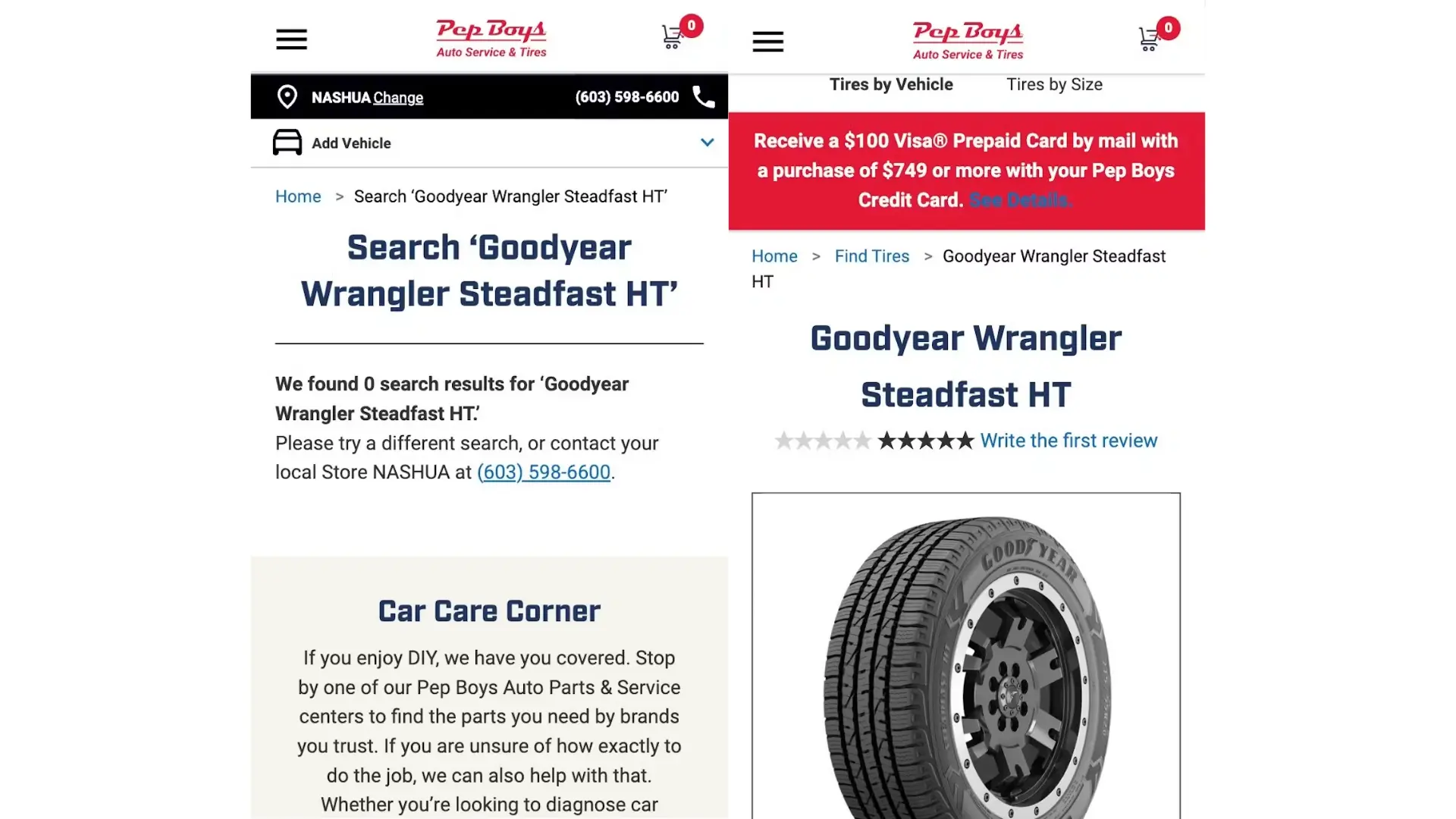
Run that against your acquisition cost. A shopper who types into the search bar has already decided what they want and named it. You paid fully loaded CAC to get them there, and if the query returns nothing the money leaves quietly, because zero-result pages appear in no report a founder reads weekly.
Paid traffic leaking out the back of the site is the version of this problem that gets fixed. Conversion rates in the abstract do not.
The query types your search has to handle
Teams test their own search by typing the product name they already know. Real shoppers do five different things, and a search stack can be excellent at one and broken at another.
Query type
What a shopper types
What it tests, and how it fails
Exact identifier
"MD812LL/A", a SKU or part number
Tests whether identifiers bypass fuzzy matching. Fails by returning a plausible but wrong product with confidence.
Brand or navigational
"Patagonia"
Tests brand entity recognition. Fails by returning every product whose description mentions the brand rather than the brand assortment.
Broad category
"mens trail running shoes"
Tests category mapping and popularity ranking. Fails by burying the obvious best sellers under long-tail items.
Multi-attribute
"organic gluten free pasta under $5"
Tests whether constraints become real filters. Fails by ignoring the price ceiling or the dietary attribute entirely.
Problem or lifestyle
"warm waterproof jacket for a Scottish winter"
Tests semantic understanding. Fails with zero results, because no product title contains those words.
The five-minute search test
Open your store, run one query of each type in the table above, and note which ones fail. Five queries, five minutes, no technical access required. Watch the last row, because a query returning nothing reads as proof you do not sell the product. Add non-product queries too, since shipping and returns questions land in the same search bar and usually go nowhere.
Typos, synonyms, and semantic search
All three share one root. Shoppers do not use the words in your product titles.
How search handles misspellings
One counts how many single-character edits separate what was typed from a real catalog term, catching "runnign" and "adiddas." The second matches on sound rather than spelling, which rescues a shopper typing "flees" for fleece. Typo tolerance set too aggressively becomes its own failure, correcting a valid part number into a shoe, so identifiers must bypass fuzzy matching. Baymard's original benchmark, published in 2014 and dated but instructive, found that 34% of the top 50 ecommerce search engines failed on a model number or a single-character misspelling.
How search handles synonyms
Static synonym dictionaries mean somebody writes "sofa equals couch," "hoodie equals sweatshirt." That works. It also never stops needing maintenance, and the file becomes a liability nobody remembers writing. The same 2014 Baymard benchmark found 70% of the top 50 search engines failing on product-type synonyms. Modern engines infer synonyms from user behavior instead. When shoppers search "sneakers," get nothing, search "trainers," and buy, the system learns the pair from behavioral data. A human is still required. The job changes from writing rules to reviewing what the machine inferred.
What is semantic search?
Semantic search is retrieval that matches on meaning rather than exact words, by converting both the query and every product into numerical representations and finding the products that sit closest to the query. A shopper searches "inexpensive evening frock." Your catalog says "affordable cocktail dress." A keyword engine scores that match at zero because no words overlap. A semantic engine returns the dress.
Vendors leave out one limitation. Vector search is weak on identifiers and will confidently return a wrong product for a part number, which is why exact search paths still matter. Serious stores run both and combine the results, called hybrid search.
How search personalizes results
Ecommerce search personalization runs across three time horizons, and only one of them applies to most DTC traffic.
The first horizon is the session itself. Most shoppers are not logged in, so the system works from a rolling window of roughly the last five minutes of behavior, which products they clicked, which categories they moved through, which filters they set. A shopper who browsed technical climbing gear and then searches "jacket" should see shells.
The second is account history. For logged-in shoppers, engines compile a profile from 30 to 365 days of purchase history, brand engagement, and price tier, then feed it into the ranking. This is only as good as the identity resolution behind it, and most brands overestimate how much of their traffic is identifiable.
The third is structural. For B2B and wholesale, personalization is a hard filter, so accounts see contract pricing and their own assortment.
Personalization applied before relevance is fixed makes a bad search experience harder to debug. Fix zero results first.
AI search inside your store
Artificial intelligence changed four things inside the store, and catalog size decides which of them matter to you.
Conversational assistants. Instead of working through filter menus, the shopper describes the problem and the assistant assembles recommendations against budget, sizing, and use case. Worth having for considered purchases and catalogs with real depth. Mostly theater on a 40-SKU store. Voice search folds into the same layer, since a spoken query is a longer, messier string hitting the same step.
Visual and multimodal search. Shoppers search with a photo, or a photo plus text, such as an image of a dress with the words in navy cotton added. Visual search earns its place in apparel, home, and anywhere the shopper cannot name what they want.
Autonomous tuning. Systems that audit their own low-performing search queries and propose index changes, tested before they ship. Practitioners at the MICES 2026 search conference in Berlin described agents doing this against offline human judgment sets and pushing validated changes through continuous deployment. An enterprise capability today. Read it as directions of travel. A $5M brand has nothing to buy here yet.
Learned relevance. The synonym and ranking improvements above, running continuously against click-through rate (CTR) and purchase data rather than a quarterly cleanup. The same models now read your product copy. A 2025 study on Trendyol's catalog, spanning more than 700 categories and attributes, found that an LLM pulled both stated and implied attributes out of unstructured product descriptions where a transformer model caught only the stated ones. Machine learning here is unglamorous and it compounds.
All of this still assumes the shopper came to your site.
AI search outside your store
A growing share of product discovery now happens before the shopper reaches a storefront. They describe what they want to ChatGPT, Gemini, or Copilot, sometimes by voice search, and the assistant queries structured product data, compares options, and returns a short list. There is no results page to merchandise and no search bar to tune. Your catalog feed is the search surface.
Adobe Analytics, tracking more than a trillion visits to US retail sites, found AI-referral traffic up 62% year over year in July 2026 and up 1,219% since tracking began in October 2024. AI-referred shoppers convert at a rate 60% higher than non-AI traffic and generate 53% more revenue per visit. July was the eleventh consecutive month of that gap. These shoppers arrive having already compared and decided.
Adobe's parallel finding is the one to act on. Most retail pages are not machine readable enough for assistants to use them confidently. Attribute completeness, structured data, accurate stock and pricing feeds. Catalog hygiene nobody owns now decides whether your brand appears in an AI recommendation.
Standards exist for how assistants query catalogs and complete purchases. The Agentic Commerce Protocol came out of OpenAI and Stripe in September 2025, and Google announced its Universal Commerce Protocol in January 2026, supporting checkout from AI Mode and Gemini. Most Shopify merchants never touch either directly. Your job is keeping the feed clean enough to qualify.
How to optimize ecommerce search
Most teams optimize search by changing settings and hoping. Ecommerce search best practices come down to four metrics, measured and acted on weekly.
Metric
What it tells you
What to do when it moves
Zero-result rate
Share of searches returning nothing. The clearest signal of a broken relevance layer or a catalog gap.
Pull the query list weekly. Split it into products you do not stock, a merchandising decision, and products you do stock under another name, a relevance fix.
Search conversion rate
Whether searchers buy. Compare against non-searchers on your own site, not against a benchmark.
If searchers convert worse than browsers, relevance is actively costing revenue. Treat it as urgent.
Query refinement rate
How often shoppers retype. High rates mean the first attempt is failing.
Read the reformulation pairs. They are a free synonym list your shoppers are writing for you.
Search exit rate
Share of sessions ending on a results page.
Cross-reference with the query list to find which specific searches are losing sessions.
The zero-result query report is the highest-return report in ecommerce and almost nobody reads it. It is a list of demand your catalog is failing to meet. Test ranking changes before you ship them, and write an expiry date on every manual rule the day it goes live.
Scale changes the answer. A $2M brand should read its zero-result report and fix its top 20 queries, and that is most of the available value. A $200M brand needs a labeled evaluation set and a testing pipeline. Handing the $2M brand the $200M answer is how search projects stall for a year.
Who owns ecommerce search, and who to hire
Search sits in a structural ownership gap, a technical system and a commercial surface at once. Engineering treats it as infrastructure and optimizes for uptime. Merchandising treats it as a campaign surface and optimizes for this week's promotion. Both teams are doing their jobs. Nobody owns the search experience. The same pattern runs through ecommerce team structure, and search is where it costs the most.
Commercial teams with no proper tools write hundreds of manual pins and boosts that accumulate, conflict, outlive their campaigns, and quietly degrade search relevance. When engineering ships models with no commercial controls, merchandising loses the ability to clear seasonal stock or honor supplier deals.
The separation that works has three parts. Developers own infrastructure and baseline relevance. Merchandising owns commercial policy inside bounded rules that expire on a date. Somebody owns the reporting that shows when a manual rule suppresses a better-converting product.
Map that back through the pipeline. Every stage in this article fails in a way that belongs to somebody. Query understanding fails when nobody reviews the synonyms the system inferred. The index fails when product data is thin or the retrieval approach does not match the queries coming in. Ranking fails when the commercial signals get set once and never revisited. Merchandising rules fail when they outlive their campaigns. Zero-result reports fail when nobody opens them.
That is five failure modes and no single role covers all five. At most brands one person is nominally responsible for all of them and none of them appear in anyone's objectives, which is why search degrades quietly while every team hits its numbers. The table below maps who should hold each failure at each stage of revenue.
Who owns ecommerce search at each revenue stage, and what triggers the next hire.
Revenue
Who owns search
What they actually do
The trigger to add the next role
$1M to $5M
Founder or ecommerce manager
Picks the search app, sets basic synonyms, reads the zero-result report.
Catalog complexity, not revenue. Roughly 500 SKUs or variant-heavy assortments.
$5M to $20M
Ecommerce merchandiser, with a developer on retainer
Owns relevance and rules as a commercial function. Developer handles the index and integrations.
Search becomes a reported KPI, or manual rules stop being auditable.
$20M to $100M
Merchandiser plus in-house developer plus analyst
Split ownership with defined boundaries. Analyst owns search reporting and test design.
Multi-market or multi-storefront operations, or AI channel volume becoming material.
$100M to $500M+
Dedicated product discovery function
Merchandising operations and search engineering as separate teams under formal governance.
Not applicable. The question shifts to how the two sides are governed.
An ecommerce merchandiser is the role most brands are missing. Some brands post it as a digital merchandiser, and the scope is the same. They own relevance as a commercial outcome: which products surface for which search queries, which rules exist and when they expire, what the zero-result report says. This is the first hire that makes search someone's job.
An ecommerce manager owns search by default at earlier stages, alongside eight other things. That holds up to a point, and the point is catalog complexity rather than revenue.
A Shopify developer owns implementation, which covers app selection and configuration, the index, feed integrity, and site performance. This person also makes your feed machine readable for the AI channels above.
An ecommerce data analyst owns measurement, which decides whether any of this works. Search conversion, zero-result trends, query-level revenue, test design behind ranking changes.
Constant Hire places these roles into DTC and ecommerce brands from $1M to $500M+. Our database of vetted ecommerce candidates puts first interviews on the calendar inside five days. A generalist recruiter sends you a department store merchandiser who has never read a zero-result report.
FAQs
How does ecommerce search work?
Ecommerce search reads the query, retrieves candidates from a catalog index, ranks them on relevance plus commercial signals like stock and margin, then applies merchandising rules. That makes the results page a revenue surface.
What is the difference between keyword search and semantic search?
Keyword search matches the words a shopper typed against the words in your product data. Semantic search matches meaning, so "evening frock" finds "cocktail dress." Keyword matching stays better for part numbers, so good stores run both.
Who should own ecommerce site search?
Developers own the infrastructure, merchandising owns relevance as a commercial outcome, and analytics owns measurement. At earlier stages the ecommerce manager holds all three. The ecommerce merchandiser is the role most brands lack.
Does ecommerce site search affect Google SEO?
No. Internal site search results pages are typically noindexed and do not influence Google rankings. The query data does matter. Your search log is a free list of the exact language shoppers use, which makes it the best keyword source you own.
What is a good zero-result rate for ecommerce search?
No independent benchmark exists. The figures circulating come from search vendors selling relevance software. Track your own trend instead: falling month over month is good, and any single query returning nothing repeatedly is a problem regardless of the overall rate.
Connor Gross founded Constant Hire in 2024. An operator turned founder with deep experience building and scaling e-commerce brands. He previously sold an Amazon brand and generated over $30M in DTC revenue through private-label Shopify businesses. He now helps fast-growing DTC brands and agencies hire top talent across marketing, creative, ops, and sales. From E‑com Managers to TikTok Creators and Heads of Growth, he knows what great looks like, and how to recruit it.