Shopper marketing at big-box retail and who to hire for it
What shopper marketing means at Walmart, Target, and club stores, how it overlaps with retail media, and what background to look for in your first hire.
Shopper marketing is the planning and execution of marketing aimed at the person making the purchase, in the store aisle or on a retailer's site or app, that helps consumer brands turn shelf placement into units sold.
Sell direct, and you control the price and the page. Put the same product on a shelf at Walmart or Target, and the shopper decides in the aisle, next to a dozen competing brands, in a store layout you didn’t design.
A DTC brand moving into big-box retail stops selling to one customer on its own site and starts competing for a shopper in someone else's store and app. If nobody owns that fight, the sell-through the retailer demands never shows up.
This piece defines shopper marketing at Walmart, Target, and club stores, separates it from trade marketing and retail media, and covers who should own it and who to hire. The hiring guidance comes from a 2026 search we ran at Constant Hire for a DTC brand’s first retail marketing hire.
What is shopper marketing?
Shopper marketing is planned retailer by retailer, built around that retailer's own calendar, loyalty program, and store formats, not one national campaign copied everywhere. In CPG shopper marketing, that means a Walmart plan and a Target plan look different even when the product on the shelf is identical.
The job also covers two shelves. The physical shelf is the display, the signage, the demo a shopper walks past in the aisle. The digital shelf is the product page, its ratings and reviews, and the sponsored listing a shopper checks on a phone before or during the trip. Manage only one of these touchpoints, and half the purchase decision goes unmanaged.
That's the real shape of shopper marketing. It targets the shopper and the place they buy at the same time, as one connected decision. A definition that stops at the physical shelf misses half of it.
Shopper marketing vs consumer marketing
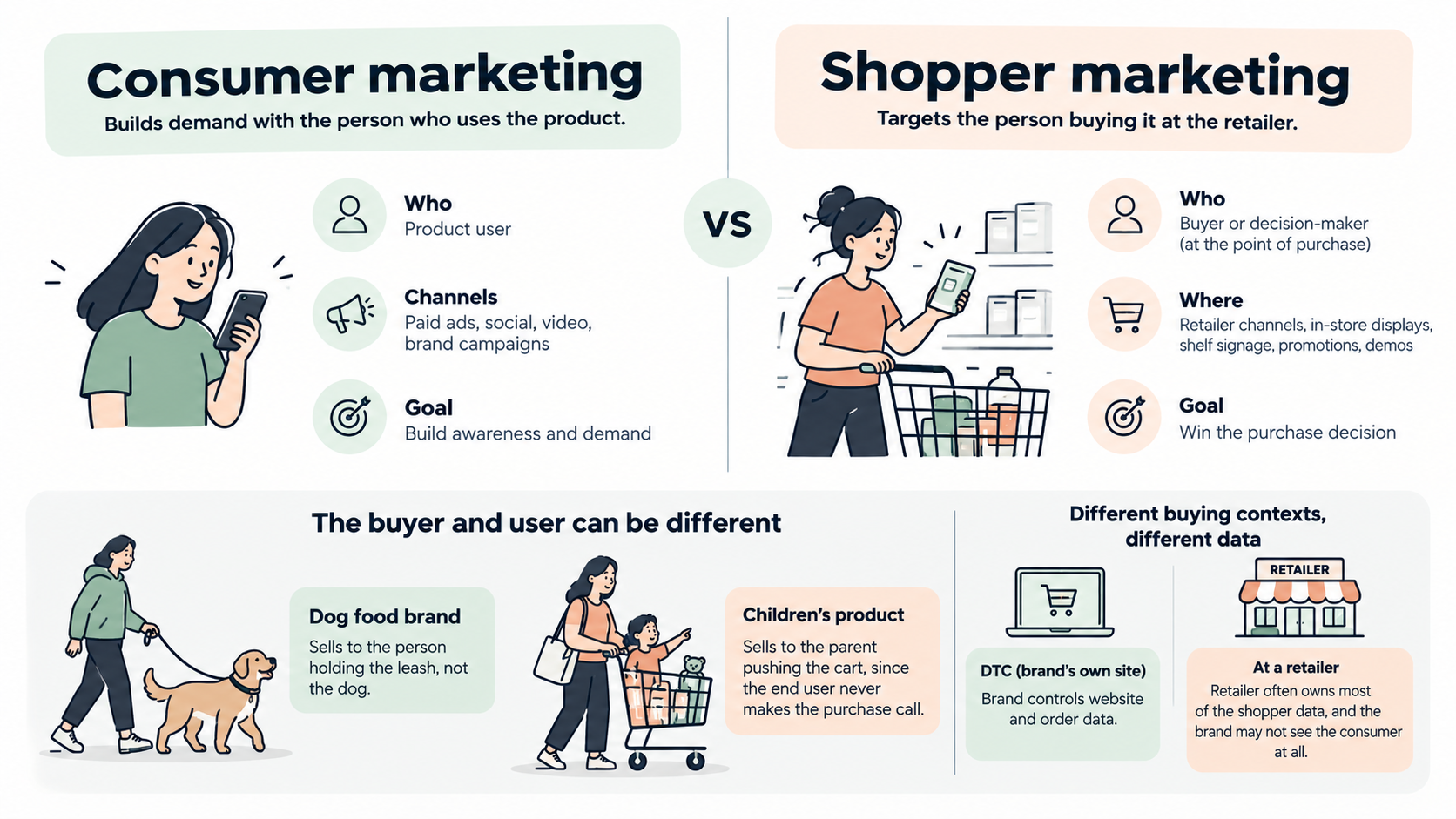
Consumer marketing builds demand with the person who uses the product, wherever they are, through brand advertising and social content. Shopper marketing targets the person buying it, who is often someone else, like a parent or the household’s main shopper, at the retailer where the purchase happens.
A dog food brand sells to the person holding the leash, and a children's product sells to the parent pushing the cart, since the end user never makes the purchase call.
The split matters most once a DTC brand adds a retailer. On its own site, shopper and consumer behavior data sit in one place. The brand sees the same person clicking the ad and buying the product. At a retailer, the brand sees the shopper mostly through that retailer's own data, often without ever seeing the consumer at all.
What shopper marketing looks like at Walmart, Target and club stores
The same brand needs a different plan at each retailer. Copy one national plan across Walmart, Target and club stores, and it underperforms everywhere, because the shopper experience, the store format and the retailer's own priorities all differ by banner.
Walmart
Walmart runs on an everyday low price model, so steady availability and shelf visibility carry more weight than a short-term price cut. Shopper marketing here pairs in-store placement and supply execution with Walmart Connect, Walmart's own advertising business, across search, display, and in-store screens.
On-time, in-full delivery carries the same weight as the media plan. An ad pointing a shopper at a listing that's already out of stock burns the budget.
Whoever owns shopper marketing at Walmart needs to coordinate retail media timing with the supply chain as a single job. Managing the brand’s Walmart Marketplace account (listings, pricing, account health) is a different job. Our page on hiring a marketplace manager covers that seat.
Target
Target is a discovery-led retailer, so design and seasonal displays do more work than at Walmart, especially the big endcaps a shopper browses without a specific list in hand. Shopper marketing at Target runs through Target Circle, the loyalty program behind its offers and personalized deals, and through Roundel, Target’s advertising business.
A hire overseeing Target needs working fluency in both Circle offer mechanics and Roundel media buys, well beyond a good eye for seasonal creative.
Costco and Sam's Club
Club retail carries few items per category and sells them in multipacks and pallets. An item that doesn’t sell gets cut at the next reset.
In-club demos and roadshows are the main way to get trial, because without one a member has to buy a full multipack to find out whether they like the product.
In the 2026 search we ran for a DTC brand’s first retail marketing hire, the client listed club experience as a strong plus.
Shopper marketing vs retail media and trade marketing
Trade marketing wins the shelf with the retailer's buyer, while shopper marketing wins the purchase with the person standing in the aisle or browsing the app.
Retail media is advertising a retailer sells on its own website, app, and in-store screens, targeted with its shopper data, that helps brands reach people close to the moment they buy.
Trade marketing
Shopper marketing
Retail media
Who it targets
The retailer's buyer and distributors
The shopper in the aisle or on the retailer's app
Shoppers on the retailer's site, app, offsite network and in-store screens
Main goal
Distribution, shelf space, promotional slots
Conversion at the point of purchase and trial
Visibility in search and placements, new-to-brand buyers
Typical budget owner
Sales
Marketing or a shopper marketing lead
Marketing or media; often contested with sales
Typical tactics
Slotting, price reductions, off-invoice and scan allowances
Displays, endcaps, sampling and demos, shelf signage, coupons and loyalty offers, PDP content
Sponsored products and search, display, offsite programmatic, in-store screens
How it is judged
Distribution and margin after deductions
Sales velocity and lift by store
Incremental sales, not only platform-reported ROAS
Constant Hire framing. Budget ownership varies by company.
Retailers now sell placements that used to get negotiated as trade concessions. A prime endcap or a featured search slot increasingly comes with a media buy on top of the trade dollars paid to the retailer.
A buyer often raises retail media spend in the same conversation as shelf space. That puts sales and marketing on the same dollars, and someone has to own the decision.
The shopper marketing vs trade marketing split in the table above stays useful as a framework, but in the room, the two budgets are rarely that clean.
More of those budgets keep shifting into retail media. The market research firm EMARKETER forecasts US retail media ad spending of around $70 billion in 2026.
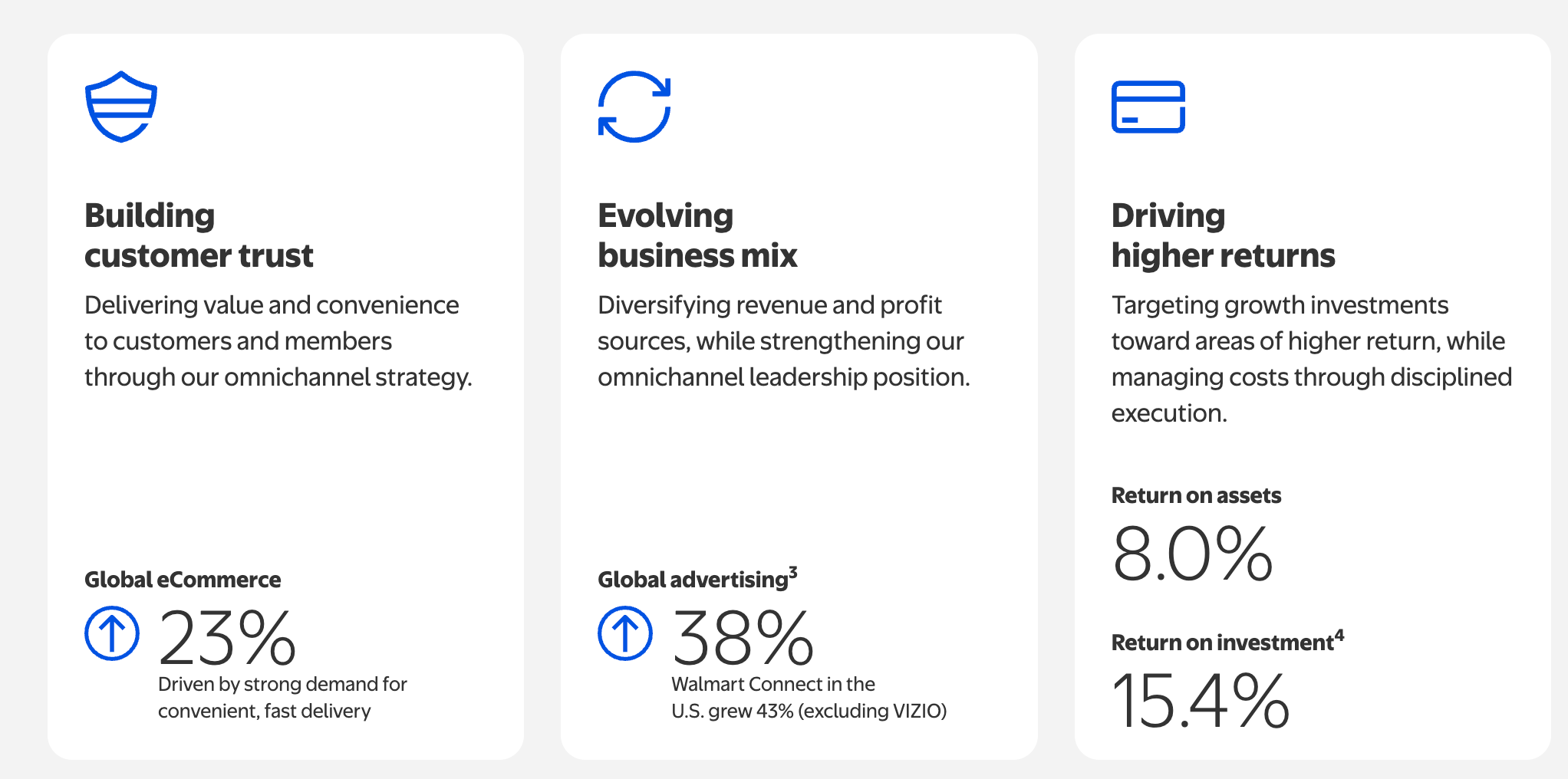
Walmart's own results show the same shift from the retailer's side, with its global advertising business growing 38% year over year in the second quarter of fiscal 2027. Walmart Connect in the US grew 43% excluding VIZIO in that same quarter. Total revenue grew 5.9% in the same quarter. A retailer growing its ad business more than six times faster has every reason to keep pulling shopper marketing dollars into media.
Shopper marketing tactics that move in-store purchase decisions
A first-year shopper marketing strategy usually starts with tactics that work late in the path to purchase, before money goes into awareness.
Secondary placement, an endcap, a floor display, a shipper near the entrance, puts the product in front of a shopper who wasn't looking for it. Sampling and in-store demos let a shopper try something before paying for it, which does the persuading for a new item that has few reviews yet.
Shelf signage, shelf talkers, and a retailer's own loyalty offers or digital coupons close the gap for a shopper who noticed the product but hasn't decided. Cross-merchandising next to a related product, a dip near the chips, catches a shopper who already decided to buy something adjacent.
The digital shelf supports all of this: the product page, the images, the ratings and reviews a shopper standing in that exact aisle checks on a phone.
The shopper marketing examples that work hardest line up several of these tactics in the same store at the same time.
An illustrative example: a better-for-you snack brand launching at Target lines up an endcap during its launch window, a Target Circle offer, sponsored search on its category terms and in-store demos in its strongest stores. It pauses media in any store that runs out of stock. No spend points at an empty shelf.
How to measure shopper marketing
Platform-reported ROAS often credits an ad with a sale that ordinary shopper behavior would have produced anyway. A loyal buyer clicks a sponsored listing for a brand they already buy every month, and the platform counts that as new revenue.
The better test is incrementality. Compare matched groups of stores running the campaign against stores that aren’t, then measure the difference in units sold at the point of sale. A platform dashboard won’t show you that on its own.
Comparing networks adds a second problem. Oliver Wyman reports growing frustration among CPG companies over the different ways networks report ROAS, which makes one network’s number hard to compare with another’s. Build an incrementality test into the first-year plan, or require one from an agency, before trusting a network's own reporting.
Who should own shopper marketing
Shopper marketing usually reports into one of three places, and each has a trade-off.
Under a CMO or VP of Marketing, the brand stays consistent and media spend tends to get more discipline. The cost is distance from purchase orders, inventory, and the buyer’s calendar.
Put shopper marketing under sales, and the role ties directly to account targets and joint business planning, the annual planning cycle between a brand and a retailer covering volume, promotions and terms. But retail media often turns into a bargaining chip in account conversations, with nobody tracking it as its own investment.
When sales, shopper marketing and retail media all report to one commercial leader, they get planned as one budget. That setup needs an executive most smaller brands can't staff yet, so it shows up mostly at larger brands.
Oliver Wyman's guidance is to bring customer development, shopper marketing, and media teams together and clarify who owns what.
Constant Hire's own 2026 search shows that same kind of role clarity in practice. The new seat reported to the VP of Marketing and worked closely with the chief revenue officer, who had owned retail before the hire.
Revisit that reporting line as the role and budget grow. Our guide to ecommerce team structure covers how the wider org shifts around it.
Who to hire to run shopper marketing
Titles don't tell you who can do this job. In that same 2026 search, run for a DTC health and wellness brand moving into Target and Walmart, only 3 of the first 15 candidates in the pipeline (as of October 23, 2026) had “shopper marketing” anywhere in their current title.
The rest came from retail marketing, a retail media agency, brand, growth, digital commerce, ecommerce, marketing operations, retail strategy and insights, and brand experience roles, plus one candidate from an in-store media vendor. The keyword on a resume tells you less than it seems to.
The table below groups the backgrounds in that pipeline into five types.
Background
What they usually bring
What to probe for a first retail seat
Legacy CPG shopper or customer marketing
Retailer calendars, joint business planning, large program budgets, agency and broker management
Ownership without a big team; comfort with a brand that has no retail playbook yet; category fit
Retail media agency
Hands-on platform skill across retail networks, reporting
Brand-side accountability for sales, not only media metrics; in-store and buyer experience
Brand-side budget ownership and measurement discipline
DTC brand that already launched into retail
Translating DTC economics into retail, building a function from zero, first-hire experience
Depth across retailers and channel types (mass, grocery, club)
DTC growth or ecommerce marketing
Performance marketing and measurement
Hands-on retail experience; usually a stretch for a first retail seat
Constant Hire framing, based on candidate backgrounds in one 2026 search. Not a statistical sample.
The client passed on a candidate with 16+ years in shopper marketing, programs at every major retailer and a budget of roughly $20 million, and asked for experience closer to its own category.
One of the candidates the client moved ahead with had run much smaller budgets, had no Walmart Connect experience, and had been the first retail marketing hire at a DTC brand launching into Target. Their title said retail marketing, not shopper marketing.
A second candidate who advanced had built a CPG company's own shopper and ecommerce approach from the inside and grown its Amazon business.
The client also asked the recruiter to probe ownership with candidates from large companies, where a title can describe a slice of a much bigger team's work instead of something that person built.
One search isn’t a rule. Still, if you’re filling your first retail seat, weigh transition experience and ownership above budget size. A candidate who ran that kind of budget at a company with a built-out team has seen scale.
A candidate who built a function from nothing at a brand your size has seen the actual problem you're hiring to solve. For a first hire, the second experience usually transfers better than the first.
Use that search's role design as a starting point for your own. The role covered the retail media briefs and spend, the product pages and item setup, the ratings and reviews program, the relationship with a retail agency, support for buyer meetings, and the link between in-house creative and the retail plan.
That's a wide seat for a first hire, which is why the background it needs rarely matches a single job title.
What to screen for
Our recruiters used the same six headings on every screen in this search. They work as a screen for any candidate in this seat.
Screen area
What to ask about
Illustrative strong signal
Illustrative weak signal
Big-box and club experience
Which retailers and channel types they ran programs for
Programs across mass, grocery and club, with retailer-specific plans
One retailer, or only through an agency
Budget and program scale
What budget they owned and how it split across in-store and digital
Can explain the split and what they cut
Large total with no sense of what worked
Retail media and in-store velocity tactics
Platforms run, launches, in-store activation
Has managed retail media spend directly and through agencies and launched new items
Talks only about one channel
Strategic ownership and autonomy
What they built versus inherited
Built a retailer plan or function from scratch
Executed a plan set by a large team
Culture and personality
Why this brand and stage
Clear reason for the stage and category
Generic interest in any next role
Compensation
Expectations against the budget
On budget or explains the gap
Mismatch discovered late
Screen areas are from Constant Hire recruiter notes. Example signals are illustrative.
Close every screen the same way: ask for a specific retailer launch they ran, what they owned, what the budget was, and how they knew it worked. Someone who can answer all four without hedging has done the job. A candidate who can only describe the campaign, missing the budget or the proof, probably managed a piece of someone else's program.
In-house hire or shopper marketing agency
Agencies are good at media buying, production, and reporting at scale. Someone in-house still has to own the retailer plan, the budget, the customer experience and the agency itself, because an agency rarely has the authority or the incentive to tell a brand its own strategy is wrong.
In that 2026 search, the client already used an agency for retail execution and hired the in-house seat to oversee it and hold it accountable. A first hire like this usually comes before a bigger agency scope. Get the ownership in place, then decide how much of the work an agency should run.
Hiring for this seat
We recruit for DTC, ecommerce, and CPG brands, and we screen retail marketing candidates on the six areas in the table above. For standard roles, we schedule first interviews within 5 business days, drawing on our proprietary database of vetted ecommerce candidates.
If you're hiring your brand's first retail marketing seat, or the next one, talk to a recruiter who already screens for this exact job. Book a call with Constant Hire to start the search, or read more about CPG recruiting first.
FAQs
What is shopper marketing?
Shopper marketing targets the person about to buy, whether that's in the store aisle, on the retailer's website or in its app. It covers in-store displays, sampling, coupons, retailer-specific promotions and retail media placements, and it is usually planned retailer by retailer rather than as one national campaign.
What is the difference between shopper marketing and consumer marketing?
Consumer marketing builds demand with whoever uses the product, wherever they are, through brand advertising and social content. Shopper marketing targets the person buying it, often a parent or household shopper, at the retailer where the purchase happens. A dog food brand markets to the owner standing in the aisle, since the dog has no say in the purchase.
How is shopper marketing different from retail media?
Retail media is a retailer's own advertising, sold through its site, app, and in-store screens, targeted with its shopper data. Shopper marketing is the broader job of winning the purchase at that retailer, which now includes buying retail media alongside displays, sampling, coupons, and promotions. In a 2026 search we ran for a brand’s first retail marketing seat, one role covered both.
Who should a DTC brand hire to run shopper marketing at big-box retail?
Prioritize someone who has already taken a brand into big-box retail over someone with the largest budget. In a 2026 search we ran for a DTC brand’s first retail marketing seat, the client moved ahead with candidates who had built a retail function from scratch, passing on a senior legacy CPG candidate without category fit.
Connor Gross founded Constant Hire in 2024. An operator turned founder with deep experience building and scaling e-commerce brands. He previously sold an Amazon brand and generated over $30M in DTC revenue through private-label Shopify businesses. He now helps fast-growing DTC brands and agencies hire top talent across marketing, creative, ops, and sales. From E‑com Managers to TikTok Creators and Heads of Growth, he knows what great looks like, and how to recruit it.