What Does a Chief Commercial Officer Do? DTC and CPG guide
A chief commercial officer owns net revenue across DTC, Amazon, retail and wholesale. Responsibilities, interview questions and a practical test for hiring one.
A chief commercial officer (CCO) is the executive who owns net revenue across every channel a consumer brand sells through that helps founders and CEOs grow sales without giving margin back through trade spend, pricing and channel conflict. At most DTC and CPG brands, those channels are DTC, Amazon, retail and wholesale.
The title is less settled than that definition suggests. Two recent CCO appointments at consumer brands, covered below, gave the seat very different jobs. A brand that hires against the title alone risks getting someone built for the other version of the role.
So the useful question is what a chief commercial officer does at your brand, at your stage. Below are the responsibilities, where the seat ends and the chief revenue officer, CMO, COO and VP of sales begin, how to scope it, what drives pay, and how to interview, test and find candidates who rarely hold the title.
What a chief commercial officer does at a DTC or CPG brand
A chief commercial officer at a consumer brand decides where the brand sells, at what price and with how much trade spend behind it. Those calls make up most of the commercial strategy, and the CCO then answers for net revenue after trade, not gross shipments.
The work runs on two tracks. The selling track means winning retail and marketplace accounts, keeping them, and doing the business development that opens the next door. The commercialization track covers what launches, where it goes first and at what price, which puts the CCO between product development and the sales team.
Two 2026 appointments show how far the same title can stretch.
Supergoop (sun care, DTC and retail)
Celsius Holdings (energy drinks, retail and direct store delivery)
How the seat was created
First-ever CCO, a newly created role, effective Sept 28, 2026
EVP of North American Sales promoted to CCO, effective Aug 10, 2026
Reports to
CEO
Not stated in the filing
Owns
Global commercial organization across retail, ecommerce and retail marketing
Field sales, key retailer accounts, direct store delivery (DSD) operations and revenue growth management across the portfolio
Sits beside
A separate CMO whose remit covers marketing, creative, consumer insights, partnerships, communications and product innovation
A prior CCO, in the seat from 2024, who moved to chief customer officer in February 2026 and then to a new transformation role
Supergoop created a channel integrator, one leader holding retail and ecommerce together while the CMO keeps consumer marketing. Celsius promoted its head of North American sales into a seat built around retailers, field sales and revenue growth management. Same title, different job.
Celsius also shows how fast the label moves inside one company. We tell clients to write the mandate before the job description, then recruit against it.
Chief commercial officer responsibilities and skills
Chief commercial officer responsibilities show up as recurring decisions about channels, price, trade and accounts. The table below shows what each one looks like in a normal week and the KPIs the CCO answers for.
Responsibility
What it looks like week to week
Measured on
Channel strategy and sequencing
Decides which retailer or marketplace comes next and which to turn down
Net revenue by channel after trade
Pricing by channel
Keeps DTC, Amazon and shelf prices from undercutting each other; reprices when a retailer or cost change forces it
Price realization and gross margin by channel
Trade spend and deductions
Approves promotions, slotting and free fills against a target return; traces deductions back to the promotion that caused them
Trade spend as a share of gross sales; return per promotion
Top accounts and partners
Owns top buyer relationships and holds brokers and distributors to account plans
Distribution gained and kept; reorders
Launches and sell-through
Gates new SKUs on supply, margin and retailer requirements; pairs new doors with a velocity plan
Velocity after launch; SKUs kept at reset
Forecast and team
Brings the retail forecast into S&OP; hires and levels the sales and commercial team
Forecast accuracy; team retention
Source: Constant Hire framing based on commercial searches, not a sourced dataset.
A strong CCO reads the P&L in net revenue after trade rather than gross sell-in, and has the negotiation skills to hold price at a category review.
They read retailer portal data, scan data and market research next to site and marketplace data, and they give the CFO a clear view of where trade dollars go. They also build a broker bench and a team that can run customer relationships without them in the room.
The hardest skill to find is fluency on both sides of the channel mix. Most commercial leaders grew up in either DTC or retail, and few have run both at once.
CCO vs CRO, CMO, COO and VP of sales
Most confusion about the chief commercial officer comes from the titles around it, and each boundary decides who owns pricing and trade.
Title
Where the line sits
Chief revenue officer
A title most common at software companies. At consumer brands it often covers DTC and ecommerce revenue. The CCO adds retail, wholesale, pricing and trade. See our chief revenue officer recruiters page.
Chief marketing officer
Owns consumer demand and the brand. The CCO owns where product sells and on what terms. Supergoop runs both seats side by side. See CMO executive search.
Chief operating officer
Owns supply, fulfillment and cost to serve. The CCO hands the COO a forecast tied to real orders. See COO executive search.
VP of sales
Runs accounts and the sales team against a plan. The CCO sets the plan, the pricing and the trade policy, and often sits above the VP of sales.
Head of commercial or commercial director
Usually the senior commercial lead one level below the C-suite, or the top commercial hire at a brand too small for a CCO.
The matrix below, from our chief commercial officer executive search page, shows what each title owns, runs and shares.
Owns / Runs Shares Contributes Not their remit
Responsibility
CCOC-suite
VP of salesReports to CCO or CEO
VP of commercializationLaunch and retail readiness
Channel strategy and sequencing across DTC, Amazon, retail, and wholesale
Owns
Contributes
Shares
Retail and wholesale account wins and buyer relationships
Owns
Runs
Contributes
Pricing and price pack architecture by channel
Owns
Contributes
Runs
Trade spend, promotions, and deductions
Owns
Shares
Shares
Broker, distributor, and rep network
Owns
Runs
Contributes
New product launch readiness and stage gates
Owns
Contributes
Runs
Sell-through and velocity after launch
Owns
Runs
Shares
Revenue forecast and S&OP input
Owns
Contributes
Shares
Consumer demand and paid media
Contributes
Not their remit
Not their remit
Commercial P&L, net revenue after trade
Owns
Reports on
Reports on
Hiring and leveling the sales and commercial team
Owns
Runs
Contributes
Define your brand’s current and future needs first
Before anyone writes a chief commercial officer job description, the CEO should answer three questions about the next stage of the business.
Start with where revenue goes next. If growth runs through retail or wholesale, the hire needs buyer and broker experience and a record of opening new doors. If it runs through DTC and Amazon, they need paid media, marketplace economics and a record of driving repeat purchase.
Then decide which decisions transfer. Pricing authority, the trade budget, broker contracts and the top buyer relationships either move to the new hire or stay with the founder. A CCO who inherits the title without those decisions is a VP of sales with a better title.
One of our searches shows where that line falls. In a director of sales search for a supplement brand, the brief had the hire negotiate pricing, trade spend, free fills and deductions within approved parameters and escalate anything above them. Whoever sets those parameters is doing the CCO job. If nobody at your brand owns that today, that is the gap.
From a director of sales search Constant Hire ran for a supplement brand in 2026. Client not named.
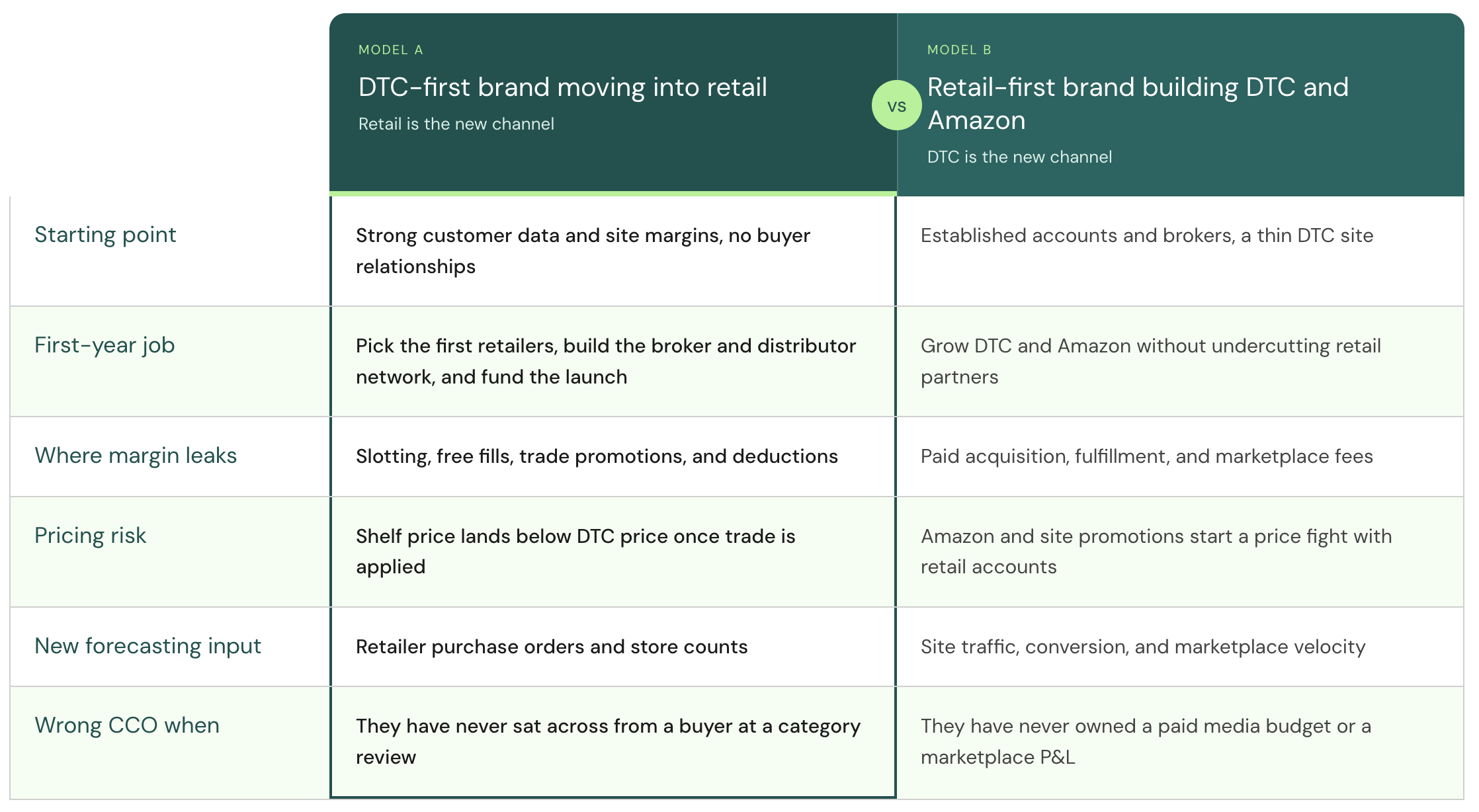
Last, confirm the level. A director of sales, VP of sales or VP of commercialization may fit a brand where the founder still holds pricing and trade. On our CCO executive search page, we map which tier fits each revenue stage and compare DTC-first and retail-first hires.
Which commercial leadership tier fits each revenue stage, with team size and wrong-hire signals.
How a DTC-first CCO and a retail-first CCO differ in background and first-year priorities.
Chief commercial officer salary expectations
Chief commercial officer salary expectations are hard to set from public data. Most published pay for the title describes public companies and B2B software, which gives a consumer brand the wrong anchor.
Our own candidate database has no usable candidate-stated pay for the title, so we don’t publish a number here.
Source: Constant Hire candidate database, keyword and mandate searches run November 2026. Qualitative finding; no compensation figures published.
Scope sets the price. A CCO who owns net revenue across every channel prices above a VP of sales, with a bonus tied to revenue and profitability targets and equity at venture-backed brands. Our chief commercial officer executive search page carries BLS pay data for the closest tracked roles, sales managers and chief executives, broken out by metro.
CCO interview questions and what strong answers sound like
These five questions test whether a chief commercial officer candidate has run net revenue across channels or only managed a sales number.
Question
A strong answer covers
Red flag
Walk me through how you set price for one SKU across DTC, Amazon and retail. What happened when a retailer promotion undercut your site?
The price floor by channel, the trade-off they accepted, who signed off and what they changed afterward
Talks about list price only, or says pricing belonged to finance
Tell me about a channel or retailer you turned down.
The economics behind the no, such as trade cost, slotting, velocity risk or price conflict
Has never declined distribution, or treats every new door as worth taking
How do you keep the commercial team focused on revenue and on what happens after the sale?
One scorecard that pairs sell-in with sell-through, velocity and reorders, reviewed with marketing on the retail calendar
Measures the team on shipments alone
How do you deliver revenue growth while finding cost savings?
Named cost lines such as trade, deductions, broker commissions, free fills or marketplace fees, plus an account or promotion they cut
A generic answer about efficiency with no line item
How do you stay current on channel and retailer changes?
Sources tied to decisions, such as retailer portal data, category review calendars, buyer conversations and marketplace policy changes they acted on
Lists newsletters and conferences with no decision attached
Example answers are illustrative.
The third question carries the most weight at brands with retail exposure. Sell-in without sell-through comes back as deductions, markdowns and a buyer who stops reordering. By the time shipments show it, the account has already soured.
Run these after the two first-interview filters below, which test trade spend as a percent of gross sales and units per store per week 26 weeks after launch.
The two filters we run before the questions above
A practical test for CCO candidates
A practical test for a chief commercial officer candidate belongs in an early round and should use a mock brief, so nobody solves your real business for free. At Constant Hire, we use a one-page channel-conflict case at this stage.
The case gives one hero SKU with its DTC price, Amazon price and retail cost. A national retailer wants a deep promotion during a reset, and the remaining trade budget is fixed. The candidate gets 48 hours, then presents for 30 minutes on their recommendation, the net revenue math after trade, what they would tell the buyer and who they would brief internally across finance, marketing and operations.
Score whether the math nets out trade and whether price architecture holds across all three channels. Above all, score whether the candidate names the trade-off instead of avoiding it. Save your real account data for the final round, where our assessment uses it.
To source a chief commercial officer, search by mandate, not title, because commercial leadership at consumer brands rarely carries the CCO label. When we searched our candidate database for the title, it appeared on one profile, and that person had never held it. A mandate search covering net revenue across retail, wholesale, Amazon and DTC, plus trade and brokers, returned 17 profiles. None of them held the CCO title. Their titles included VP of sales, director of sales, a combined chief revenue officer and SVP of sales title, head of ecommerce and CMO.
Source: Constant Hire candidate database, keyword and mandate searches run November 2026. Qualitative finding; no compensation figures published.
So build the shortlist from people who have owned net revenue after trade across DTC and retail at a brand near your stage. Most of them are employed and not applying, which is why this hire usually runs as a retained search. At Constant Hire, we run chief commercial officer executive search on a retained basis for DTC and CPG brands. We scope the mandate before sourcing and put first interviews on your calendar within 10 business days. Book a call to scope the seat.
FAQs
What does CCO stand for?
At consumer brands, CCO usually stands for chief commercial officer, the executive who owns revenue across every channel the brand sells through. The same letters can mean chief customer officer or chief creative officer, so read the scope, not the acronym. Celsius, for example, moved its chief commercial officer into a chief customer officer role in 2026.
What does a head of commercial do?
A head of commercial leads sales and channel performance, usually one level below the C-suite or as the senior commercial hire at a smaller brand. The role typically runs accounts, pricing proposals and the revenue forecast. Final calls on channel strategy and trade policy tend to stay with the CEO until a chief commercial officer is hired.
Who does a chief commercial officer report to?
Usually the CEO. Supergoop’s first chief commercial officer, appointed in September 2026, reports to the CEO and leads retail, ecommerce and retail marketing. At founder-led brands the CCO often takes over decisions the founder held, such as pricing and the top retail relationships, so settle the reporting line before the search starts.
Does a chief commercial officer manage marketing?
Sometimes, and usually only the part tied to the shelf. At Supergoop, retail marketing sits in the commercial organization while a separate CMO’s remit covers marketing, creative, consumer insights and communications. For most consumer brands, a workable split gives the CCO where and how product sells and leaves consumer demand with the CMO.
Connor Gross founded Constant Hire in 2024. An operator turned founder with deep experience building and scaling e-commerce brands. He previously sold an Amazon brand and generated over $30M in DTC revenue through private-label Shopify businesses. He now helps fast-growing DTC brands and agencies hire top talent across marketing, creative, ops, and sales. From E‑com Managers to TikTok Creators and Heads of Growth, he knows what great looks like, and how to recruit it.