TikTok Shop Staffing: Live Selling vs Affiliate Management
Live selling and affiliate management are two jobs. Use the Live Share Test to decide if your TikTok Shop needs one hire or two, and which to fill first.
TikTok Shop staffing is a headcount decision that helps DTC operators decide how many people run the channel and who owns live selling and creator affiliate management.
Most brands scope TikTok Shop too narrowly. They hand it to a social media manager, and on Constant Hire's sales calls the next thing we hear is that the channel has stalled. No tool fixes that, because the missing piece is an owner. TikTok Shop holds at least two operating jobs with opposite tempos. Live selling is synchronous and measured in hours on camera. Affiliate management is asynchronous and measured in creators activated. They share a platform and almost nothing else.
One hire can run a TikTok Shop until live selling becomes a workload of its own, and then live needs its own owner. The Live Share Test shows in ten minutes which side of that line you are on. This guide covers what breaks when one person holds both jobs, when to split, and what the split costs.
Everything here assumes your TikTok Shop already runs and already has one owner. This guide covers the second hire.
Why TikTok Shop staffing outgrew the one-hire assumption
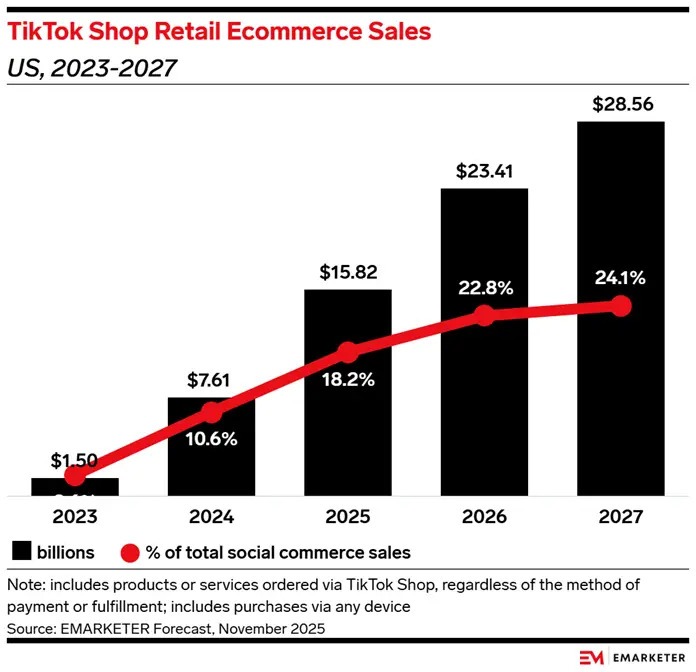
Consumer Edge card data puts TikTok Shop at about 2% of US online retail spend in July 2026, up from 1.2% a year earlier, measured within its card panel. The share is small. The channel still grew faster than the org charts brands built around it.
Constant Hire's Revenue Operator Stack defines what a TikTok Shop manager does in three layers: the affiliate and creator pipeline, fulfillment and account health, and TikTok SEO and paid amplification.
Live production sits outside all three. A full-time manager can carry live at low volume, and the Live Share Test below shows when live needs its own owner.
Mammoth Brands, Stila and BaubleBar were all recruiting dedicated TikTok Shop roles in August 2026, and Jool Baby was hiring an ecommerce marketplace manager to run TikTok Shop and social commerce.
Jool Baby's founder, Judah Bergman, told Modern Retail there is no large pool of TikTok Shop managers to hire from, and that the experienced ones mostly sit at agencies. Constant Hire candidate data agrees: nearly every live selling record sits at an agency or a live-commerce studio, and almost none sit at a brand. Scope the job before you open the search, because you are hiring from a thin pool.
The Live Share Test is a staffing diagnostic that helps operators decide whether live is a second headcount or a side task by measuring what percentage of a brand's TikTok Shop revenue comes from live selling.
Live was 8.2% of attributed GMV on US TikTok Shop in H1 2026, per analytics-vendor panel data. In luxury resale, TikTok says live drove 94% of year-to-date US revenue. One is a platform-wide attribution estimate and the other is one invite-only category's revenue share, so the gap is directional.
Live works where a buyer needs a conversation about condition, fit, or scale before committing. Rainee Walker, TikTok Shop's head of category for luxury resale, argued that a live host can answer where a bag strap lands on a different body, which a static product page cannot. In categories where the product explains itself, live does far less work and affiliate video carries the channel.
You can't copy another brand's TikTok Shop org chart unless you sell in the same kind of category. Staff a conversation-led category like a discovery channel and live gets squeezed into someone's spare hours. Staff a self-explaining product like a live channel, and you pay for a broadcast clock the revenue never needed.
Live share of your GMV
What that means
Staffing answer
Where this shows up
Under 10%
Live is mainly a discovery and community tool at this share.
One hire, affiliate-weighted, with staff rotation or creators covering live.
Self-explaining products that sell on short video. For reference, live was 8.2% of platform-wide attributed GMV in H1 2026.
10%–40%
Live is a real revenue line competing for the same person's hours.
The split starts here. Contract a host before committing to a second salary.
Beauty, food and beverage, apparel with demo-led products.
Over 40%
Live is the channel, and affiliate supports it.
Two roles, minimum. A dedicated host or producer plus an affiliate owner.
Luxury resale, collectibles, high-consideration and condition-led goods.
Sourced from Momentum Works (H1 2026, attributed GMV) and Modern Retail (September 2026, luxury resale revenue). The bands and category examples are Constant Hire's operator judgment.
Answer three questions from your own Seller Center data in ten minutes:
What share of last month's TikTok Shop GMV came from your live sessions?
How many hours a week do your live sessions run on camera?
How many creator applications and sample requests wait on the person who goes on camera?
Your first answer sets your band, and the other two feed two of the split triggers below. Treat the first answer as a floor. Attributed GMV credits the surface where a sale closes, and in H1 2026 more US sales closed in the Shop tab after buyers found the product in video or live. If your lives send viewers to buy later in the Shop tab, your live share will read lower than the work live is doing. Compare Shop-tab GMV on live days against non-live days before you settle on a band.
TikTok Shop live selling is a production job
In Constant Hire's operator view, TikTok Shop live selling runs in three phases, and each one carries a hard time cost. Staging covers camera, lighting, audio, product setup, reserved promotional inventory, and scheduled vouchers.
Broadcast means two to four hours of continuous delivery while you read live metrics, run flash discounts, answer objections in chat, and reset the pace to catch new traffic. Teardown and review cover session analytics, retention, click-through, and the next lineup.
A three-hour broadcast consumes five to six hours of the day and cannot be paused, moved, or done in the background. While it runs, the creator inbox, the sample queue, and every open approval wait.
A TikTok Shop affiliate manager runs a sales pipeline that creators happen to staff. The job starts with prospecting category leaderboards for creators who have proven they can sell, whatever their follower count, then recruiting them into your TikTok Shop affiliate program. Outreach and negotiation run across hundreds of touchpoints, and every commission rate has to protect margin.
Sample seeding means vetting requests, coordinating warehouse fulfillment, and tracking delivery. The activation loop is where programs succeed or quietly fail. It covers follow-up in the days after a sample lands, compliance checks, Spark Ad code capture, and keeping the roster warm. When nobody follows up, the brand absorbs the product and shipping cost and gets no video.
For the full fee stack, see what TikTok Shop actually costs; two figures drive affiliate margin, a 6% unified referral fee for most categories and a 13.02% average commission. On an affiliate-driven order in a 6% category, the two add up to 19.02%, roughly a fifth, before fulfillment and returns.
Commission is a P&L lever with a lag. When you cut an open-collaboration rate, creators already promoting the product keep the old rate until their 30-day lock-up ends. Whoever owns affiliate needs margin fluency as much as creator relationships.
Samples ship, nobody follows up, and the brand absorbs the product and shipping cost and gets no video.
What breaks when one person holds both
Across 271 TikTok Shop, social commerce and affiliate operators in Constant Hire's candidate pipeline, only 17 have run TikTok live selling in any role. Thirteen of those 17 (76%) were carrying affiliate work at the same time, so double-hatting is the default for the people who do this job. Affiliate experience is common by comparison, with 142 of the 271 showing it.
The pool holds 50 distinct job titles containing "TikTok" across 61 position records, close to one distinct title per record. Roughly a third of those 50 titles bolt TikTok onto another function.
Three examples: influencer marketing plus sample center plus content creator; social media coordinator plus TikTok lead plus influencer support; and TikTok Shop manager slash digital marketing manager.
Meanwhile, 666 records are titled around influencer or social media against 61 titled around TikTok, so social roles absorb the work instead of scoping it as its own. Only three distinct titles name TikTok live.
Broadcast days do not move, so when both jobs share one calendar, live wins because it earns revenue today. Prospecting stops, creator applications sit unreviewed, sample follow-ups lapse, and the affiliate pipeline decays while the live numbers look fine. By the time anyone notices, the roster has gone cold.
If the Shop Performance Score falls below 3.0, the shop loses affiliate access until it recovers to 3.5. A fulfillment miss can switch off the affiliate channel, so name an operations owner for the warehouse KPIs, separate from whoever runs creators.
Dimension
Live selling
Affiliate management
Tempo
Synchronous, with fixed broadcast windows.
Asynchronous, with a continuous pipeline.
Daily shape
Two to four hours on camera plus two to three hours of setup and teardown.
Ongoing outreach, sample approvals and follow-up cadences.
Output scales with
Hours on camera.
Number of creators activated.
Core skill
On-camera delivery, real-time merchandising, reading live metrics.
Pipeline management, commission and margin modeling, relationship retention.
Primary metric
GMV per thousand views.
Attributed affiliate GMV and active creator ratio.
Fails as
Dead air, flat conversion, technical faults.
Cold roster, lapsed follow-ups, sample budget written off.
Bottleneck
Calendar capacity.
Attention across a growing roster.
Sourced from Constant Hire operator analysis.
When to split the role
Constant Hire's working financial trigger is $35,000 to $50,000 in monthly TikTok Shop GMV. At that level, contribution margin net of the referral fee, affiliate commissions and COGS can usually carry a second specialist salary. The number is operator judgment, as are the operational triggers below.
Three operational triggers can fire first, and any one justifies the split on its own:
Live cadence past six to eight hours a week, since two multi-hour sessions weekly is where outbound creator work starts losing the calendar fight.
Sample shipments past 50 units a month, because processing, fulfillment, and follow-up take the better part of a working week.
Active roster past 30 to 50 creators, because relationships, rate escalations and Spark Ad code capture become a full account management load.
The Live Share Test picks which job to hire first, and monthly GMV decides when the second salary is affordable. Don't hire both at once. Hire the dominant function full-time and contract the other, which turns the second job from a fixed salary into a cost that moves with revenue.
On Constant Hire's bands, if live is under 10% of your GMV, hire an affiliate owner and let rotation or creators cover live until it earns a contracted host. If it is over 40%, hire the live owner and consider an affiliate agency.
Stila shows what the step from rotation to an owner looks like. Its staffers and creators host lives today, CMO Mary Rodrigues says the livestream strategy is still in the "baby stages," and an agency already runs affiliate. With a studio built in its office, the brand opened a dedicated TikTok Shop marketing role to run live in-house.
What the split actually costs
ZipRecruiter puts the average US TikTok Shop manager at $54,099 a year, with the 90th percentile at $78,000. The TikTok Shop manager salary benchmarks break this down by experience and specialty.
Constant Hire's candidate pipeline shows a $137,500 median base expectation across 86 operators with usable US compensation data, $59,500 above even the job board's 90th percentile. The 52 of those operators with influencer or social titles have a $122,500 median.
In Constant Hire's read, job boards pool part-time, freelance, and entry-level listings with full-time US brand-side roles under one title, so their averages describe a mixed pool. The pipeline holds candidate-stated base expectations. A brand budgeting $60k against the influencer or social median will struggle to fill the role, and Constant Hire sees that budgeting failure more than any other on this channel.
Only six of the 17 live selling operators in the pipeline have compensation data, too few to band. That gap is itself a scarcity signal.
SharkNinja was paying as much as $154k a year for a full-time TikTok Shop manager in December 2025.
SharkNinja posted a TikTok Shop manager role covering sales and live operations at $112,000 to $154,000 in November 2025. In July 2026 it posted a separate social affiliate manager role at $77,000 to $149,100. A budget set near the job board average sits about $58,000 below the live operations floor and $23,000 below the affiliate floor.
Mixed part-time, freelance and entry-level listings under one title. Skews junior.
Constant Hire pipeline, all operators
$137,500 median
Candidate-stated base expectations, n=86, with quartiles at $115,000 and $200,000.
Constant Hire pipeline, influencer- and social-titled
$122,500 median
n=52, with a range of $70,000–$216,000.
Constant Hire pipeline, live selling
Not published
n=6, below Constant Hire's reporting threshold, so the pool is too thin to band.
The job board row uses ZipRecruiter data for the US in September 2026. The other rows use Constant Hire candidate data from 2025 to 2026, which holds candidate-stated base expectations and excludes placement salaries. Constant Hire suppresses segments below 15 records.
What to keep in-house and what to contract
The hybrid Constant Hire sees most often keeps affiliate in-house and contracts live. Creator relationships are the asset that walks out the door when an agency contract ends, while studio hardware and host hours are capital and capacity costs a partner can carry.
Stila, covered above, runs the inverse. SharkNinja keeps both jobs in-house as two separate roles. Its TikTok Shop manager posting covers sales and live operations and names the affiliate team as a partner, while a social affiliate manager owns the creator program. All three setups can work. What fails is handing the whole channel to an outside partner with nobody inside owning it.
Jool Baby worked with a TikTok Shop agency, leaned on one of its top affiliates to steer strategy for six months, traced about 5% of sales to the channel, and is now hiring an in-house owner
Agencies hold most of the experienced live operators, which is why contracting live is often faster than hiring it. The agency vs in-house manager comparison runs the numbers for the whole channel.
What to screen for in each hire
The first signal is which of live selling and affiliate management a candidate would drop first when a week cannot fit both. People who have held both give fast, specific answers; the rest say they would do both.
For live, the signal is their own GMV per thousand views and what they changed to move it. Vague answers about energy or engagement are the red flag.
For affiliate, the signal is how they set commission rates and what they do when margin moves against them. A candidate who cannot connect commission to contribution margin is a creator relationship manager and cannot own the channel.
The full interview process is in how to hire a TikTok Shop manager. Constant Hire screens TikTok Shop operators for the specific function you need, live selling or affiliate management, and our TikTok Shop manager recruitment delivers qualified candidates within 5 days.
One owner per job
TikTok Shop stalls when one person owns two jobs with opposite tempos. Live selling runs on a broadcast clock and scales with hours on camera. Affiliate management runs as a pipeline and scales with the creators you activate.
The fix is a staffing decision, and the Live Share Test tells you which job to fill first. Hire the function your category rewards, contract the other, and add the second salary once revenue can carry it.
Write each role around its own metric and give each one a named owner. A team built that way stops asking one person to run a broadcast and a pipeline from the same calendar.
FAQs
Do I need two people to run TikTok Shop?
Not always. It depends on how much of your GMV comes from live selling. On Constant Hire's Live Share Test bands, under 10%, one affiliate-weighted hire works. Between 10% and 40%, contract a host before adding a salary. Over 40%, live needs its own owner. Constant Hire's working threshold for a second specialist is $35,000 to $50,000 in monthly GMV.
Can a social media manager run TikTok Shop?
No. TikTok Shop is a commerce operation with fulfillment deadlines, commission margin, and platform compliance attached, and Seller Center requires you to mark regular orders In Transit within two business days. Social media management is a content discipline; the overlap ends at the platform.
What is the difference between a TikTok Shop live host and an affiliate manager?
A live host produces and presents broadcasts, and output scales with hours on camera. A TikTok Shop affiliate manager recruits and activates creators, and output scales with the number of creators managed. One works to a broadcast clock and the other to a pipeline, so the skills and metrics differ.
Connor Gross founded Constant Hire in 2024. An operator turned founder with deep experience building and scaling e-commerce brands. He previously sold an Amazon brand and generated over $30M+ in DTC revenue through private-label Shopify businesses. He now helps fast-growing DTC brands and agencies hire top talent across marketing, creative, ops, and sales. From E‑com Managers to TikTok Creators and Heads of Growth, he knows what great looks like, and how to recruit it.