How to Hire an Ecommerce Manager: What Great Looks Like
How to hire an ecommerce manager in 2026. Covers skills, salary benchmarks, evaluation frameworks, and sourcing strategies for DTC and ecommerce brands.
Hiring an ecommerce manager means finding someone who can own your online storefront end to end: conversion rate, merchandising, promo calendar, and on-site revenue performance. The role sits between marketing, tech, and operations. The right person turns site traffic into profitable online sales.
At brands where assortment and onsite search need a full-time owner, that scope often splits out into an ecommerce merchandising manager.
Most brands don't have a hiring problem. They have a storefront ownership gap. Someone runs ads. Someone else updates product pages. A third person handles email marketing. But nobody owns the digital P&L. That gap compounds fast: leaked conversion rate, untested promotions, and ad spend compensating for a site nobody owns.
This guide breaks down how to hire an ecommerce manager in 2026: signs you're ready, the skills that separate great from average, where to find the right candidate, how to evaluate them, and what to pay. It draws from Constant Hire's placement data across 190+ vetted ecommerce candidates and research across DTC, omnichannel, and marketplace brands.
Key Takeaways
The storefront ownership gap is the number one reason ecommerce brands plateau online.
Conversion rate ownership, platform fluency, and promo calendar experience are the three non-negotiable skills.
Mid-level ecommerce manager base salary has shifted above $100,000 for revenue-owning roles; senior hires with P&L ownership regularly expect $145,000 to $180,000+
Top candidates are off the market within 10 to 14 days
Fractional hiring is a viable path for brands under $5M in annual online revenue.
What Is an Ecommerce Manager?
An ecommerce manager is the person accountable for online storefront performance, including conversion rate, merchandising, promo calendar, and on-site revenue, that helps DTC and ecommerce brands turn traffic into profitable sales.
Scope varies by company size. At lean DTC startups, the ecommerce manager may also handle retention and email marketing. At larger organizations, the role centers on site operations and cross-functional coordination across the e-commerce business. The north star is revenue per session and contribution margin, not vanity metrics.
This role is distinct from a Digital Marketing Manager, who drives traffic and owns customer acquisition cost, and an Ecommerce Director, who holds full P&L accountability at the strategic level.
Why the Ecommerce Manager Role Has Changed in 2026
The job has changed in ways that a 2021 job description won't reflect.
AI-Driven Discovery Is Replacing Traditional Search
AI assistants can now browse catalogs and complete purchases without a customer ever visiting the storefront. Shopify's Universal Commerce Protocol is one driver of this shift.
Amazon's Rufus uses behavioral context to automate recommendations within the shopping flow. Managers must build an "AI-readable" brand footprint: structured product data, third-party credibility, and Reddit-visible discussions.
Shopify revenue grew 30% in 2025, reaching $11.56 billion, driven largely by B2B expansion and Markets Pro cross-border tools.
Platform Policies Are Tightening
TikTok Shop phased out independent seller shipping in the US as of February 2026; all orders must use FBT, Upgraded TikTok Shipping, or Cross-Border Transport. Amazon's Account Health Rating now includes "Negative Feedback Rate." Shopify charges 4% on ChatGPT Instant Checkout sales, pushing total transaction costs to 7-9%. Managers who don't track policy shifts risk margin erosion and account suspension.
The Barbell Economy Demands Pricing Discipline
The 20-50% discount bracket is now a dead zone for profitability. Brands either protect full-price integrity on evergreen collections or liquidate aged inventory fast through private, unindexed links. There is no profitable middle ground. Velocity now wins over margin for aged goods because warehousing costs exceed deep-discount losses.
Composable Commerce Is the New Standard
Over 60% of mid-to-large retailers run modular, API-driven architectures with headless CMS, Algolia or Bloomreach for search, and separate personalization layers. A 1-second improvement in page load time can lift conversion rates by 2%. The ecommerce manager doesn't need to code, but their ecommerce strategy only holds up if they understand how components connect and where bottlenecks form.
Here's the hiring problem most founders miss: the majority of ecommerce managers who built their careers before 2023 learned on monolithic platforms. They managed one dashboard, not six APIs. Finding candidates who can operate confidently inside a composable stack, and troubleshoot across vendors when something breaks, is a meaningfully smaller talent pool. That gap between what the role now requires and what most resumes actually reflect is where hiring mistakes happen.
5 Signs You're Ready to Hire an Ecommerce Manager
You're the founder still updating product pages, pulling Shopify reports, and tweaking homepage banners. Your time is better spent on product, fundraising, or partnerships.
Your conversion rate has plateaued or declined and no one has a diagnosis or test plan. You're spending more on Google Ads to compensate for a leaky funnel.
Promotions happen reactively. No promo calendar, no margin analysis pre-launch, no post-mortem.
Your tech stack feels duct-taped. Apps conflict, site performance is degrading, and nobody owns the platform relationship.
Your online business is scaling past $1-2M in annual online revenue and the complexity of channels and customer segments has outgrown what one generalist can handle.
If two or more apply, you're already late.
What Skills to Look for When Hiring an Ecommerce Manager
Forget generic "digital marketing skills" lists. These are the key skills that separate great from average in 2026.
Conversion Rate Ownership
The single most important skill. Can the candidate walk through their CRO process: identify friction, prioritize tests, measure significance, translate to permanent site changes? Managers who own conversion rate optimization think in revenue per session, not traffic volume.
Platform Fluency
Hands-on experience with your e-commerce platforms (Shopify, BigCommerce, Magento, WooCommerce) is non-negotiable. In 2026, familiarity with headless tools like Storyblok and Sanity is increasingly valuable.
Promo Calendar and Merchandising Experience
A full-year promotional calendar that balances brand equity with cash flow. Margin analysis before every sale. Knows when to protect full-price integrity on new products and when to run a flash sale.
Data and Analytics Literacy
Fluency in GA4, Looker Studio, Shopify analytics, and profit-tracking tools like Triple Whale or Nova. AI personalization paired with real-time behavioral analysis has been reported to boost conversion rates by as much as 369%, according to Netguru's headless commerce analysis. The right person operationalizes these metrics, not just reads them.
Cross-Functional Collaboration
This role touches paid media, creative, email marketing, customer experience, fulfillment, and dev. Strong communication skills and the ability to lead without direct authority are requirements.
Marketplace and Channel Awareness
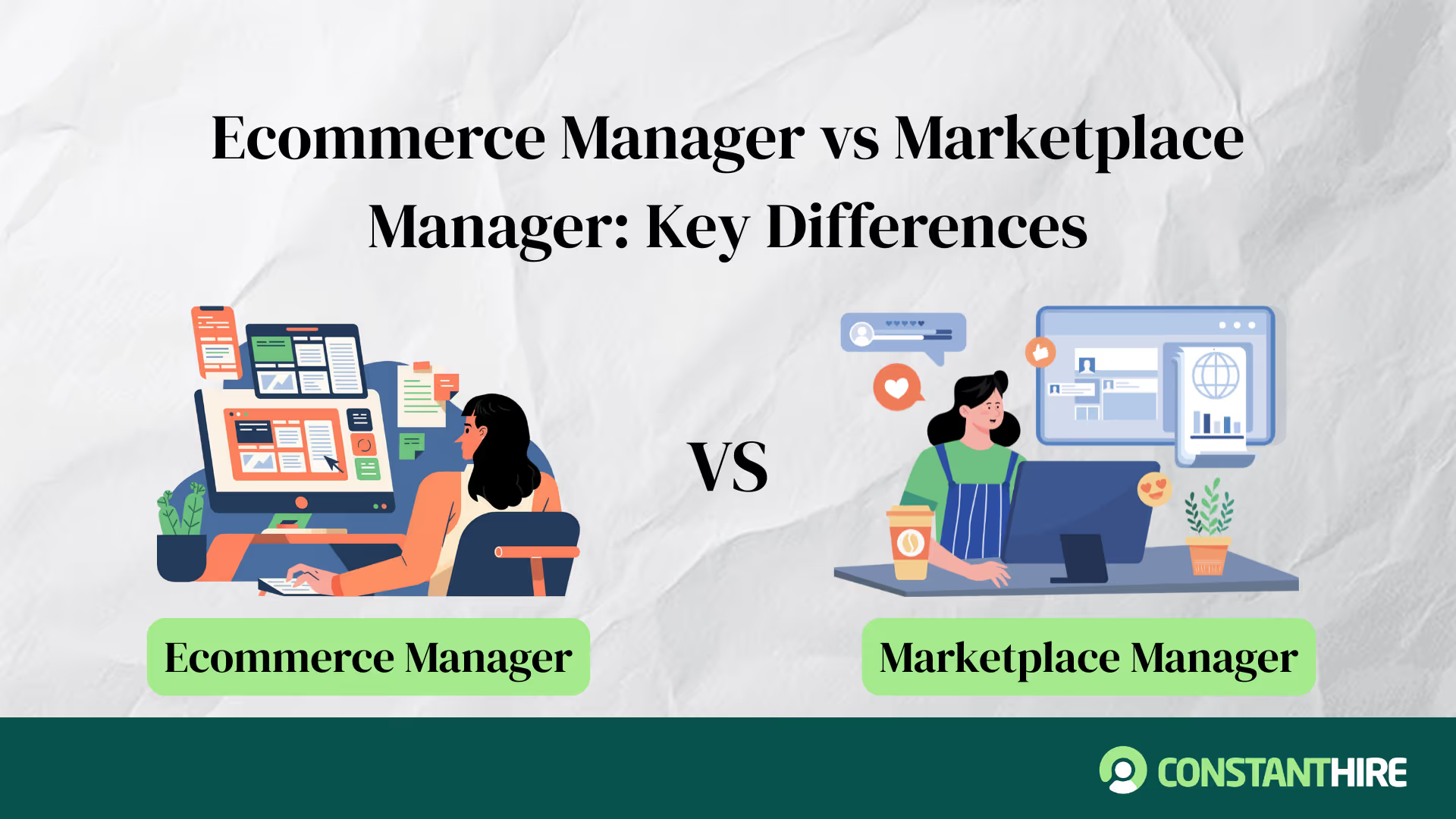
Relevant if the brand sells on Amazon, TikTok Shop, or wholesale alongside DTC, the distinction between an ecommerce manager vs marketplace manager becomes important at this stage.
Brands scaling on TikTok specifically should review what to look for when hiring a TikTok Shop manager. TikTok's Project Horizon is incentivizing agencies to recruit brands with at least $10M in annual sales, targeting $50M in collective platform sales by late 2026.
Skills Evaluation Matrix
Skill area
What to probe in interviews
Red flag
CRO
Specific CVR lifts and testing methodology
Cannot name a single A/B test; cites only traffic growth
Platform expertise
Walk through a migration, integration, or checkout customization
Only used one platform at a basic level
Promo & merchandising
Outline a Q4 promo calendar with margin guardrails
Defaults to "20% off" with no analysis
Analytics
Give a GA4 screenshot; ask to diagnose a conversion drop
Never built a custom report
Cross-functional
Describe a scenario where paid and email teams disagree on attribution
Defers all decisions upward
Marketplace
How they would launch or optimize Amazon or TikTok Shop
Dismisses marketplaces entirely
How Much Does an Ecommerce Manager Make?
Public salary databases consistently underrepresent the DTC market. ZipRecruiter reports approximately $80,487, but that figure clusters ecommerce managers with general marketing managers. The most reliable predictor of ecommerce manager salary is the brand's annual revenue stage.
Salary by Experience Tier (Constant Hire proprietary data, 190+ vetted candidates, 2025-2026)
Ecommerce Manager Salary by Experience Tier
Constant Hire Data — 190+ vetted candidates, 2025–2026
Tier
Experience
Base Salary Range (USD)
Common Bonus / Incentives
Junior / Entry
0–2 Years
$70,000 – $95,000
Small performance bonus; health benefits focus
Mid Level
2–5 Years
$100,000 – $140,000
10–15% bonus; remote flexibility often prioritized
Source: Constant Hire proprietary dataset, 190+ vetted ecommerce manager candidates interviewed in 2025–2026.
Salary by Brand Revenue Stage (Constant Hire proprietary data)
Ecommerce Manager Salary by Brand Revenue Stage
Constant Hire Data — 190+ vetted candidates, 2025–2026
Revenue Stage
Base Salary (USD)
OTE (Base + Bonus)
Typical Context
Under $1M
$55K – $75K
$60K – $85K
First ecom hire; generalist scope; informal bonus
$1M – $5M
$75K – $100K
$85K – $115K
Owns channel P&L; growing team; 10–20% bonus
$5M – $20M
$95K – $130K
$110K – $155K
Strategic scope; has reports; equity begins
Top Tier $20M+
$120K – $185K+
$140K – $220K+
Director-adjacent; equity + profit-share standard
Source: Constant Hire proprietary dataset, 190+ vetted ecommerce manager candidates interviewed in 2025–2026.
Tech stack drives pay more than most founders expect. Standard stack operators (Shopify, Klaviyo, Meta/Google Ads) average $105K-$120K. Advanced growth operators with CRO tooling and subscription platforms average $165K-$210K, a gap of $60K-$90K+ in base alone. DTC brands increasingly use equity to compete: a $130K base with 20% bonus and 0.1-0.3% equity can represent $175K+ total comp. Geographic premiums are compressing with remote-first hiring, but NYC (+20-30%), LA (+15-25%), and SF/Bay Area (+20-35%) in-office roles still carry uplift.
Tech Stack as a Salary Driver
Avg. compensation expectation by software skill type
Software Skill Type
Specific Software Mentioned
Avg. Comp Expectation
Standard Stack
Shopify, Klaviyo, Meta/Google Ads
$105K – $120K
Data & BI
SQL, Power BI, Tableau, Looker
$140K – $160K
Enterprise Ops
NetSuite, SAP, Salesforce, EDI
$150K – $180K
Highest Earning Advanced Growth
CRO (Hotjar/VWO), Python, Skio/Recharge
$165K – $210K
Source: Constant Hire proprietary dataset, 190+ vetted ecommerce manager candidates interviewed in 2025–2026.
Full-Time vs. Fractional: Which Hiring Model Fits?
Hiring Model Best For Typical Cost Full-Time Brands past $2-5M needing daily operational ownership $70K-$150K+ annual salary + benefits Fractional / Part-Time Early-stage brands, seasonal businesses, migrations $2,700-$15,000/monthContract / Freelance Short-term projects: site audit, launch support, promo buildout$25-$100/hour
Hiring model
Best for
Typical cost
Full-time
Brands past $2-5M needing daily operational ownership
Short-term projects: site audit, launch support, promo buildout
$25-$100/hour
Day-to-day promos, complex app stacks, and multi-channel coordination point to full-time. If the business needs strategic direction with periodic execution rather than daily ops coverage, a fractional ecommerce talent hire is the right starting point. Fractional Growth Manager rates for operators scaling multi-million-dollar businesses range from $9,000 to $15,000 per month.
Where to Find Ecommerce Manager Candidates
The talent pool is smaller than founders expect. Average time-to-hire for mid-level ecommerce roles is between 28 and 38 days. Top candidates are off-market within 10-14 days.
Specialized Ecommerce Recruitment Agencies
Specialized ecommerce manager recruitment agencies are the fastest path. Constant Hire, for example, maintains pre-screened candidate pools focused exclusively on ecommerce talent. Manual screening takes 20+ hours per role. For most internal teams, that is unsustainable.
The math on whether paying for an ecommerce recruitment agency makes sense usually comes down to that time cost. Specialized recruiters with pre-vetted pipelines compress the timeline from weeks to days.
LinkedIn and Ecommerce Communities
Search LinkedIn for Ecommerce Manager, Digital Trading Manager, DTC Operations Lead, or Head of Online. Ecommerce Slack groups, Shopify partner communities, and conferences like eTail also surface passive candidates who aren't actively job hunting.
Referrals from Agency and Platform Partners
Your Shopify Plus partner, email marketing agency, or paid media team often knows strong operators considering a move.
Freelance-to-Full-Time Conversion
Platforms like Upwork, Toptal, and Contra work well for trial projects before committing to a full-time offer. Both sides evaluate fit through real work, reducing risk.
How to Evaluate Ecommerce Manager Candidates
Use what Constant Hire calls The Storefront Ownership Screen, a four-step evaluation framework built to filter for commercial operators who move metrics.
Step 1: Resume Screen for Specificity
"Managed ecommerce operations" tells you nothing. "Increased CVR from 1.8% to 2.6% through checkout optimization and homepage testing" signals a strong candidate. A real ecommerce expert speaks in CVR, AOV, LTV, and contribution margin. Case studies with before-and-after results carry more weight than certifications.
Step 2: Scenario-Based Interview Questions
Use scenarios that mirror real challenges: diagnosing a sudden 15% drop in conversion rate, building a Q4 promo calendar with margin guardrails, determining whether paid media is cannibalizing organic revenue, or defending budget cuts with commercial metrics. The best ecommerce manager interview questions test strategy and prioritization under pressure, not textbook recall.
Step 3: Paid Test Project
Compensated mini-project reflecting real work: audit a landing page with a prioritized change list, or review last quarter's promo performance and propose adjustments. Pay $200-$500. This is the single best predictor of on-the-job performance.
Step 4: Reference Checks with Teeth
Ask: "What was the most impactful project this person led, and what was the measurable result?" Ask: "Where did they need the most support?" Generic date-confirmation references are worthless. Push for substance and specific project management outcomes.
The 80/20 Rule in Ecommerce Hiring
80% of online revenue typically comes from 20% of products, channels, and customer segments. The ecommerce manager who understands this focuses ruthlessly on highest-leverage activities.
Ask candidates to describe how they've applied the 80/20 rule. Best answers reference specific decisions: cutting underperforming SKUs, reallocating budget from low-ROI channels, doubling down on hero products, simplifying bloated promo schedules. If they can't articulate tradeoffs, they'll struggle with prioritization at your ecommerce store.
Common Mistakes When Hiring an Ecommerce Manager
Hiring a marketer when you need an operator. If the core problem is site performance and CRO, a candidate with 90% PPC experience won't solve it. Match the hire to the gap.
Writing a 25-responsibility job description. If the role requires Shopify, Amazon, TikTok Shop, email, SEO, and warehouse logistics, you're describing three people. Define the core mandate.
Prioritizing certifications over commercial results. A track record of growing revenue beats credentials.
Moving too slowly. The average hiring process across professional roles takes 44 days. The best ecommerce candidates are gone in under two weeks. That gap is where you lose them. Most ecommerce hiring mistakes follow predictable shapes once you've seen enough of them.
Skipping the paid test project. Interviews assess communication skills. Test projects assess execution quality.
Which Ecommerce Platform Should You Be On? (And Why It Affects the Hire)
Platform
Best for
Hiring implication
Shopify / Shopify Plus
DTC, fast-growing mid-market, B2B via Markets Pro
Largest talent pool; look for Liquid, app ecosystem, headless familiarity
BigCommerce
Mid-market with complex catalogs, multi-storefront
Smaller talent pool; prioritize API integration experience
Magento / Adobe Commerce
Enterprise with heavy customization
Requires technical literacy; usually works alongside a dev team
WooCommerce
Small businesses, content-driven brands
Budget-friendly; needs WordPress and plugin management skills
Amazon (primary channel)
Marketplace-dominant brands
Hire a specialist; AMC, AHR, Rufus optimization are distinct skill sets
Why Many Ecommerce Stores Have Traffic but No Sales
Traffic without conversion usually points to fixable issues. Poor product-market fit on the landing page means visitors arrive expecting one thing and find another. Friction in the checkout flow, from surprise shipping costs to broken payment integrations, kills the user experience. Missing social proof and urgency signals cause browsers to leave without buying. Undifferentiated brand positioning makes pricing the only differentiator in a crowded online store.
Hiring an ecommerce manager won't fix product-market fit. But no marketing campaign performs at its ceiling when the storefront underneath it leaks conversions.
How to Onboard Your New Ecommerce Manager for Success
Days 1-14: Immersion. Full access to analytics, platform admin, and documentation. Written audit of quick wins and priorities. No changes yet.
Days 15-45: Quick wins. 2-3 high-confidence improvements: checkout friction fixes, product page updates, or a homepage test. Early results build credibility across the team's marketing efforts.
Days 46-90: Strategic roadmap. A 6-month plan covering site optimization, promotional calendar, platform improvements, and agency coordination. Align KPIs with leadership. First 90-day satisfaction accounts for 70% of team engagement variance.
Hire Faster with Constant Hire
The storefront ownership gap costs brands more than any single ad campaign. Every week without the right ecommerce manager means leaked revenue, untested hypotheses, and reactive decision-making. With the best candidates off-market in under two weeks, ecommerce hiring strategies that move slowly lose.
At Constant Hire, we pre-screen for exactly the criteria in this guide: conversion rate ownership, platform fluency, promo calendar experience, analytics depth, and cross-functional leadership.
We work exclusively in ecommerce recruitment, so our candidate pool is already filtered for the skills DTC and omnichannel brands need. Pre-vetted, interview-ready ecommerce managers in front of you within 5 days.
FAQs
What is an ecommerce manager?
An ecommerce manager is the person accountable for online storefront performance, including conversion rate, merchandising, promotional execution, and on-site revenue, that helps DTC and ecommerce brands turn traffic into profitable sales. The role sits between marketing, tech, and operations.
What is the salary of an ecommerce manager?
For DTC brands where the hire owns revenue, the mid-level base range is $100,000 to $140,000 in 2026 according to Constant Hire placement data. Public databases like ZipRecruiter report approximately $80,000, but those figures cluster ecommerce managers with general marketing managers. Revenue stage is the strongest predictor of pay.
When should you hire an ecommerce manager?
Knowing when to hire an ecommerce manager comes down to a few clear signals: stalling conversion rate, unstructured promotions, no single owner of the tech stack, or scaling past $1-2M in annual online revenue. If the founder is still pulling Shopify reports and managing product listings, the storefront ownership gap is already costing you money.
Connor Gross founded Constant Hire in 2024. An operator turned founder with deep experience building and scaling e-commerce brands. He previously sold an Amazon brand and generated over $30M in DTC revenue through private-label Shopify businesses. He now helps fast-growing DTC brands and agencies hire top talent across marketing, creative, ops, and sales. From E‑com Managers to TikTok Creators and Heads of Growth, he knows what great looks like, and how to recruit it.